Remifentanil
JFDA label: Ultiva Injection
- Addiction, abuse, and misuse:
Mechanism of Action
Binds with stereospecific mu-opioid receptors at many sites within the CNS, increases pain threshold, alters pain reception, inhibits ascending pain pathways
Indications
Approved
- Anesthesia
Off-label
- Pain in mechanically-ventilated patients (management)
Contraindications
Source: Lexicomp
- Hypersensitivity (eg, anaphylaxis) to remifentanil or any component of the formulation Absolute
- intrathecal or epidural administration. Documentation of allergenic cross-reactivity for opioids is limited. However, because of similarities in chemical structure and/or pharmacologic actions, the possibility of cross-sensitivity cannot be ruled out with certainty Absolute
Adverse Reactions
Cardiac disorders (3)
Very Common Hypotension
Common Bradycardia · shivering
Nervous system disorders (1)
Very Common Headache
General disorders and administration site conditions (1)
Common Pain at injection site
Respiratory, thoracic and mediastinal disorders (1)
Common Respiratory depression (Miscellaneous: Fever (
Dosing
Source: Lexicomp
Warnings & Precautions
Source: Lexicomp
Hypotension
May cause hypotension; use with caution in patients with hypovolemia, cardiovascular disease (including acute MI), or drugs which may exaggerate hypotensive effects (including phenothiazines or general anesthetics). Monitor for symptoms of hypotension following initiation or dose titration.
Intraoperative awareness
Intraoperative awareness has been reported when used with propofol infusion rates of ≤75 mcg/kg/minute in patients • Respiratory depression: Serious, life-threatening, or fatal respiratory depression, even when used as recommended may occur. Monitor closely for respiratory depression, especially during initiation or dose escalation. Carbon dioxide retention from opioid-induced respiratory depression can exacerbate the sedating effects of opioids.
Serotonin syndrome
Potentially life-threatening serotonin syndrome (SS) has occurred with concomitant use of remifentanil and serotonergic agents (eg, SSRIs, SNRIs, triptans, TCAs, 5-HT3 receptor antagonists, mirtazapine, trazodone, tramadol) and agents that impair metabolism of serotonin (eg, MAO inhibitors). Monitor patients closely for signs of SS such as mental status changes (eg, agitation, hallucinations, delirium, coma); autonomic instability (eg, tachycardia, labile blood pressure, diaphoresis); neuromuscular changes (eg, tremor, rigidity, myoclonus); GI symptoms (eg, nausea, vomiting, diarrhea); and/or seizures. Discontinue remifentanil if serotonin syndrome is suspected. Disease-related concerns:
Abdominal conditions
May obscure diagnosis or clinical course of patients with acute abdominal conditions.
Biliary tract impairment
Use with caution in patients with biliary tract dysfunction, including acute pancreatitis; opioids may cause constriction of sphincter of Oddi.
Bradycardia
Use with caution when administering to patients with bradycardia.
Delirium tremens
Use with caution in patients with delirium tremens.
Head trauma
Use with extreme caution in patients with head injury, intracranial lesions, or elevated intracranial pressure (ICP); exaggerated elevation of ICP may occur.
Obesity
Use with caution in patients who are morbidly obese.
Prostatic hyperplasia/urinary stricture
Use with caution in patients with prostatic hyperplasia and/or urinary stricture.
Psychosis
Use with caution in patients with toxic psychosis.
Respiratory disease
Use with caution and monitor for respiratory depression in patients with significant chronic obstructive pulmonary disease or cor pulmonale, and those with a substantially decreased respiratory reserve, hypoxia, hypercapnia, or preexisting respiratory depression, particularly when initiating and titrating therapy; critical respiratory depression may occur, even at therapeutic dosages.
Seizures
Use with caution in patients with a history of seizure disorders; may increase risk or exacerbate preexisting seizure disorders.
Thyroid dysfunction
Use with caution in patients with thyroid dysfunction. Concurrent drug therapy issues:
Benzodiazepines or other CNS depressants
Concomitant use of opioids with benzodiazepines or other CNS depressants, including alcohol, may result in hypotension, profound sedation, respiratory depression, coma, and death. Alcohol should be avoided for 24 hours after surgery.
Drug-drug interactions
Potentially significant interactions may exist, requiring dose or frequency adjustment, additional monitoring, and/or selection of alternative therapy. Consult drug interactions database for more detailed information. Special populations:
Cachectic or debilitated patients
Use with caution in cachectic or debilitated patients; there is a greater potential for critical respiratory depression, even at therapeutic dosages.
Elderly
Use with caution in the elderly; may be more sensitive to adverse effects. Decrease initial dose. Other warnings/precautions:
Abuse/misuse/diversion
Remifentanil exposes users to the risks of opioid addiction, abuse, and misuse, which can lead to overdose and death. Assess each patient’s risk prior to prescribing remifentanil.
Appropriate use
Inadequate clearing of IV tubing following administration has been associated with muscle rigidity, respiratory depression, and apnea when another fluid is administered through the same line. Do not administer into the same IV tubing with blood due to potential inactivation by nonspecific esterases in blood products.
Discontinuation of therapy
Interruption of an infusion will result in offset of effect within 5 to 10 minutes; the discontinuation of an infusion should be preceded by the establishment of adequate postoperative analgesia.
General anesthesia use
Not recommended as the sole agent for induction of anesthesia, because the loss of consciousness cannot be assured.
Rapid infusion
Rapid IV infusion (single dose >1 mcg/kg over 30 to 60 seconds and infusion rates >0.1 mcg/kg/minute) should only be used during maintenance of general anesthesia; rapid infusion may result in skeletal muscle and chest wall rigidity. Chest wall rigidity may resolve by decreasing the infusion rate, discontinuing the infusion, or by administering a neuromuscular blocking agent.
Trained individuals
Remifentanil should only be administered by health care providers specifically trained in the use of anesthetic agents. Should not be used in diagnostic or therapeutic procedures outside the monitored anesthesia setting; resuscitative and intubation equipment should be readily available.
Pregnancy & Lactation
Pregnancy
Adverse events have not been observed in animal reproduction studies. Remifentanil has been shown to cross the placenta; fetal and maternal concentrations may be similar. Use during labor and delivery is not recommended by the manufacturer.
Lactation
It is not known if remifentanil is excreted in breast milk. According to the manufacturer, the decision to continue or discontinue breast-feeding during therapy should take into account the risk of infant exposure, the benefits of breast-feeding to the infant, and benefits of treatment to the mother. Remifentanil has a limited duration of action; use may be appropriate for breast-feeding women undergoing short procedures (Montgomery 2012).
Monitoring
| Clinical pearl | Respiratory and cardiovascular status, blood pressure, heart rate |
|---|
Chemistry & Properties
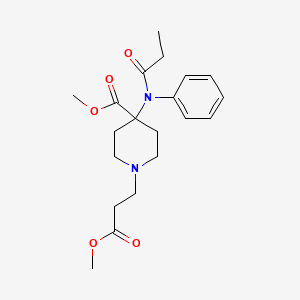
| Formula | C20H28N2O5 |
|---|---|
| Molecular weight | 376.45 g/mol |
| IUPAC name | methyl 1-(3-methoxy-3-oxopropyl)-4-(N-propanoylanilino)piperidine-4-carboxylate |
| CAS | 132875-61-7 |
| PubChem CID | 60815 |
| InChIKey | ZTVQQQVZCWLTDF-UHFFFAOYSA-N |
| logP | 2.0 (XLogP 1.9) |
| Polar surface area | 76.15 Ų |
| H-bond acceptors / donors | 6 / 0 |
| Drug-likeness (QED) | 0.68 |
| Lipinski violations | 0 |
SMILES
CCC(=O)N(c1ccccc1)C1(C(=O)OC)CCN(CCC(=O)OC)CC1Biology & Pharmacokinetics
Pharmacokinetics
| BBB penetrant | Yes |
|---|
Enzyme interactions
| Enzyme | Role | Detail |
|---|---|---|
| CYP2B6 | Inhibitor | — |
| CYP2C19 | Inhibitor | — |
| CYP2C8 | Inhibitor | — |
| CYP2C9 | Inhibitor | — |
| CYP3A4 | Inhibitor | — |
| CYP3A4 | Substrate | — |
Transporters
BCRP (Inhibitor)BSEP (Inhibitor)MRP1 (Inhibitor)OATP1B1 (Inhibitor)OATP1B3 (Inhibitor)P-gp (Inhibitor)P-gp (Substrate)
Drug–drug interactions (86, DDInter)
| Interacting drug | Severity | Management |
|---|---|---|
| Bupropion | major | |
| Chlorphenesin | major | |
| Dexfenfluramine | major | |
| Dolasetron | major | |
| Fenfluramine | major | |
| Granisetron | major | |
| Iohexol | major | |
| Iopamidol | major | |
| Lorcaserin | major | |
| Methylene blue | major | |
| Naltrexone | major | |
| Ondansetron | major | |
| Palonosetron | major | |
| Procarbazine | major | |
| Sibutramine | major | |
| Aldesleukin | moderate | |
| Alimemazine | moderate | |
| Atropine | moderate | |
| Azatadine | moderate | |
| Azelastine (nasal) | moderate | |
| Baricitinib | moderate | |
| Brimonidine (ophthalmic) | moderate | |
| Brimonidine (topical) | moderate | |
| Brompheniramine | moderate | |
| Carbinoxamine | moderate | |
| Cetirizine | moderate | |
| Chlorcyclizine | moderate | |
| Chlorpheniramine | moderate | |
| Cimetidine | moderate | |
| Clemastine | moderate | |
| Clidinium | moderate | |
| Clofedanol | moderate | |
| Clopidogrel | moderate | |
| Codeine | moderate | |
| Cyclizine | moderate | |
| Cyproheptadine | moderate | |
| Desmopressin | moderate | |
| Dexbrompheniramine | moderate | |
| Dicyclomine | moderate | |
| Difenoxin | moderate |
Showing 40 of 86.
Registered Products (11)
| Brand | Form / strength | Pack | Agent | Citizen (JOD) |
|---|---|---|---|---|
| DORMIDEN | Vial 5 mg | 5 vial pack varies | Al Hilal Drug Store | — |
| DORMIDEN | Vial 2 mg | 5 vial pack varies | Al Hilal Drug Store | — |
| DORMIDEN | Vial 2 mg | 10 vial pack varies | Al Hilal Drug Store | — |
| DORMIDEN | Vial 2 mg | 50 vial pack varies | Al Hilal Drug Store | — |
| DORMIDEN | Vial 5 mg | 10 vial pack varies | Al Hilal Drug Store | — |
| DORMIDEN | Vial 5 mg | 50 vial pack varies | Al Hilal Drug Store | — |
| Rimfanile 5mg/vial powder for solution for intravenous infusion | Infusion 5 mg | 5 vial | MS PHARMA/JORDAN | — |
| Salarem | Vial 2.0 mg | 5 vial | Banafsag Drug Store | — |
| Ultiva | Vial 2 mg | 5 vial | Suleiman Tannous & Sons Co. Ltd | — |
| Ultiva Injection | Powder for Injection 5 mg | 5 vial | Suleiman Tannous & Sons Co. Ltd | — |
| Ultiva Injection | Injection 1 mg/ml | 5 vial | Suleiman Tannous & Sons Co. Ltd | — |