Rifaximin
JFDA label: Xifaxan 200mg tab
Mechanism of Action
Inhibitor of Bacterial DNA-directed RNA polymerase — Bacterial DNA-directed RNA polymerase inhibitor
| Target | Action | Gene / class |
|---|---|---|
| Bacterial DNA-directed RNA polymerase efficacy | INHIBITOR |
Indications
Approved
- Hepatic encephalopathy
- Irritable bowel syndrome with diarrhea
- Traveler's diarrhea
Off-label
- Clostridium difficile infection (recurrent)
- Overt hepatic encephalopathy episodes (treatment)
Antimicrobial Spectrum
Expected / intrinsic spectrum (EUCAST breakpoints & labels) — not local resistance. Source: openfda-label.
Bacteria
| Organism | Activity | MIC |
|---|---|---|
| Escherichia coli | Active | — |
Contraindications
Source: Lexicomp
- Hypersensitivity to rifaximin, other rifamycin antibiotics, or any component of the formulation Absolute
Adverse Reactions
Cardiac disorders (1)
Very Common Peripheral edema
Nervous system disorders (4)
Very Common Dizziness · fatigue
Common depression · Headache
Hepatobiliary disorders (2)
Very Common Ascites
Common Increased serum ALT
Gastrointestinal disorders (3)
Very Common Nausea
Common Abdominal pain · pseudomembranous colitis
Skin and subcutaneous tissue disorders (2)
Common Pruritus · skin rash
Musculoskeletal and connective tissue disorders (3)
Common arthralgia · increased creatine phosphokinase, dyspnea, epistaxis · Muscle spasm
General disorders and administration site conditions (1)
Common Fever
Other (5)
Common Clostridium difficile associated diarrhea · exfoliative dermatitis · flushing · hypersensitivity reaction · urticaria
Dosing
Source: Lexicomp
Warnings & Precautions
Source: Lexicomp
Hypersensitivity
Hypersensitivity reactions (eg, exfoliative dermatitis, rash, urticaria, flushing, angioneurotic edema, pruritus, anaphylaxis) have occurred; these events have occurred as early as within 15 minutes of drug administration.
Superinfection
Prolonged use may result in fungal or bacterial superinfection, including C. difficile-associated diarrhea (CDAD) and pseudomembranous colitis; CDAD has been observed >2 months postantibiotic treatment. Disease-related concerns:
Diarrhea
Appropriate use: Avoid use in diarrhea with fever and/or blood in the stool and in the treatment of diarrhea due to pathogens other than E. coli, including C. jejuni, Shigella, and Salmonella (efficacy has not been established). Consider alternative therapy if symptoms persist or worsen after 24 to 48 hours of treatment.
Hepatic impairment
Efficacy for prevention of encephalopathy has not been established in patients with a Model for End-Stage Liver Disease (MELD) score >25; use caution in patients with severe hepatic impairment (Child-Pugh class C). Concurrent drug therapy issues:
Drug-drug interactions
Potentially significant interactions may exist, requiring dose or frequency adjustment, additional monitoring, and/or selection of alternative therapy. Consult drug interactions database for more detailed information. Dosage form specific issues:
Propylene glycol
Some dosage forms may contain propylene glycol; large amounts are potentially toxic and have been associated hyperosmolality, lactic acidosis, seizures, and respiratory depression; use caution (AAP 1997; Zar 2007). Other warnings/precautions:
Appropriate use
Not for treatment of systemic infections;
Pregnancy & Lactation
Pregnancy
Adverse events have been observed in some animal reproduction studies. Due to the limited oral absorption of rifaximin in patients with normal hepatic function, exposure to the fetus is expected to be low.
Lactation
It is not known if rifaximin is excreted in human milk. According to the manufacturer, the decision to breast-feed during therapy should take into account the risk of exposure to the infant and the benefits of treatment to the mother. Because of the limited oral absorption of rifaximin in patients with normal hepatic function, exposure to the nursing infant is expected to be low.
Monitoring
| Clinical pearl | Hypersensitivity reactions, temperature, blood in stool, change in symptoms; monitor changes in mental status in hepatic encephalopathy |
|---|
Chemistry & Properties
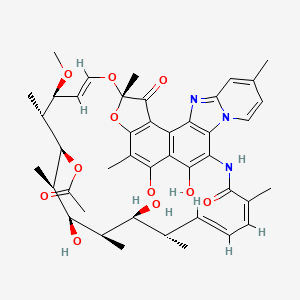
| Formula | C43H51N3O11 |
|---|---|
| Molecular weight | 785.89 g/mol |
| IUPAC name | [(7S,9E,11S,12R,13S,14R,15R,16R,17S,18S,19E,21Z)-2,15,17,36-tetrahydroxy-11-methoxy-3,7,12,14,16,18,22,30-octamethyl-6,23-dioxo-8,37-dioxa-24,27,33-triazahexacyclo[23.10.1.14,7.05,35.026,34.027,32]heptatriaconta-1(35),2,4,9,19,21,25(36),26(34),28,30,32-undecaen-13-yl] acetate |
| CAS | 80621-81-4 |
| PubChem CID | 6436173 |
| InChIKey | NZCRJKRKKOLAOJ-XRCRFVBUSA-N |
| logP | 6.16 (XLogP 6.9) |
| Polar surface area | 198.38 Ų |
| H-bond acceptors / donors | 13 / 5 |
| Drug-likeness (QED) | 0.11 |
| Lipinski violations | 3 |
SMILES
CO[C@H]1/C=C/O[C@@]2(C)Oc3c(C)c(O)c4c(O)c(c5c(nc6cc(C)ccn65)c4c3C2=O)NC(=O)/C(C)=C\C=C\[C@H](C)[C@H](O)[C@@H](C)[C@@H](O)[C@@H](C)[C@H](OC(C)=O)[C@@H]1CBiology & Pharmacokinetics
Pharmacokinetics
| BBB penetrant | No |
|---|
Enzyme interactions
| Enzyme | Role | Detail |
|---|---|---|
| CYP1A2 | Substrate | — |
| CYP2C8 | Inhibitor | — |
| CYP3A4 | Substrate | — |
Transporters
BCRP (Inhibitor)BSEP (Inhibitor)BSEP (Inhibitor)MDR1 (Inhibitor)MRP1 (Inhibitor)MRP2 (Inhibitor)MRP3 (Inhibitor)MRP4 (Inhibitor)OATP1B1 (Inhibitor)OATP1B3 (Inhibitor)OATP1B3 (Inhibitor)P-gp (Inhibitor)MDR1 (Substrate)P-gp (Substrate)Transporter(unspecified) (Substrate)
Drug–drug interactions (48, DDInter)
| Interacting drug | Severity | Management |
|---|---|---|
| Typhoid vaccine (live) | major | |
| Vibrio cholerae CVD 103-HgR strain live antigen (live) | major | |
| Alpelisib | moderate | |
| Anisindione | moderate | |
| Apalutamide | moderate | |
| Bempedoic acid | moderate | |
| Bifidobacterium longum infantis | moderate | |
| Brigatinib | moderate | |
| Cabozantinib | moderate | |
| Capmatinib | moderate | |
| Cyclosporine | moderate | |
| Daclatasvir | moderate | |
| Darolutamide | moderate | |
| Dicoumarol | moderate | |
| Elagolix | moderate | |
| Elexacaftor | moderate | |
| Eliglustat | moderate | |
| Enasidenib | moderate | |
| Encorafenib | moderate | |
| Entrectinib | moderate | |
| Enzalutamide | moderate | |
| Erdafitinib | moderate | |
| Flibanserin | moderate | |
| Fostamatinib | moderate | |
| Fostemsavir | moderate | |
| Gemfibrozil | moderate | |
| Gilteritinib | moderate | |
| Glasdegib | moderate | |
| Ibrutinib | moderate | |
| Istradefylline | moderate | |
| Lactobacillus acidophilus | moderate | |
| Lasmiditan | moderate | |
| Ledipasvir | moderate | |
| Lonafarnib | moderate | |
| Midostaurin | moderate | |
| Neratinib | moderate | |
| Nilotinib | moderate | |
| Picosulfuric acid | moderate | |
| Ponatinib | moderate | |
| Rolapitant | moderate |
Showing 40 of 48.
Registered Products (1)
| Brand | Form / strength | Pack | Agent | Citizen (JOD) |
|---|---|---|---|---|
| Xifaxan | Tablet 200 mg | 12 tab | Almutanabbe Drug Store | 6.410 |