Sucralfate
JFDA label: Sucrate Oral Gel
Mechanism of Action
Inhibitor of Pepsin A — Pepsin A inhibitor; Cross-Linking Agent of Glycoproteins — Glycoproteins cross-linking agent
| Target | Action | Gene / class |
|---|---|---|
| Glycoproteins efficacy | CROSS-LINKING AGENT | |
| Pepsin A efficacy | INHIBITOR | PGA5 |
Indications
Approved
- Duodenal ulcer
Contraindications
Source: Lexicomp
- Hypersensitivity to sucralfate or any component of the formulation Absolute
Adverse Reactions
Other (1)
Common Gastrointestinal: Constipation
Dosing
Source: Lexicomp
Warnings & Precautions
Source: Lexicomp
Diabetes
Hyperglycemia has been reported with sucralfate suspension in patients with diabetes; monitor glycemia closely; adjustment of antidiabetic treatment may be necessary.
Duodenal ulceration
Because sucralfate acts locally at the ulcer, successful therapy with sucralfate should not be expected to alter the posthealing frequency of recurrence or the severity of duodenal ulceration.
Renal impairment
Use with caution in patients with chronic renal failure; sucralfate is an aluminum complex, small amounts of aluminum are absorbed following oral administration. Excretion of aluminum may be decreased in patients with chronic renal failure or on dialysis, increasing the risk of aluminum accumulation and toxicity (eg, aluminum osteodystrophy, osteomalacia, and encephalopathy). Concurrent drug therapy issues:
Drug-drug interactions
Potentially significant interactions may exist, requiring dose or frequency adjustment, additional monitoring, and/or selection of alternative therapy. Consult drug interactions database for more detailed information. Dosage form specific issues:
Tablets
Use with caution in patients with conditions that may impair swallowing (eg, recent or prolonged intubation, tracheostomy, dysphagia, history of aspiration) or other conditions that may alter gag/cough reflexes, or diminish oropharyngeal coordination or motility; aspiration with accompanying respiratory complications has been reported. Other warnings/precautions:
Administration
Administer sucralfate by oral route only; fatal complications, including cerebral and pulmonary emboli, have been reported with inadvertent IV administration of sucralfate.
Pregnancy & Lactation
Pregnancy
Adverse events were not observed in animal reproduction studies. Sucralfate is only minimally absorbed following oral administration. Based on available data, use of sucralfate does not appear to increase the risk of adverse fetal events when used during the first trimester (Mahadevan, 2006).
Lactation
It is not known if sucralfate is present in breast milk. Sucralfate is only minimally absorbed following oral administration. The manufacturer recommends that caution be exercised when administering sucralfate to breastfeeding women.
Monitoring
| Clinical pearl | Blood glucose levels (in diabetic patients receiving oral suspension). |
|---|
Chemistry & Properties
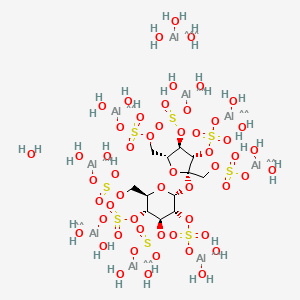
| Formula | C12H54Al9O55S8 |
|---|---|
| Molecular weight | 1577.9 g/mol |
| PubChem CID | 121494085 |
| InChIKey | YZPQNHUVIVIUCT-JTJNLBSYSA-F |
| Polar surface area | 536.0 Ų |
| H-bond acceptors / donors | 55 / 20 |
SMILES
C(C1C(C(C(C(O1)OC2(C(C(C(O2)COS(=O)(=O)O[Al])OS(=O)(=O)O[Al])OS(=O)(=O)O[Al])COS(=O)(=O)O[Al])OS(=O)(=O)O[Al])OS(=O)(=O)O[Al])OS(=O)(=O)O[Al])OS(=O)(=O)O[Al].O.O.O.O.O.O.O.O.O.O.O.O.O.O.O.O.O.O.O.O.[Al]Biology & Pharmacokinetics
Pharmacokinetics predicted
| Bioavailability | 10.0% |
|---|---|
| Half-life | 1.894 h |
| Volume of distribution | 0.534 L/kg |
| Protein binding | 64.1% |
| BBB penetrant | No |
Enzyme interactions
| Enzyme | Role | Detail |
|---|---|---|
| CYP2C9 | Substrate | — |
Transporters
BCRP (Inhibitor)BSEP (Inhibitor)MRP1 (Inhibitor)OATP1B1 (Inhibitor)OATP1B3 (Inhibitor)P-gp (Inhibitor)P-gp (Substrate)
Drug–drug interactions (100+, DDInter)
| Interacting drug | Severity | Management |
|---|---|---|
| Bictegravir | major | |
| Dolutegravir | major | |
| Doxercalciferol | major | |
| Paricalcitol | major | |
| Acarbose | moderate | |
| Acetohexamide | moderate | |
| Albiglutide | moderate | |
| Alendronic acid | moderate | |
| Allopurinol | moderate | |
| Alogliptin | moderate | |
| Aluminum hydroxide | moderate | |
| Anisindione | moderate | |
| Ascorbic acid | moderate | |
| Baloxavir marboxil | moderate | |
| Calcifediol | moderate | |
| Calcitriol | moderate | |
| Calcium carbonate | moderate | |
| Canagliflozin | moderate | |
| Chenodeoxycholic acid | moderate | |
| Chlorpropamide | moderate | |
| Cholic Acid | moderate | |
| Cinoxacin | moderate | |
| Ciprofloxacin | moderate | |
| Cyclosporine | moderate | |
| Dapagliflozin | moderate | |
| Deferasirox | moderate | |
| Deferiprone | moderate | |
| Delafloxacin | moderate | |
| Demeclocycline | moderate | |
| Dicoumarol | moderate | |
| Digitoxin | moderate | |
| Digoxin | moderate | |
| Doxycycline | moderate | |
| Dulaglutide | moderate | |
| Eltrombopag | moderate | |
| Empagliflozin | moderate | |
| Enoxacin | moderate | |
| Ertugliflozin | moderate | |
| Ethotoin | moderate | |
| Etidronic acid | moderate |
Showing 40 of 100+.
Registered Products (2)
| Brand | Form / strength | Pack | Agent | Citizen (JOD) |
|---|---|---|---|---|
| Gastrofait Tab | Tablet 1 g. | 20 tab | AL-Faiasel Drug Store | 1.950 |
| Sucrate Oral Gel | Gel 1 g/5 ml | 30 g tube | AL Rahma Drug Store | 4.760 |