Terbinafine
JFDA label: Lamisil Dermgel
Mechanism of Action
Inhibitor of Squalene monooxygenase — Squalene monooxygenase inhibitor
| Target | Action | Gene / class |
|---|---|---|
| Squalene monooxygenase efficacy | INHIBITOR |
Indications
Approved
- Onychomycosis — tinea
- Tinea — tinea
Off-label
- Colitis, Ulcerative
- Crohn Disease
- Tinea Pedis
Antimicrobial Spectrum
Expected / intrinsic spectrum (EUCAST breakpoints & labels) — not local resistance. Source: openfda-label.
Fungi
| Organism | Activity | MIC |
|---|---|---|
| Candida albicans | Active | — |
| Epidermophyton floccosum | Active | — |
| Trichophyton mentagrophytes | Active | — |
| Trichophyton rubrum | Active | — |
Class profile
| antifungalClass | Allylamine |
|---|---|
| targetMolecule | Squalene epoxidase (SQLE, ERG1) |
| isFungicidal | 1 |
| spectrumCandida | Variable |
| spectrumAspergillus | Resistant |
| spectrumCryptococcus | Resistant |
| spectrumDermatophytes | S (gold standard) |
| resistanceMechanisms | SQLE mutations (L393F and others),CYP1A2/CYP3A4 drug interactions |
| source | Pappas2016/Lass-Florl2011 |
Contraindications
Source: openFDA
- Terbinafine tablets are contraindicated in patients with: • History of allergic reaction to oral terbinafine because of the risk of anaphylaxis [see Adverse Reactions (6.2) ] • Chronic or active liver disease [see Warnings and Precautions (5.1) ] • History of allergic reaction to oral terbinafine because of the risk of anaphylaxis. (4) • Chronic or active liver disease. (4) Absolute
Adverse Reactions
Blood and lymphatic system disorders (5)
Not Known Agranulocytosis · Anemia · Pancytopenia · Severe Neutropenia · Thrombocytopenia
Skin and subcutaneous tissue disorders (6)
Not Known Angioedema And Allergic Reactions Inc · Bullous Dermatitis · Erythema Multiforme · Exfoliative Dermatitis · Stevens-Johnson Syndrome · Toxic Epidermal Necrolysis
Musculoskeletal and connective tissue disorders (2)
Not Known Arthralgia · Rhabdomyolysis
Eye disorders (1)
Not Known Visual Field Defects
Ear and labyrinth disorders (1)
Not Known Vertigo
Infections and infestations (1)
Not Known Influenza-Like Illness
General disorders and administration site conditions (6)
Not Known Acute Generalized Exanthematous Pustulosis · Fatigue · Idiosyncr · Psoriasiform Eruptions · Serious Skin Reactions E G · Thrombotic Microangiopathy Tma
Dosing
Source: openFDA
Warnings & Precautions
Source: openFDA
Warnings & Precautions
• Liver failure, sometimes leading to liver transplant or death, has occurred with the use of oral terbinafine. Obtain pretreatment serum transaminases. Prior to initiating treatment and periodically during therapy, assess liver function tests. Discontinue terbinafine tablets if liver injury develops. (5.1) • Taste disturbance, including taste loss, has been reported with the use of terbinafine tablets. Taste disturbance can be severe, may be prolonged, or may be permanent. Discontinue terbinafine tablets if taste disturbance occurs. (5.2) • Smell disturbance, including loss of smell, has been reported with the use of terbinafine tablets. Smell disturbance may be prolonged, or may be permanent. Discontinue terbinafine tablets if smell disturbance occurs. (5.3) • Depressive symptoms have been reported with terbinafine use. Prescribers should be alert to the development of depressive symptoms. (5.4) • Severe neutropenia has been reported. If the neutrophil count is less than or equal to 1000 cells/mm 3 , terbinafine tablets should be discontinued. (5.5) • Stevens-Johnson syndrome, toxic epidermal necrolysis, erythema multiforme, exfoliative dermatitis, bullous dermatitis, and drug reaction with eosinophilia and systemic symptoms (DRESS) syndrome have been reported with oral terbinafine use. If signs or symptoms of drug reaction occur, treatment with terbinafine tablets should be discontinued. (5.6)
Hepatotoxicity Terbinafine tablets are contraindicated for patients wi
Hepatotoxicity Terbinafine tablets are contraindicated for patients with chronic or active liver disease. Before prescribing terbinafine tablets, perform liver function tests because hepatotoxicity may occur in patients with and without preexisting liver disease. Cases of liver failure, some leading to liver transplant or death, have occurred with the use of terbinafine tablets in individuals with and without preexisting liver disease. In the majority of liver cases reported in association with use of terbinafine tablets, the patients had serious underlying systemic conditions. The severity of hepatic events and/or their outcome may be worse in patients with active or chronic liver disease. Periodic monitoring of liver function tests is recommended. Discontinue terbinafine tablets if biochemical or clinical evidence of liver injury develops. Warn patients prescribed terbinafine tablets and/or their caregivers to report immediately to their healthcare providers any symptoms or signs of persistent nausea, anorexia, fatigue, vomiting, right upper abdominal pain or jaundice, dark urine, or pale stools. Advise patients with these symptoms to discontinue taking oral terbinafine, and immediately evaluate the patient’s liver function.
Taste Disturbance Including Loss of Taste Taste disturbance, including
Taste Disturbance Including Loss of Taste Taste disturbance, including taste loss, has been reported with the use of terbinafine tablets. It can be severe enough to result in decreased food intake, weight loss, anxiety, and depressive symptoms. Taste disturbance may resolve within several weeks after discontinuation of treatment, but may be prolonged (greater than 1 year), or may be permanent. If symptoms of a taste disturbance occur, terbinafine tablets should be discontinued.
Smell Disturbance Including Loss of Smell Smell disturbance, including
Smell Disturbance Including Loss of Smell Smell disturbance, including loss of smell, has been reported with the use of terbinafine tablets. Smell disturbance may resolve after discontinuation of treatment, but may be prolonged (greater than 1 year), or may be permanent. If symptoms of a smell disturbance occur, terbinafine tablets should be discontinued.
Depressive Symptoms Depressive symptoms have occurred during postmarke
Depressive Symptoms Depressive symptoms have occurred during postmarketing use of terbinafine tablets. Prescribers should be alert to the development of depressive symptoms, and patients should be instructed to report depressive symptoms to their physician.
Hematologic Effects Transient decreases in absolute lymphocyte counts
Hematologic Effects Transient decreases in absolute lymphocyte counts (ALCs) have been observed in controlled clinical trials. In placebo-controlled trials, 8/465 subjects receiving terbinafine tablets (1.7%) and 3/137 subjects receiving placebo (2.2%) had decreases in ALC to below 1000/mm 3 on 2 or more occasions. In patients with known or suspected immunodeficiency, physicians should consider monitoring complete blood counts if treatment continues for more than 6 weeks. Cases of severe neutropenia have been reported. These were reversible upon discontinuation of terbinafine tablets, with or without supportive therapy. If clinical signs and symptoms suggestive of secondary infection occur, a complete blood count should be obtained. If the neutrophil count is less than or equal to 1000 cells/mm 3 , terbinafine tablets should be discontinued and supportive management started.
Serious Skin/Hypersensitivity Reactions There have been postmarketing
Serious Skin/Hypersensitivity Reactions There have been postmarketing reports of serious skin/hypersensitivity reactions [e.g., Stevens-Johnson syndrome, toxic epidermal necrolysis, erythema multiforme, exfoliative dermatitis, bullous dermatitis, and drug reaction with eosinophilia and systemic symptoms (DRESS) syndrome]. Manifestations of DRESS syndrome may include cutaneous reaction (such as rash or exfoliative dermatitis), eosinophilia, and one or more organ complications such as hepatitis, pneumonitis, nephritis, myocarditis, and pericarditis. If progressive skin rash or signs/symptoms of the above drug reactions occur, treatment with terbinafine tablets should be discontinued.
Lupus Erythematosus During postmarketing experience, precipitation and
Lupus Erythematosus During postmarketing experience, precipitation and exacerbation of cutaneous and systemic lupus erythematosus have been reported in patients taking terbinafine tablets. Terbinafine tablets should be discontinued in patients with clinical signs and symptoms suggestive of lupus erythematosus.
Thrombotic Microangiopathy Cases of thrombotic microangiopathy (TMA),
Thrombotic Microangiopathy Cases of thrombotic microangiopathy (TMA), including thrombotic thrombocytopenic purpura and hemolytic uremic syndrome, some fatal, have been reported with terbinafine. Discontinue terbinafine if clinical symptoms and laboratory findings consistent with TMA occur. The findings of unexplained thrombocytopenia and anemia should prompt further evaluation and consideration of diagnosis of TMA.
Pregnancy & Lactation
Pregnancy
Lactation
Limited information indicates that oral maternal doses of 500 mg daily produce low levels in milk and would not be expected to cause any adverse
Monitoring
| Efficacy | Fungal culture and species identification; minimum inhibitory concentration (MIC) where available; clinical response (temperature, imaging for invasive fungal disease) |
|---|---|
| Toxicity | LFTs (hepatotoxicity — azoles in particular); renal function; ECG for QT prolongation (azoles); drug levels if available (itraconazole, voriconazole) |
| Clinical pearl | Voriconazole levels are highly variable due to CYP2C19 polymorphism — TDM recommended (target trough 2–5 mg/L). Check for drug interactions with CYP3A4 substrates. |
| Counseling | Report visual disturbances (voriconazole), jaundice, or rash. Take azoles with food or as directed to optimise absorption. |
Chemistry & Properties
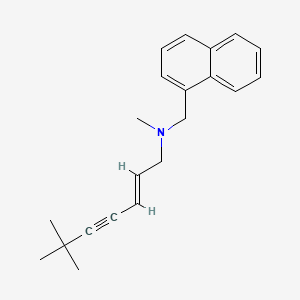
| Formula | C21H25N |
|---|---|
| Molecular weight | 291.44 g/mol |
| IUPAC name | (E)-N,6,6-trimethyl-N-(naphthalen-1-ylmethyl)hept-2-en-4-yn-1-amine |
| CAS | 91161-71-6 |
| PubChem CID | 1549008 |
| InChIKey | DOMXUEMWDBAQBQ-WEVVVXLNSA-N |
| logP | 4.88 (XLogP 5.6) |
| Polar surface area | 3.24 Ų |
| H-bond acceptors / donors | 1 / 0 |
| Drug-likeness (QED) | 0.73 |
| Lipinski violations | 0 |
SMILES
CN(C/C=C/C#CC(C)(C)C)Cc1cccc2ccccc12Biology & Pharmacokinetics
Pharmacokinetics
| BBB penetrant | Yes (logBB 0.1) |
|---|
Enzyme interactions
| Enzyme | Role | Detail |
|---|---|---|
| CYP1A2 | Inhibitor | — |
| CYP1A2 | Substrate | — |
| CYP2C19 | Inhibitor | — |
| CYP2C19 | Substrate | — |
| CYP2C9 | Substrate | — |
| CYP2D6 | Inhibitor | IC₅₀ 0.20000000000000004 µM |
| CYP3A4 | Inhibitor | — |
| CYP3A4 | Substrate | — |
Transporters
BCRP (Inhibitor)BSEP (Inhibitor)BSEP (Inhibitor)MRP1 (Inhibitor)MRP2 (Inhibitor)MRP3 (Inhibitor)MRP4 (Inhibitor)OATP1B1 (Inhibitor)OATP1B3 (Inhibitor)P-gp (Inhibitor)P-gp (Substrate)
Drug–drug interactions (100+, DDInter)
| Interacting drug | Severity | Management |
|---|---|---|
| Dextromethorphan | major | |
| Eliglustat | major | |
| Leflunomide | major | |
| Lomitapide | major | |
| Mipomersen | major | |
| Oliceridine | major | |
| Pexidartinib | major | |
| Pimozide | major | |
| Pitolisant | major | |
| Tamoxifen | major | |
| Teriflunomide | major | |
| Thioridazine | major | |
| Valbenazine | major | |
| Vortioxetine | major | |
| Abametapir (topical) | moderate | |
| Alimemazine | moderate | |
| Alpelisib | moderate | |
| Aminophylline | moderate | |
| Amiodarone | moderate | |
| Amitriptyline | moderate | |
| Amoxapine | moderate | |
| Amphetamine | moderate | |
| Anisindione | moderate | |
| Apalutamide | moderate | |
| Aripiprazole | moderate | |
| Asparaginase Erwinia chrysanthemi | moderate | |
| Asparaginase Escherichia coli | moderate | |
| Atomoxetine | moderate | |
| Bedaquiline | moderate | |
| Benzhydrocodone | moderate | |
| Brentuximab vedotin | moderate | |
| Calaspargase pegol | moderate | |
| Cannabidiol | moderate | |
| Carvedilol | moderate | |
| Cevimeline | moderate | |
| Chloroquine | moderate | |
| Chlorpromazine | moderate | |
| Clofarabine | moderate | |
| Clomipramine | moderate | |
| Clozapine | moderate |
Showing 40 of 100+.
Registered Products (15)
| Brand | Form / strength | Pack | Agent | Citizen (JOD) |
|---|---|---|---|---|
| Negafen Cream | Cream 1 % | 15 g tube | Professional Drug Store | 2.350 |
| Lamisil Dermgel | Cream 1 % | 15 g tube | Sukhtian Group | 3.080 |
| Solveasy Tinea Cream | Cream 1 % | 15 g tube | Sukhtian Group | 3.200 |
| Lamifen Cream | Cream 1 % | 15 g tube | شركة مستودع ادوية الايمان | 3.290 |
| Tinasil Cream | Cream 1 % | 15 g tube | Sukhtian Group | 3.410 |
| Fungazine Cream | Cream 1 g/100 g | 15 GM/1 TUB | Sukhtian Pharma Co. (SP) | 3.430 |
| Lamisil Once | Cream 1 % | 4 gm | Nabulsi Drug Store | 4.680 |
| Turbosil Topical Spray | Spray 1 g/100 ml | 30 MILLILITER/1 CAN | Amman Pharmaceutical Industries Co | 4.840 |
| Lamisil Spray | Spray 1 % | 15 ml pack varies | Sukhtian Group | 5.430 |
| Lamisil Cream | Cream 1 % | 15 g tube pack varies | Sukhtian Group | 5.510 |
| Tinasil | Tablet 250 mg | 10 tab pack varies | Sukhtian Group | 5.990 |
| Lamifen Tablet | Tablet 250 mg | 14 tab | شركة مستودع ادوية الايمان | 8.380 |
| Negafen | Tablet 250 mg | 14 tab | Professional Drug Store | 8.400 |
| Lamisil Tab | Tablet 250 mg | 14 tab | The Jordan Drugstore Co | 13.100 |
| Tinasil | Tablet 250 mg | 1000 tab pack varies | Sukhtian Group | 509.150 |