Tolterodine
JFDA label: Detrusitol tabs
Mechanism of Action
Tolterodine is a competitive antagonist of muscarinic receptors. In animal models, tolterodine demonstrates selectivity for urinary bladder receptors over salivary receptors. Urinary bladder contraction is mediated by muscarinic receptors. Tolterodine increases residual urine volume and decreases detrusor muscle pressure.
Indications
Approved
- Polyuria — Polyuria
- Urinary Incontinence — Urinary incontinence
Off-label
- Kidney Calculi
- Low Back Pain
- Pain
- Pelvic Organ Prolapse
- Urinary Bladder, Overactive
Contraindications
Source: Lexicomp
- Hypersensitivity to tolterodine or fesoterodine (both are metabolized to 5-hydroxymethyl tolterodine) or any component of the formulation Absolute
- gastric retention Absolute
- uncontrolled narrow-angle glaucoma Absolute
- urinary retention Absolute
Adverse Reactions
Cardiac disorders (1)
Common Chest pain
Nervous system disorders (5)
Common anxiety · dizziness · drowsiness · fatigue · Headache
Renal and urinary disorders (1)
Common Dysuria
Metabolism and nutrition disorders (1)
Common Weight gain
Gastrointestinal disorders (4)
Common abdominal pain · Constipation · diarrhea · dyspepsia
Skin and subcutaneous tissue disorders (1)
Common Xeroderma
Musculoskeletal and connective tissue disorders (1)
Common Arthralgia
Eye disorders (2)
Common visual disturbance · Xerophthalmia
Infections and infestations (1)
Common Infection
Other (1)
Very Common Gastrointestinal: Xerostomia
Respiratory, thoracic and mediastinal disorders (3)
Common bronchitis · Flu-like symptoms · sinusitis
Dosing
Source: Lexicomp
Warnings & Precautions
Source: Lexicomp
Angioedema
Cases of angioedema have been reported; some cases have occurred after a single dose. Discontinue immediately if angioedema and associated difficulty breathing, airway obstruction, or hypotension develop.
CNS effects
May cause drowsiness, dizziness, and/or blurred vision, which may impair physical or mental abilities; patients must be cautioned about performing tasks which require mental alertness (eg, operating machinery or driving). Dose reduction or discontinuation should be considered if CNS effects occur.
QT prolongation
Has been associated with QTc prolongation at high (supratherapeutic) doses. The manufacturer recommends caution in patients with congenital prolonged QT or in patients receiving concurrent therapy with QTc-prolonging drugs (class Ia or III antiarrhythmics). However, the extent of QTc prolongation even at supratherapeutic dosages was less than 15 msec. Individuals who are CYP2D6 poor metabolizers or in the presence of inhibitors of CYP2D6 and CYP3A4 may be more likely to exhibit prolongation. Disease-related concerns:
Alzheimer disease
Preliminary data suggests that long-term use of anticholinergics may potentially adversely affect the clinical course of Alzheimer disease in patients receiving cholinesterase inhibitors (Lu 2003; Sink 2008). Additional monitoring for decreases in cognition, functional abilities and increased problematic behaviors should be considered in patients with dementia receiving dual therapy with an anticholinesterase inhibitor and a bladder anticholinergic, such as tolterodine.
Bladder flow obstruction
Use with caution in patients with bladder flow obstruction (eg, benign prostatic hypertrophy); may increase the risk of urinary retention.
GI obstructive disorders
Use with caution in patients with decreased GI motility or gastrointestinal obstructive disorders (ie, pyloric stenosis); may increase the risk of gastric retention.
Glaucoma
Use with caution in patients with controlled (treated) narrow-angle glaucoma.
Hepatic impairment
Use with caution in patients with hepatic impairment; dosage adjustment is required.
Myasthenia gravis
Use with caution in patients with myasthenia gravis.
Renal impairment
Use with caution in patients with renal impairment; dosage adjustment is required. Concurrent drug therapy issues:
CYP3A4 inhibitors
Dosage adjustment is recommended in patients receiving CYP3A4 inhibitors; a lower dose of tolterodine is recommended.
Pregnancy & Lactation
Pregnancy
Teratogenic effects were observed in some animal reproduction studies.
Lactation
It is not known if tolterodine is excreted in breast milk. Due to the potential for serious adverse reactions in the nursing infant, a decision should be made whether to discontinue nursing or to discontinue the drug, taking into account the importance of treatment to the mother.
Monitoring
| Clinical pearl | Anticholinergic effects (ie, dry mouth, constipation, dizziness); renal function (BUN, creatinine); hepatic function; postvoid residual (PVR) urine volume prior to initiation of therapy (ACOG 2015) |
|---|
Chemistry & Properties
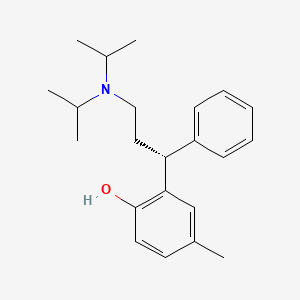
| Formula | C22H31NO |
|---|---|
| Molecular weight | 325.5 g/mol |
| IUPAC name | 2-[(1R)-3-[di(propan-2-yl)amino]-1-phenylpropyl]-4-methylphenol |
| CAS | 124937-51-5 |
| PubChem CID | 443879 |
| InChIKey | OOGJQPCLVADCPB-HXUWFJFHSA-N |
| logP | 5.34 (XLogP 5.6) |
| Polar surface area | 23.47 Ų |
| H-bond acceptors / donors | 2 / 1 |
| Drug-likeness (QED) | 0.74 |
| Lipinski violations | 1 |
SMILES
Cc1ccc(O)c([C@H](CCN(C(C)C)C(C)C)c2ccccc2)c1Biology & Pharmacokinetics
Pharmacokinetics
| BBB penetrant | No |
|---|
Enzyme interactions
| Enzyme | Role | Detail |
|---|---|---|
| CYP1A2 | Substrate | — |
| CYP2C19 | Substrate | — |
| CYP2C9 | Substrate | — |
| CYP2D6 | Inhibitor | — |
| CYP2D6 | Substrate | — |
| CYP3A4 | Substrate | — |
Transporters
BCRP (Inhibitor)BSEP (Inhibitor)BSEP (Inhibitor)MRP1 (Inhibitor)MRP3 (Inhibitor)MRP4 (Inhibitor)OATP1B1 (Inhibitor)OATP1B3 (Inhibitor)OCT2 (Inhibitor)P-gp (Inhibitor)P-gp (Substrate)
Drug–drug interactions (100+, DDInter)
| Interacting drug | Severity | Management |
|---|---|---|
| Potassium chloride | major | |
| Potassium citrate | major | |
| Aclidinium | moderate | |
| Acrivastine | moderate | |
| Alimemazine | moderate | |
| Apalutamide | moderate | |
| Aprepitant | moderate | |
| Atropine | moderate | |
| Azatadine | moderate | |
| Bicalutamide | moderate | |
| Brigatinib | moderate | |
| Brompheniramine | moderate | |
| Carbinoxamine | moderate | |
| Ceritinib | moderate | |
| Chloramphenicol | moderate | |
| Chlorcyclizine | moderate | |
| Chlorpheniramine | moderate | |
| Cimetidine | moderate | |
| Clarithromycin | moderate | |
| Clemastine | moderate | |
| Clidinium | moderate | |
| Clotrimazole | moderate | |
| Cobicistat | moderate | |
| Codeine | moderate | |
| Crizotinib | moderate | |
| Cyclizine | moderate | |
| Cyclosporine | moderate | |
| Cyproheptadine | moderate | |
| Dabrafenib | moderate | |
| Deferasirox | moderate | |
| Dexbrompheniramine | moderate | |
| Dicoumarol | moderate | |
| Dicyclomine | moderate | |
| Diphenhydramine | moderate | |
| Doxepin | moderate | |
| Doxepin (topical) | moderate | |
| Doxylamine | moderate | |
| Edrophonium | moderate | |
| Eluxadoline | moderate | |
| Entrectinib | moderate |
Showing 40 of 100+.
Registered Products (4)
| Brand | Form / strength | Pack | Agent | Citizen (JOD) |
|---|---|---|---|---|
| DETERO | Tablet 2 mg | 10 tab pack varies | Omicron Pharma | 3.330 |
| DETERO | Tablet 2 mg | 30 tab pack varies | Omicron Pharma | 9.420 |
| Terodine | Tablet 2 mg | 3*10 BLISTERS/1 BOX | Sun Set Drug Store | 10.150 |
| Detrusitol tabs | Tablet L Tartarate 2 mg | 28 tab | Khoury Drug Store | 11.280 |