Ketoprofen
🧬 Cross-allergy: NSAIDs
JFDA label: Fastum Gel
- Serious cardiovascular thrombotic events:
- Serious gastrointestinal bleeding, ulceration, and perforation:
Mechanism of Action
Inhibitor of Cyclooxygenase — Cyclooxygenase inhibitor
| Target | Action | Gene / class |
|---|---|---|
| Cyclooxygenase efficacy | INHIBITOR |
Indications
Approved
- Osteoarthritis
- Pain (immediate release only)
- Primary dysmenorrhea (immediate release only)
- Rheumatoid arthritis
Off-label
- Ankylosing spondylitis
- Migraine prophylaxis
Class profile
| cox1_IC50_uM | 3.0 |
|---|---|
| cox2_IC50_uM | 6.0 |
| cox2_selectivity | 0.5 |
| inhibitionType | reversible |
| preferentialCOX2 | 0 |
| selectiveCOX2 | 0 |
| plateletEffect | 1 |
| source | Warner1999/Vane1996/ChEMBL |
Contraindications
Source: Lexicomp
- Additional contraindications (not in US labeling): Active peptic ulcer or active inflammatory disease of the GI tract Absolute
- Hypersensitivity to ketoprofen or any component of the formulation Absolute
- history of asthma, urticaria, or allergic-type reactions after taking aspirin or other NSAIDs Absolute
- inflammatory lesions or recent bleeding of the rectum or anus (suppository only) Absolute
- use in the setting of CABG surgery Absolute
Adverse Reactions
Cardiac disorders (1)
Common Peripheral edema
Nervous system disorders (8)
Common abnormal dreams · depression · dizziness · drowsiness · Headache · insomnia · malaise · nervousness
Hepatobiliary disorders (1)
Very Common Abnormal hepatic function tests
Renal and urinary disorders (2)
Common Renal insufficiency · Urinary tract irritation
Gastrointestinal disorders (11)
Very Common Dyspepsia
Common Abdominal pain · anorexia · constipation · diarrhea · flatulence · gastrointestinal hemorrhage · nausea · peptic ulcer · stomatitis · vomiting
Skin and subcutaneous tissue disorders (1)
Common Skin rash
Eye disorders (1)
Common Visual disturbance
Ear and labyrinth disorders (1)
Common Tinnitus
Dosing
Source: Lexicomp
Warnings & Precautions
Source: Lexicomp
Anaphylactoid reactions
Even in patients without prior exposure anaphylactoid reactions may occur; patients with "aspirin triad" (bronchial asthma, aspirin intolerance, rhinitis) may be at increased risk. Contraindicated in patients who experience bronchospasm, asthma, rhinitis, or urticaria with NSAID or aspirin therapy.
Cardiovascular events
NSAIDs cause an increased risk of serious (and potentially fatal) adverse cardiovascular thrombotic events, including MI and stroke. Risk may occur early during treatment and may increase with duration of use. Relative risk appears to be similar in those with and without known cardiovascular disease or risk factors for cardiovascular disease; however, absolute incidence of serious cardiovascular thrombotic events (which may occur early during treatment) was higher in patients with known cardiovascular disease or risk factors and in those receiving higher doses. New onset hypertension or exacerbation of hypertension may occur (NSAIDs may also impair response to ACE inhibitors, thiazide diuretics, or loop diuretics); may contribute to cardiovascular events; monitor blood pressure; use with caution in patients with hypertension. May cause sodium and fluid retention, use with caution in patients with edema. Avoid use in heart failure (ACCF/AHA [Yancy 2013]). Avoid use in patients with a recent MI unless benefits outweigh risk of cardiovascular thrombotic events. Use the lowest effective dose for the shortest duration of time, consistent with individual patient goals, to reduce risk of cardiovascular events; alternate therapies should be considered for patients at high risk.
CNS effects
May cause drowsiness, dizziness, blurred vision, and other neurologic effects which may impair physical or mental abilities; patients must be cautioned about performing tasks which require mental alertness (eg, operating machinery or driving).
GI events
NSAIDs cause increased risk of serious GI inflammation, ulceration, bleeding, and perforation (may be fatal); elderly patients and patients with history of peptic ulcer disease and/or GI bleeding are at greater risk of serious GI events. These events may occur at any time during therapy and without warning. Avoid use in patients with active GI bleeding. In patients with a history of acute lower GI bleeding, avoid use of non-aspirin NSAIDs, especially if due to angioectasia or diverticulosis (Strate 2016). Use caution with a history of GI ulcers, concurrent therapy known to increase the risk of GI bleeding (eg, aspirin, anticoagulants and/or corticosteroids, selective serotonin reuptake inhibitors), advanced hepatic disease, coagulopathy, smoking, use of alcohol, or in elderly or debilitated patients. Use the lowest effective dose for the shortest duration of time, consistent with individual patient goals, to reduce risk of GI adverse events; alternate therapies should be considered for patients at high risk. When used concomitantly with aspirin, a substantial increase in the risk of GI complications (eg, ulcer) occurs; concomitant gastroprotective therapy (eg, proton pump inhibitors) is recommended (Bhatt 2008).
Hematologic effects
Platelet adhesion and aggregation may be decreased; may prolong bleeding time; patients with coagulation disorders or who are receiving anticoagulants should be monitored closely. Anemia may occur; patients on long-term NSAID therapy should be monitored for anemia. Rarely, NSAID use has been associated with potentially severe blood dyscrasias (eg, agranulocytosis, thrombocytopenia, aplastic anemia).
Hepatic effects
Transaminase elevations have been reported with use; closely monitor patients with any abnormal LFT. Rare (sometimes fatal) severe hepatic reactions (eg, fulminant hepatitis, hepatic necrosis, hepatic failure) have occurred with NSAID use; discontinue immediately if signs or symptoms of hepatic disease develop or if systemic manifestations occur.
Hyperkalemia
NSAID use may increase the risk of hyperkalemia, particularly in the elderly, diabetics, renal disease, and with concomitant use of other agents capable of inducing hyperkalemia (eg, ACE-inhibitors). Monitor potassium closely.
Ophthalmic events
Blurred/diminished vision has been reported; discontinue therapy and refer for ophthalmologic evaluation if symptoms occur. Periodic ophthalmic exams may be necessary with prolonged use.
Renal effects
NSAID use may compromise existing renal function; dose-dependent decreases in prostaglandin synthesis may result from NSAID use, reducing renal blood flow which may cause renal decompensation (usually reversible). Patients with impaired renal function, dehydration, hypovolemia, heart failure, hepatic impairment, those taking diuretics, and ACE inhibitors, and the elderly are at greater risk of renal toxicity. Rehydrate patient before starting therapy; monitor renal function closely. Long-term NSAID use may result in renal papillary necrosis and other renal injury.
Skin reactions
NSAIDs may cause potentially fatal serious skin adverse events including exfoliative dermatitis, Stevens-Johnson syndrome (SJS), and toxic epidermal necrolysis (TEN); may occur without warning; discontinue use at first sign of skin rash (or any other hypersensitivity). Disease-related concerns:
Aseptic meningitis
May increase the risk of aseptic meningitis, especially in patients with systemic lupus erythematosus (SLE) and mixed connective tissue disorders.
Asthma
Contraindicated in patients with aspirin-sensitive asthma; severe and potentially fatal bronchospasm may occur. Use caution in patients with other forms of asthma.
Coronary artery bypass graft surgery
Use is contraindicated in the setting of coronary artery bypass graft (CABG) surgery. Risk of MI and stroke may be increased with use following CABG surgery.
Hepatic impairment
Use with caution in patients with hepatic impairment; patients with advanced hepatic disease are at an increased risk of GI bleeding with NSAIDs. Systemic exposure may be increased in patients with chronic disease and/or hypoalbuminemia. Closely monitor patients with any abnormal liver function test (LFT).
Renal impairment
Avoid use in patients with advanced renal disease; discontinue use with persistent or worsening abnormal renal function tests. Concurrent drug therapy issues:
Drug-drug interactions
Potentially significant interactions may exist, requiring dose or frequency adjustment, additional monitoring, and/or selection of alternative therapy. Consult drug interactions database for more detailed information. Special populations:
Elderly
Elderly patients are at greater risk for serious GI, cardiovascular, and/or renal adverse events; use with caution. Other warnings/precautions:
Surgical/dental procedures
Withhold for at least 4 to 6 half-lives prior to surgical or dental procedures.
Pregnancy & Lactation
Pregnancy
Ketoprofen crosses the placenta (Bannwarth 1999). Birth defects have been observed following in utero NSAID exposure in some studies; however, data is conflicting (Bloor 2013). Nonteratogenic effects, including prenatal constriction of the ductus arteriosus, persistent pulmonary hypertension of the newborn, oligohydramnios, necrotizing enterocolitis, renal dysfunction or failure, and intracranial hemorrhage have been observed in the fetus/neonate following in utero NSAID exposure. In addition, nonclosure of the ductus arteriosus postnatally may occur and be resistant to medical management (Bermas 2014; Bloor 2013). Because they may cause premature closure of the ductus arteriosus, the use of NSAIDs late in pregnancy should be avoided. Use of NSAIDs can be considered for the treatment of mild rheumatoid arthritis flares in pregnant women; however, use should be minimized or avoided early and late in pregnancy (Bermas 2014; Saavedra Salinas 2015). The chronic use of NSAIDs in women of
Lactation
Ketoprofen is present in breast milk (Jacqz-Aigrain 2007). One case each of esophageal ulcer, erosive gastritis, meningeal hemorrhage, and renal insufficiency following ketoprofen exposure via breast milk were spontaneously reported to the French Pharmacoviligance Database between 1984 and 2011 (Soussan 2014). Breastfeeding is not recommended by the manufacturer. In general, NSAIDs may be used in postpartum women who wish to breastfeed; however, agents other than ketoprofen are preferred (Mo
Monitoring
| Efficacy | Pain and inflammation control (VAS/NRS scores, joint mobility, functional status); minimum effective dose |
|---|---|
| Toxicity | Blood pressure (raises BP, antagonises antihypertensives); renal function (SCr, eGFR — especially in elderly, heart failure, CKD, dehydrated); Hb/faecal occult blood (GI bleeding); LFTs; oedema |
| Clinical pearl | Use the lowest effective dose for the shortest duration. Consider co-prescribing a proton pump inhibitor if GI risk factors present. COX-2 selective agents reduce GI but not CV risk. |
| Counseling | Take with food or milk to reduce GI upset. Report black stools, blood in urine, or significant ankle swelling. Monitor blood pressure regularly if hypertensive. |
Chemistry & Properties
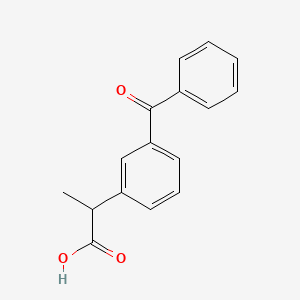
| Formula | C16H14O3 |
|---|---|
| Molecular weight | 254.29 g/mol |
| IUPAC name | 2-(3-benzoylphenyl)propanoic acid |
| CAS | 22071-15-4 |
| PubChem CID | 3825 |
| InChIKey | DKYWVDODHFEZIM-UHFFFAOYSA-N |
| logP | 3.11 (XLogP 3.1) |
| Polar surface area | 54.37 Ų |
| H-bond acceptors / donors | 2 / 1 |
| Drug-likeness (QED) | 0.85 |
| Lipinski violations | 0 |
SMILES
CC(C(=O)O)c1cccc(C(=O)c2ccccc2)c1Biology & Pharmacokinetics
Pharmacokinetics predicted
| Bioavailability | 10.0% |
|---|---|
| Half-life | 1.889 h |
| Volume of distribution | 0.113 L/kg |
| Protein binding | 98.9% |
| BBB penetrant | No |
Receptor binding (top 4)
| Target | Action | Affinity |
|---|---|---|
| COX-1 | Binding | pKi 7.1 |
| COX-1 (PTGS1) | Inhibitor | pIC50 6.5 |
| COX-2 (PTGS2) | Inhibitor | pIC50 6.2 |
| COX-2 | Binding | pKi 6.1 |
Transporters
ASBT (Inhibitor)BCRP (Inhibitor)BSEP (Inhibitor)LAT1 (Inhibitor)MDR1 (Inhibitor)MRP1 (Inhibitor)MRP2 (Inhibitor)MRP4 (Inhibitor)NTCP (Inhibitor)OAT1 (Inhibitor)OAT2 (Inhibitor)OAT3 (Inhibitor)OAT4 (Inhibitor)OATP1A2 (Inhibitor)OATP1B1 (Inhibitor)OATP1B1 (Inhibitor)OATP1B3 (Inhibitor)OATP1B3 (Inhibitor)OCT1 (Inhibitor)OCT2 (Inhibitor)P-gp (Inhibitor)LAT1 (Substrate)MDR1 (Substrate)MRP2 (Substrate)OAT (Substrate)OAT1 (Substrate)OAT3 (Substrate)OATP (Substrate)OATP1A2 (Substrate)OATP1B1 (Substrate)OATP1B3 (Substrate)OATP2B1 (Substrate)P-gp (Substrate)
Drug–drug interactions (100+, DDInter)
| Interacting drug | Severity | Management |
|---|---|---|
| Acalabrutinib | major | |
| Aminolevulinic acid | major | |
| Apixaban | major | |
| Betrixaban | major | |
| Cabozantinib | major | |
| Dalteparin | major | |
| Danaparoid | major | |
| Dasatinib | major | |
| Deferasirox | major | |
| Desirudin | major | |
| Diatrizoate | major | |
| Dicoumarol | major | |
| Drotrecogin alfa | major | |
| Edoxaban | major | |
| Enoxaparin | major | |
| Everolimus | major | |
| Fondaparinux | major | |
| Ibritumomab tiuxetan | major | |
| Ibrutinib | major | |
| Iodipamide | major | |
| Iodixanol | major | |
| Iohexol | major | |
| Iopamidol | major | |
| Iopromide | major | |
| Iothalamic acid | major | |
| Ioversol | major | |
| Ioxilan | major | |
| Leflunomide | major | |
| Methotrexate | major | |
| Omacetaxine mepesuccinate | major | |
| Panobinostat | major | |
| Ponatinib | major | |
| Prasugrel | major | |
| Ramucirumab | major | |
| Regorafenib | major | |
| Rivaroxaban | major | |
| Sirolimus | major | |
| Tacrolimus | major | |
| Temsirolimus | major | |
| Teriflunomide | major |
Showing 40 of 100+.
Registered Products (9)
| Brand | Form / strength | Pack | Agent | Citizen (JOD) |
|---|---|---|---|---|
| Ketofast | Cream 2.5 g/100 g | 50 GRAM/1 TUBE pack varies | SANA PHARMACEUTICAL INDUSTRY/JORDAN | 1.500 |
| Fastum Gel | Gel 2.5 % | 50 g tube pack varies | ORIENT DRUG STORE CO | 1.850 |
| Profemigr | Tablet 150 mg | 10 tab | Ulfa Pharma Co. | 2.480 |
| Ketofast | Cream 2.5 g/100 g | 100 GRAM/1 TUBE pack varies | SANA PHARMACEUTICAL INDUSTRY/JORDAN | 2.850 |
| Flexo® Gel | Gel 2.5 % | 100 GM | Jerash Pharmaceutical Company | 2.900 |
| Keflam | Vial 100 mg/2 ml | 5 vial | MS PHARMA/JORDAN | 3.070 |
| Fastum Gel | Gel 2.5 % | 100 g tube pack varies | ORIENT DRUG STORE CO | 3.500 |
| Profenid F.C. Tabs | Film-Coated Tablet 100 mg | 30 tab | Ulfa Pharma Co. | 3.740 |
| Ketofpan | Ampoule 50 mg/2 ml | 10 amp | AL Rahma Drug Store | 5.790 |