Alpelisib
JFDA label: Piqray
Mechanism of Action
Inhibitor of Phosphatidylinositol 4,5-bisphosphate 3-kinase catalytic subunit alpha isoform — PI3-kinase p110-alpha subunit inhibitor
| Target | Action | Gene / class |
|---|---|---|
| Phosphatidylinositol 4,5-bisphosphate 3-kinase catalytic subunit alpha isoform efficacy | INHIBITOR | PIK3CA |
Indications
Approved
- Breast Neoplasms — breast carcinoma
- Neoplasms — neoplasm
Off-label
- Carcinoma, Squamous Cell
- Colorectal Neoplasms
- Endometrial Neoplasms
- Head and Neck Neoplasms
- Lymphedema
- Ovarian Neoplasms
- Squamous Cell Carcinoma of Head and Neck
- Triple Negative Breast Neoplasms
Contraindications
Source: openFDA
- is contraindicated in patients with severe hypersensitivity to alpelisib or any of its ingredients [see Warnings and Precautions (5.1)] . Severe hypersensitivity to VIJOICE or to any of its ingredients. ( 4 ) Absolute
Adverse Reactions
Skin and subcutaneous tissue disorders (5)
Not Known Acne Including Dermatitis Acneiform · And Rash Pruritic · Rash Erythematous · Rash Including Rash Maculo-Papular · Rash Papular
Dosing
Source: openFDA
Warnings & Precautions
Source: openFDA
Warnings & Precautions
Severe Hypersensitivity : Permanently discontinue VIJOICE. Promptly initiate appropriate treatment. ( 5.1 ) Severe Cutaneous Adverse Reactions (SCARs) : VIJOICE can cause SCARs, including Stevens-Johnson syndrome (SJS), erythema multiforme (EM), toxic epidermal necrolysis (TEN), and drug reaction with eosinophilia and systemic symptoms (DRESS). Interrupt VIJOICE for signs or symptoms of SCARs. Permanently discontinue VIJOICE if SCARs are confirmed. ( 2.5 , 5.2 ) Hyperglycemia : VIJOICE can cause severe hyperglycemia, in some cases associated with hyperglycemic hyperosmolar non-ketotic syndrome (HHNKS) or ketoacidosis. The safety of VIJOICE in patients with Type 1 or uncontrolled Type 2 diabetes has not been established. Before initiating treatment with VIJOICE, test fasting plasma glucose (FPG), HbA1c, and optimize blood glucose. After initiating treatment, monitor periodically. Initiate or optimize anti-hyperglycemic medications as clinically indicated. Interrupt, reduce dose, or discontinue VIJOICE if severe hyperglycemia occurs. ( 2.5 , 5.3 ) Pneumonitis : VIJOICE can cause severe pneumonitis and interstitial lung disease. Monitor for clinical symptoms or radiological changes. Permanently discontinue VIJOICE if pneumonitis occurs. ( 2.5 , 5.4 ) Diarrhea or Colitis : VIJOICE can cause severe diarrhea, resulting in dehydration and in some cases in acute kidney injury, as well as colitis. Monitor for diarrhea and additional symptoms of colitis, including abdominal pain and mucus or blood in stool. Interrupt, reduce dose, or permanently discontinue VIJOICE based on severity of diarrhea or colitis. Patients with colitis may require additional treatment, such as enteric-acting and/or systemic steroids. ( 2.5 , 5.5 ) Embryo-Fetal Toxicity : VIJOICE can cause fetal harm. Advise patients of potential risk to a fetus and to use effective contraception. ( 5.6 , 8.1 , 8.3 )
Severe Hypersensitivity Severe hypersensitivity reactions, including a
Severe Hypersensitivity Severe hypersensitivity reactions, including anaphylaxis, anaphylactic shock, and angioedema, have occurred in adult patients treated with alpelisib in the oncology setting and in patients treated with VIJOICE [see Adverse Reactions (6.1)] . VIJOICE is not approved for use in the oncology setting. Permanently discontinue VIJOICE in the event of severe hypersensitivity [see Contraindications (4)] .
Severe Cutaneous Adverse Reactions Severe cutaneous adverse reactions
Severe Cutaneous Adverse Reactions Severe cutaneous adverse reactions (SCARs), including Stevens-Johnson syndrome (SJS), erythema multiforme (EM), toxic epidermal necrolysis (TEN), and drug reaction with eosinophilia and systemic symptoms (DRESS), have occurred in adult patients treated with alpelisib in the oncology setting and may occur in patients treated with VIJOICE. VIJOICE is not approved for use in the oncology setting. If signs or symptoms of SCARs occur, interrupt VIJOICE until the etiology of the reaction has been determined. Consultation with a dermatologist is recommended. If a SCAR is confirmed, permanently discontinue VIJOICE. If a SCAR is not confirmed, VIJOICE may require dose modifications, topical or systemic corticosteroids, or oral antihistamine treatment as described in Table 4 [see Dosage and Administration (2.5)] .
Hyperglycemia Severe hyperglycemia, in some cases associated with hype
Hyperglycemia Severe hyperglycemia, in some cases associated with hyperglycemic hyperosmolar non-ketotic syndrome (HHNKS) or fatal cases of ketoacidosis, has occurred in adult patients treated with alpelisib in the oncology setting and may occur in patients treated with VIJOICE. VIJOICE is not approved for use in the oncology setting. In the EPIK-P1 study, Grade 1 or 2 hyperglycemia was reported in 12% of patients treated with VIJOICE [see Adverse Reactions (6.1)] . Before initiating treatment with VIJOICE, test fasting plasma glucose (FPG), HbA1c, and optimize blood glucose. After initiating treatment with VIJOICE, monitor fasting glucose (FPG or fasting blood glucose) at least once every week for the first 2 weeks, then at least once every 4 weeks, and as clinically indicated. Monitor HbA1c every 3 months and as clinically indicated. Monitor fasting glucose more frequently for the first few weeks during treatment with VIJOICE in patients with risk factors for hyperglycemia, such as obesity (BMI ≥ 30), elevated FPG, HbA1c at the upper limit of normal or above, use of concomitant systemic corticosteroids, or age ≥ 75 [see Use in Specific Populations (8.5)] . If a patient experiences hyperglycemia after initiating treatment with VIJOICE, monitor fasting glucose as clinically indicated, and at least twice weekly until fasting glucose decreases to normal levels. During treatment with anti-hyperglycemic medication, continue monitoring fasting glucose at least once a week for 8 weeks, followed by once every 2 weeks and as clinically indicated. Consider consultation with a healthcare practitioner with expertise in the treatment of hyperglycemia and counsel patients on lifestyle changes. The safety of VIJOICE in patients with Type 1 and uncontrolled Type 2 diabetes has not been established. Patients with a history of diabetes mellitus may require intensified hyperglycemic treatment. Closely monitor patients with diabetes. Interrupt, reduce the dose, or permanently discontinue VIJOICE based on the severity as described in Table 5 [see Dosage and Administration (2.5)] .
Pneumonitis Severe pneumonitis, including acute interstitial pneumonit
Pneumonitis Severe pneumonitis, including acute interstitial pneumonitis and interstitial lung disease, has occurred in adult patients treated with alpelisib in the oncology setting and may occur in patients treated with VIJOICE. VIJOICE is not approved for use in the oncology setting. In patients who have new or worsening respiratory symptoms or are suspected to have developed pneumonitis, interrupt VIJOICE immediately and evaluate the patient for pneumonitis. Consider a diagnosis of non-infectious pneumonitis in patients presenting with non-specific respiratory signs and symptoms, such as hypoxia, cough, dyspnea, or interstitial infiltrates on radiologic exams and in whom infectious, neoplastic, and other causes have been excluded by means of appropriate investigations. Permanently discontinue VIJOICE in all patients with confirmed pneumonitis [see Dosage and Administration (2.5)] .
Diarrhea or Colitis Severe diarrhea, resulting in dehydration and in s
Diarrhea or Colitis Severe diarrhea, resulting in dehydration and in some cases in acute kidney injury, as well as colitis, have occurred in adult patients treated with alpelisib in the oncology setting and may occur in patients treated with VIJOICE. VIJOICE is not approved for use in the oncology setting. In the EPIK-P1 study, 16% of patients experienced Grade 1 diarrhea during treatment with VIJOICE [see Adverse Reactions (6.1)] . Monitor patients for diarrhea and additional symptoms of colitis, such as abdominal pain and mucus or blood in stool. Interrupt, reduce the dose or permanently discontinue VIJOICE based on the severity of diarrhea or colitis [see Dosage and Administration (2.5)] . Patients with colitis may require additional treatment, such as enteric-acting and/or systemic steroids [see Dosage and Administration (2.5)] .
Embryo-Fetal Toxicity Based on findings in animals and its mechanism o
Embryo-Fetal Toxicity Based on findings in animals and its mechanism of action, VIJOICE can cause fetal harm when administered to a pregnant woman. In animal reproduction studies, oral administration of alpelisib to pregnant animals during organogenesis caused adverse developmental outcomes, including embryo-fetal mortality (post-implantation loss), reduced fetal weights, and increased incidences of fetal malformations at doses that were approximately equivalent to the recommended pediatric and adult doses. Advise pregnant women and females of reproductive potential of the potential risk to a fetus. Advise females of reproductive potential to use effective contraception during treatment with VIJOICE and for 1 week after the last dose. Advise male patients with female partners of reproductive potential to use condoms and effective contraception during treatment with VIJOICE and for 1 week after the last dose [see Use in Specific Populations (8.1, 8.3) and Clinical Pharmacology (12.1)] .
Pregnancy & Lactation
Lactation
Because of possible infant toxicity, the manufacturer recommends that breastfeeding be discontinued during alpelisib therapy and for 1 week after the final dose.
Chemistry & Properties
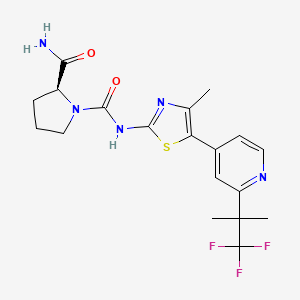
| Formula | C19H22F3N5O2S |
|---|---|
| Molecular weight | 441.48 g/mol |
| IUPAC name | (2S)-1-N-[4-methyl-5-[2-(1,1,1-trifluoro-2-methylpropan-2-yl)-4-pyridinyl]-1,3-thiazol-2-yl]pyrrolidine-1,2-dicarboxamide |
| CAS | 1217486-61-7 |
| PubChem CID | 56649450 |
| InChIKey | STUWGJZDJHPWGZ-LBPRGKRZSA-N |
| logP | 3.84 (XLogP 3.2) |
| Polar surface area | 101.21 Ų |
| H-bond acceptors / donors | 5 / 2 |
| Drug-likeness (QED) | 0.75 |
| Lipinski violations | 0 |
SMILES
Cc1nc(NC(=O)N2CCC[C@H]2C(N)=O)sc1-c1ccnc(C(C)(C)C(F)(F)F)c1Biology & Pharmacokinetics
Pharmacokinetics
| BBB penetrant | No |
|---|
Enzyme interactions
| Enzyme | Role | Detail |
|---|---|---|
| CYP2C19 | Inhibitor | — |
| CYP2C8 | Inhibitor | — |
Receptor binding (top 4)
| Target | Action | Affinity |
|---|---|---|
| phosphatidylinositol-4,5-bisphosphate 3-kinase catalytic subunit alpha (PIK3CA) | Inhibitor | pIC50 8.3 |
| phosphatidylinositol-4,5-bisphosphate 3-kinase catalytic subunit gamma (PIK3CG) | Inhibitor | pIC50 6.6 |
| phosphatidylinositol-4,5-bisphosphate 3-kinase catalytic subunit delta (PIK3CD) | Inhibitor | pIC50 6.5 |
| phosphatidylinositol-4,5-bisphosphate 3-kinase catalytic subunit beta (PIK3CB) | Inhibitor | pIC50 5.9 |
Transporters
BCRP (Inhibitor)BSEP (Inhibitor)MDR1 (Inhibitor)MRP1 (Inhibitor)OATP1B1 (Inhibitor)OATP1B3 (Inhibitor)P-gp (Inhibitor)BCRP (Substrate)MDR1 (Substrate)MRP2 (Substrate)P-gp (Substrate)Transporter(unspecified) (Substrate)
Drug–drug interactions (100+, DDInter)
| Interacting drug | Severity | Management |
|---|---|---|
| Apalutamide | major | |
| Carbamazepine | major | |
| Edoxaban | major | |
| Enzalutamide | major | |
| Fosphenytoin | major | |
| Lumacaftor | major | |
| Mitotane | major | |
| Phenobarbital | major | |
| Phenytoin | major | |
| Primidone | major | |
| Rifabutin | major | |
| Rifampicin | major | |
| Rifapentine | major | |
| St. John's Wort | major | |
| Abametapir (topical) | moderate | |
| Acarbose | moderate | |
| Acetohexamide | moderate | |
| Afatinib | moderate | |
| Albiglutide | moderate | |
| Alendronic acid | moderate | |
| Aliskiren | moderate | |
| Alogliptin | moderate | |
| Alosetron | moderate | |
| Aminoglutethimide | moderate | |
| Amitriptyline | moderate | |
| Amobarbital | moderate | |
| Apixaban | moderate | |
| Armodafinil | moderate | |
| Artesunate | moderate | |
| Atorvastatin | moderate | |
| Belinostat | moderate | |
| Betrixaban | moderate | |
| Bexarotene | moderate | |
| Bortezomib | moderate | |
| Bosentan | moderate | |
| Bosutinib | moderate | |
| Brentuximab vedotin | moderate | |
| Brigatinib | moderate | |
| Bupropion | moderate | |
| Butabarbital | moderate |
Showing 40 of 100+.
Registered Products (2)
| Brand | Form / strength | Pack | Agent | Citizen (JOD) |
|---|---|---|---|---|
| Piqray | Film-Coated Tablet 200, 50 mg | 200 mg | The Jordan Drugstore Co | — |
| Piqray | Tablet 150 + 150 mg | 56 tab | The Jordan Drugstore Co | — |