Axitinib
JFDA label: Inlyta 1mg F.C Tab
Mechanism of Action
Inhibitor of Vascular endothelial growth factor receptor — Vascular endothelial growth factor receptor inhibitor
| Target | Action | Gene / class |
|---|---|---|
| Vascular endothelial growth factor receptor efficacy | INHIBITOR |
Indications
Approved
- Renal cell carcinoma, advanced
Off-label
- Thyroid cancer (differentiated, advanced)
Contraindications
Source: Lexicomp
- Hypersensitivity to axitinib or any component of the formulation Absolute
- There are no contraindications listed within the manufacturer’s US labeling Absolute
Adverse Reactions
Cardiac disorders (7)
Very Common Hypertension
Common arterial thrombosis · pulmonary embolism deep vein thrombosis · retinal thrombosis · retinal vein occlusion · transient ischemic attack · Venous thrombosis
Nervous system disorders (4)
Very Common Fatigue · headache · voice disorder
Common Dizziness
Renal and urinary disorders (3)
Very Common Increased serum creatinine · Proteinuria
Common Hematuria
Blood and lymphatic system disorders (4)
Very Common Anemia, increased serum ALT, arthralgia, limb pain
Common Increased hemoglobin · polycythemia · rectal hemorrhage
Metabolism and nutrition disorders (2)
Common Dehydration · hyperthyroidism
Gastrointestinal disorders (4)
Common Dyspepsia · gastrointestinal fistula · gastrointestinal perforation · hemorrhoids
Skin and subcutaneous tissue disorders (6)
Very Common Palmar-plantar erythrodysesthesia · skin rash, hypocalcemia, hyperglycemia, weight loss, hypothyroidism, decreased appetite, nausea, increased serum lipase, increased serum amylase, vomiting, constipation, mucosal inflammation, stomatit
Common alopecia · erythema · pruritus · Xeroderma
Musculoskeletal and connective tissue disorders (1)
Common Myalgia
Ear and labyrinth disorders (1)
Common Tinnitus
Respiratory, thoracic and mediastinal disorders (4)
Very Common Cough · dyspnea
Common Epistaxis · hemoptysis
Dosing
Source: Lexicomp
Warnings & Precautions
Source: Lexicomp
Cardiac effects
Cardiac failure, including fatal events, has been observed rarely. Monitor for signs/symptoms of cardiac failure throughout therapy; management may require permanent therapy discontinuation.
Gastrointestinal events
Gastrointestinal perforation and fistulas (including a fatality) have been reported. Monitor for signs/symptoms throughout treatment.
Hemorrhage
Hemorrhagic events (cerebral hemorrhage, gastrointestinal hemorrhage, hematuria, hemoptysis, and melena) have been reported (with some fatalities). Temporarily interrupt treatment with any hemorrhage requiring medical intervention.
Hypertension
May cause hypertension; the median onset is within the first month, and has been observed as early as 4 days after treatment initiation. Hypertensive crisis has been reported. Blood pressure should be well-controlled prior to treatment initiation. Monitor blood pressure and treat with standard antihypertensive therapy. Persistent hypertension (despite antihypertensive therapy) may require dose reduction; discontinue if severe and persistent despite concomitant antihypertensives (or dose reduction), or with evidence of hypertensive crisis. Monitor for hypotension if on antihypertensive therapy and axitinib is withheld or discontinued.
Proteinuria
Proteinuria is associated with use. Monitor for proteinuria at baseline and periodically throughout therapy. If moderate or severe proteinuria occurs, reduce dose or temporarily withhold treatment.
Reversible posterior leukoencephalopathy syndrome (RPLS)
Cases of RPLS have been reported. Symptoms of RPLS include confusion, headache, hypertension (mild-to-severe), lethargy, seizure, blindness and/or other vision or neurologic disturbances; interrupt treatment and manage hypertension. MRI is recommended to confirm RPLS diagnosis. Discontinue axitinib if RPLS is confirmed. The safety of reinitiating axitinib in patients previously experiencing RPLS is unknown.
Thrombotic events
Arterial thrombotic events (cerebrovascular accident, MI, retinal artery occlusion, and transient ischemic attack), with fatalities, have been reported. Venous thrombotic events, including pulmonary embolism, deep vein thrombosis, retinal vein occlusion and retinal vein thrombosis, have been observed (with some fatalities). Use with caution in patients with a history of or risks for arterial or venous thrombotic events; has not been studied in patients within 12 months of an arterial thrombotic event or within 6 months of a venous thrombotic event.
Thyroid dysfunction
Hypothyroidism occurs commonly with tyrosine kinase inhibitors, including axitinib. Hyperthyroidism has also been reported. Monitor thyroid function at baseline and periodically throughout therapy. Thyroid disorders should be treated according to standard practice to achieve/maintain euthyroid state.
Wound healing complications
Although the effect on wound healing has not been studied with axitinib, vascular endothelial growth factor (VEGF) receptor inhibitors are associated with impaired wound healing. Discontinue treatment at least 24 hours prior to scheduled surgery; treatment reinitiation should be guided by clinical judgment and wound assessment. Disease-related concerns:
Brain metastases
Has not been studied in patients with evidence of untreated brain metastases; use is not recommended.
Gastrointestinal bleeding
Has not been studied in patients with recent active gastrointestinal bleeding; use is not recommended.
Hepatic impairment
Systemic exposure to axitinib is increased in patients with moderate impairment (Child-Pugh class B); dose reductions are recommended. Has not been studied in patients with severe impairment (Child-Pugh class C). Increases in ALT have been observed; monitor liver function tests prior to therapy initiation and periodically throughout treatment. Concurrent drug therapy issues:
Drug-drug interactions
Potentially significant interactions may exist, requiring dose or frequency adjustment, additional monitoring, and/or selection of alternative therapy. Consult drug interactions database for more detailed information.
Pregnancy & Lactation
Pregnancy
Teratogenic, embryotoxic, and fetotoxic events were observed in animal reproduction studies when administered in doses less than the normal human dose. Based on its mechanism of action and because axitinib inhibits angiogenesis (a critical component of fetal development), adverse effects on pregnancy would be expected. Women of childbearing potential should be advised to avoid pregnancy during therapy.
Lactation
It is not known if axitinib is excreted in breast milk. Due to the potential for serious adverse reactions in the nursing infant, the manufacturer recommends a decision be made to discontinue nursing or to discontinue the drug, taking into account the importance of treatment to the mother.
Monitoring
| Clinical pearl | Hepatic function (ALT, AST, and bilirubin; baseline and periodic), thyroid function (baseline and periodic), urinalysis (for proteinuria; baseline and periodically); blood pressure, signs/symptoms of RPLS, gastrointestinal bleeding/perforation/fistula, signs/symptoms cardiac failure Thyroid function testing recommendations (Hamnvik, 2011): Preexisting levothyroxine therapy: Obtain baseline TSH levels, then monitor every 4 weeks until levels and levothyroxine dose are stable, then monitor every 2 months Without preexisting thyroid hormone replacement: TSH at baseline, then monthly for 4 months, then every 2-3 months |
|---|
Chemistry & Properties
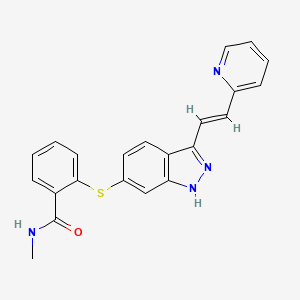
| Formula | C22H18N4OS |
|---|---|
| Molecular weight | 386.48 g/mol |
| IUPAC name | N-methyl-2-[[3-[(E)-2-pyridin-2-ylethenyl]-1H-indazol-6-yl]sulfanyl]benzamide |
| CAS | 319460-85-0 |
| PubChem CID | 6450551 |
| InChIKey | RITAVMQDGBJQJZ-FMIVXFBMSA-N |
| logP | 4.64 (XLogP 4.2) |
| Polar surface area | 70.67 Ų |
| H-bond acceptors / donors | 4 / 2 |
| Drug-likeness (QED) | 0.52 |
| Lipinski violations | 0 |
SMILES
CNC(=O)c1ccccc1Sc1ccc2c(/C=C/c3ccccn3)n[nH]c2c1Biology & Pharmacokinetics
Pharmacokinetics
| BBB penetrant | No |
|---|
Enzyme interactions
| Enzyme | Role | Detail |
|---|---|---|
| CYP1A2 | Inhibitor | — |
| CYP2C19 | Inhibitor | — |
| CYP2C8 | Inhibitor | — |
| CYP2C9 | Inhibitor | — |
Receptor binding (top 3)
| Target | Action | Affinity |
|---|---|---|
| kinase insert domain receptor (KDR) | Inhibitor | pIC50 9.6 |
| kinase insert domain receptor (KDR) | Inhibitor | pKd 8.2 |
| polo like kinase 4 (PLK4) | Inhibitor | pIC50 7.3 |
Transporters
BCRP (Inhibitor)BCRP (Inhibitor)BSEP (Inhibitor)MDR1 (Inhibitor)MRP1 (Inhibitor)OATP1B1 (Inhibitor)OATP1B1 (Inhibitor)OATP1B3 (Inhibitor)OATP2B1 (Inhibitor)P-gp (Inhibitor)BCRP (Substrate)MDR1 (Substrate)NTCP (Substrate)OATP1B1 (Substrate)OATP1B3 (Substrate)OATP2B1 (Substrate)P-gp (Substrate)Proton pump (Substrate)Transporter(unspecified) (Substrate)
Drug–drug interactions (100+, DDInter)
| Interacting drug | Severity | Management |
|---|---|---|
| Amprenavir | major | |
| Apalutamide | major | |
| Atazanavir | major | |
| Boceprevir | major | |
| Bosentan | major | |
| Carbamazepine | major | |
| Cenobamate | major | |
| Ceritinib | major | |
| Clarithromycin | major | |
| Cobicistat | major | |
| Conivaptan | major | |
| Dabrafenib | major | |
| Delavirdine | major | |
| Dexamethasone | major | |
| Efavirenz | major | |
| Enzalutamide | major | |
| Erythromycin | major | |
| Etravirine | major | |
| Fosamprenavir | major | |
| Fosphenytoin | major | |
| Idelalisib | major | |
| Indinavir | major | |
| Itraconazole | major | |
| Ketoconazole | major | |
| Leflunomide | major | |
| Lomitapide | major | |
| Lonafarnib | major | |
| Lorlatinib | major | |
| Lumacaftor | major | |
| Mifepristone | major | |
| Mipomersen | major | |
| Mitotane | major | |
| Modafinil | major | |
| Nafcillin | major | |
| Nefazodone | major | |
| Nelfinavir | major | |
| Pexidartinib | major | |
| Phenobarbital | major | |
| Phenytoin | major | |
| Posaconazole | major |
Showing 40 of 100+.
Registered Products (2)
| Brand | Form / strength | Pack | Agent | Citizen (JOD) |
|---|---|---|---|---|
| Inlyta 1mg F.C Tab | Film-Coated Tablet 1 mg | 56 tab | Petra Drug Store | — |
| Inlyta 5mg F.C Tab | Film-Coated Tablet 5 mg | 56 tab | Petra Drug Store | — |