Cabozantinib
JFDA label: Cabometyx
- Perforations and fistulas (Cometriq):
- Hemorrhage (Cometriq):
Mechanism of Action
Cabozantinib is a potent inhibitor of proinvasive receptor tyrosine kinases (RTKs), including AXL, FLT-3, KIT, MER, MET, RET, ROS1, TIE-2, TRKB, TYRO3, and VEGFR-1, -2, and -3; induces apoptosis of cancer cells and suppresses tumor growth, metastasis, and angiogenesis (Yakes 2011).
Indications
Approved
- Renal cell carcinoma, advanced (Cabometyx)
- Thyroid cancer, medullary (Cometriq)
Contraindications
Source: Lexicomp
- There are no contraindications listed in the manufacturer's labeling Absolute
Adverse Reactions
Cardiac disorders (5)
Very Common Hypertension
Common arterial thromboembolism · hypotension · pulmonary embolism · Venous thromboembolism
Nervous system disorders (9)
Very Common dizziness · Fatigue · headache · mouth pain · voice disorder
Common Anxiety · paresthesia · peripheral neuropathy · peripheral sensory neuropathy
Hepatobiliary disorders (4)
Very Common hyperbilirubinemia · increased serum alkaline phosphatase · Increased serum ALT · increased serum AST
Renal and urinary disorders (2)
Very Common Increased serum creatinine · Proteinuria
Blood and lymphatic system disorders (5)
Very Common anemia · Lymphocytopenia · neutropenia · thrombocytopenia
Common Hemorrhage
Metabolism and nutrition disorders (12)
Very Common hyperglycemia · hypoalbuminemia · hypocalcemia · hypokalemia · hypomagnesemia · hyponatremia · hypophosphatemia · hypothyroidism · increased gamma-glutamyl transferase · Increased serum triglycerides · weight loss
Common Dehydration
Gastrointestinal disorders (14)
Very Common abdominal pain · constipation · decreased appetite · Diarrhea · dysgeusia · dyspepsia · dysphagia · mucosal inflammation · nausea · stomatitis · vomiting
Common gastrointestinal fistula · gastrointestinal perforation · Hemorrhoids
Skin and subcutaneous tissue disorders (7)
Very Common alopecia · erythema · hair discoloration · Palmar-plantar erythrodysesthesia · skin rash · xeroderma
Common Hyperkeratosis
Musculoskeletal and connective tissue disorders (6)
Very Common arthralgia · limb pain · muscle spasm · Weakness
Common Musculoskeletal chest pain · osteonecrosis of the jaw
General disorders and administration site conditions (2)
Common Fistula · wound healing impaired
Respiratory, thoracic and mediastinal disorders (2)
Very Common cough · Dyspnea
Dosing
Source: Lexicomp
Warnings & Precautions
Source: Lexicomp
Dermatologic toxicity
Palmar-plantar erythrodysesthesia syndrome (PPES) was commonly observed in clinical trials; severe PPES (≥ grade 3) also occurred frequently. May require dosage reduction and/or discontinuation.
GI toxicity
Diarrhea was commonly observed in cabozantinib-treated patients in clinical trials. May require therapy interruption and/or dosage reduction. Cabozantinib is associated with a moderate emetic potential; antiemetics are recommended to prevent nausea/vomiting (Hesketh 2017). [US Boxed Warning]: Cometriq: Serious GI perforations and fistulas have been reported when used for medullary thyroid cancer; discontinue for GI perforation or fistula formation. May be fatal. Tracheal/esophageal fistulas were also noted; some cases were fatal. GI fistula/perforation (including fatal perforations) were also reported in patients with renal cell cancer. Monitor for signs/symptoms of perforations and fistulas, including abscess and sepsis. May require therapy discontinuation.
Hemorrhage
Cometriq: Serious and occasionally fatal hemorrhage (including hemoptysis and gastrointestinal) has occurred with cabozantinib when used for medullary thyroid cancer. Monitor for signs/symptoms of bleeding and do not administer to patients with severe hemorrhage or a recent history of hemorrhage or hemoptysis. Severe hemorrhage has also been reported in patients with renal cell cancer, including grade 3 or higher events. Do not administer to patients with or at risk for severe hemorrhage.
Hypertension
Treatment emergent hypertension was commonly seen in clinical trials (including grade 3 or higher toxicity and hypertensive crisis). Monitor blood pressure prior to therapy initiation and regularly thereafter; withhold for hypertension that is uncontrolled with appropriate medical management. May require cabozantinib dosage reduction and/or therapy discontinuation.
Osteonecrosis of the jaw
Osteonecrosis of the jaw (ONJ) occurred rarely; oral examinations should be performed prior to and periodically throughout therapy. Patients should maintain proper oral hygiene practices; if possible, withhold therapy for at least 28 days prior to scheduled invasive dental procedures. Discontinue cabozantinib if ONJ develops.
Proteinuria
Proteinuria occurred in a small number of patients receiving cabozantinib in clinical trials; nephrotic syndrome was also reported (rare). Monitor urine protein regularly and discontinue therapy if nephrotic syndrome develops.
Reversible posterior leukoencephalopathy syndrome
Reversible posterior leukoencephalopathy syndrome (RPLS), also referred to as posterior reversible leukoencephalopathy syndrome (PRES), occurred rarely in clinical studies. Monitor for signs/symptoms of RPLS (seizures, headache, visual disturbances, confusion or altered mental function); if diagnosis confirmed, discontinue therapy.
Thromboembolic events
An increased incidence of thrombotic events (venous thromboembolism, including pulmonary embolism and arterial thromboembolism) was seen in cabozantinib-treated patients in clinical trials; discontinue therapy in patients who develop an acute myocardial infarction, cerebral infarction, or other clinically significant arterial thromboembolic event.
Wound healing impairment
Cabozantinib inhibits vascular endothelial growth factor receptors 1, 2, and 3; wound complications have been reported with therapy. Hold treatment at least 28 days prior to scheduled surgery (including dental surgery); resume based on judgment of adequate wound healing post surgery. Withhold treatment in patients with dehiscence or other wound healing complications requiring intervention. Disease-related concerns:
Hepatic impairment
Cabozantinib exposure is increased in patients with hepatic impairment. Reduced initial doses are recommended for patients with mild or moderate impairment; use is not recommended in patients with severe impairment. Concurrent drug therapy issues:
Drug-drug interactions
Potentially significant interactions may exist, requiring dose or frequency adjustment, additional monitoring, and/or selection of alternative therapy. Consult drug interactions database for more detailed information. Dosage form specific issues:
Formulations
Cabozantinib is available in tablets (Cabometyx) and capsules (Cometriq) which are NOT interchangeable; do NOT substitute.
Pregnancy & Lactation
Pregnancy
Adverse events have been observed in animal reproduction studies. Based on its mechanism of action, adverse effects on pregnancy would be expected. Patients (male and female) should use effective contraception during therapy and for 4 months after therapy completion. Cabozantinib may impair fertility in females and males.
Lactation
It is not known if cabozantinib is present in breast milk. Due to the potential for serious adverse reactions in the breastfed infant, the manufacturer recommends discontinuing breastfeeding during treatment and for 4 months after the last dose.
Monitoring
| Clinical pearl | Renal function, liver function, CBC with differential and platelets, serum electrolytes; blood pressure (prior to initiation and regularly during therapy); monitor for perforations, fistulas, signs/symptoms of bleeding, palmar-plantar erythrodysesthesia syndrome (PPES), reversible posterior leukoencephalopathy syndrome (RPLS), proteinuria (regularly during therapy), osteonecrosis of the jaw (perform oral examination prior to initiation and periodically during therapy), wound healing complications, diarrhea, stomatitis. Monitor adherence. |
|---|
Chemistry & Properties
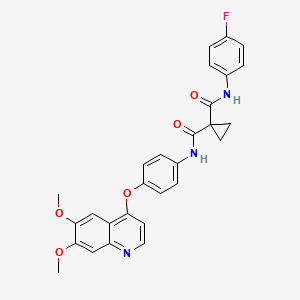
| Formula | C28H24FN3O5 |
|---|---|
| Molecular weight | 501.51 g/mol |
| IUPAC name | 1-N-[4-(6,7-dimethoxyquinolin-4-yl)oxyphenyl]-1-N'-(4-fluorophenyl)cyclopropane-1,1-dicarboxamide |
| CAS | 849217-68-1 |
| PubChem CID | 25102847 |
| InChIKey | ONIQOQHATWINJY-UHFFFAOYSA-N |
| logP | 5.54 (XLogP 5.4) |
| Polar surface area | 98.78 Ų |
| H-bond acceptors / donors | 6 / 2 |
| Drug-likeness (QED) | 0.31 |
| Lipinski violations | 2 |
SMILES
COc1cc2nccc(Oc3ccc(NC(=O)C4(C(=O)Nc5ccc(F)cc5)CC4)cc3)c2cc1OCBiology & Pharmacokinetics
Pharmacokinetics predicted
| Bioavailability | 10.0% |
|---|---|
| Half-life | 0.988 h |
| Volume of distribution | 3.875 L/kg |
| Protein binding | 93.7% |
| BBB penetrant | No |
Enzyme interactions
| Enzyme | Role | Detail |
|---|---|---|
| CYP2C19 | Inhibitor | — |
| CYP2C8 | Inhibitor | — |
| CYP2C9 | Inhibitor | — |
| CYP2D6 | Substrate | — |
| CYP3A4 | Substrate | — |
Receptor binding (top 3)
| Target | Action | Affinity |
|---|---|---|
| kinase insert domain receptor (KDR) | Inhibitor | pIC50 10.5 |
| MET proto-oncogene, receptor tyrosine kinase (MET) | Inhibitor | pIC50 8.9 |
| ret proto-oncogene (RET) | Inhibitor | pIC50 8.0 |
Transporters
BCRP (Inhibitor)BSEP (Inhibitor)MDR1 (Inhibitor)MRP1 (Inhibitor)OATP1B1 (Inhibitor)OATP1B3 (Inhibitor)P-gp (Inhibitor)MDR1 (Substrate)MRP2 (Substrate)P-gp (Substrate)
Drug–drug interactions (100+, DDInter)
| Interacting drug | Severity | Management |
|---|---|---|
| Abarelix | major | |
| Abciximab | major | |
| Abiraterone | major | |
| Acalabrutinib | major | |
| Acetylsalicylic acid | major | |
| Adenosine | major | |
| Alfuzosin | major | |
| Alimemazine | major | |
| Alteplase | major | |
| Amiodarone | major | |
| Amisulpride | major | |
| Amitriptyline | major | |
| Amoxapine | major | |
| Amprenavir | major | |
| Anagrelide | major | |
| Anisindione | major | |
| Anistreplase | major | |
| Antithrombin III human | major | |
| Apalutamide | major | |
| Apixaban | major | |
| Apomorphine | major | |
| Ardeparin | major | |
| Argatroban | major | |
| Arsenic trioxide | major | |
| Asenapine | major | |
| Astemizole | major | |
| Atazanavir | major | |
| Atomoxetine | major | |
| Avapritinib | major | |
| Azithromycin | major | |
| Bedaquiline | major | |
| Bepridil | major | |
| Berotralstat | major | |
| Betrixaban | major | |
| Bicalutamide | major | |
| Binimetinib | major | |
| Bivalirudin | major | |
| Boceprevir | major | |
| Bosutinib | major | |
| Bromfenac | major |
Showing 40 of 100+.
Registered Products (3)
| Brand | Form / strength | Pack | Agent | Citizen (JOD) |
|---|---|---|---|---|
| Cabometyx | Tablet 60 mg | 30 tab | Petra Drug Store | — |
| Cabometyx | Tablet 40 mg | 30 tab | Petra Drug Store | — |
| Cabometyx | Tablet 20 mg | 30 tab | Petra Drug Store | — |