Chlordiazepoxide
JFDA label: Limbitrol
- Risks from concomitant use of benzodiazepines and opioids:
Mechanism of Action
Positive Allosteric Modulator of GABA-A receptor; anion channel — GABA-A receptor; anion channel positive allosteric modulator
| Target | Action | Gene / class |
|---|---|---|
| GABA-A receptor; anion channel efficacy | POSITIVE ALLOSTERIC MODULATOR |
Indications
Approved
- Acute alcohol withdrawal
- Anxiety
- Preoperative anxiety
Contraindications
Source: Lexicomp
- Hypersensitivity to chlordiazepoxide or any component of the formulation. Documentation of allergenic cross-reactivity for benzodiazepines is limited. However, because of similarities in chemical structure and/or pharmacologic actions, the possibility of cross-sensitivity cannot be ruled out with certainty Absolute
Adverse Reactions
Cardiac disorders (2)
Not Known Edema · syncope
Nervous system disorders (5)
Not Known Abnormal electroencephalogram · ataxia · confusion · drowsiness · drug-induced extrapyramidal reaction
Hepatobiliary disorders (2)
Not Known Hepatic insufficiency · jaundice
Blood and lymphatic system disorders (2)
Not Known Agranulocytosis · bone marrow depression
Metabolism and nutrition disorders (2)
Not Known Change in libido · menstrual disease
Gastrointestinal disorders (2)
Not Known Constipation · nausea
Skin and subcutaneous tissue disorders (1)
Not Known Skin rash
General disorders and administration site conditions (1)
Not Known Paradoxical reaction
Dosing
Source: Lexicomp
Warnings & Precautions
Source: Lexicomp
Anterograde amnesia
Benzodiazepines have been associated with anterograde amnesia (Nelson 1999).
CNS depression
May cause CNS depression, which may impair physical or mental abilities; patients must be cautioned about performing tasks which require mental alertness (eg, operating machinery or driving).
Paradoxical reactions
Paradoxical reactions, including hyperactive or aggressive behavior, have been reported with benzodiazepines, particularly in adolescent/pediatric or psychiatric patients. Disease-related concerns:
Depression
Use caution in patients with depression, particularly if suicidal risk may be present.
Drug abuse
Use with caution in patients with a history of drug abuse or acute alcoholism; potential for drug dependency exists. Psychological and physical dependence, as well as tolerance to sedative and anticonvulsive effects, may occur with prolonged use (Vinkers 2012).
Hepatic impairment
Use with caution in patients with hepatic impairment.
Porphyria
Use with caution in patients with porphyria.
Renal impairment
Use with caution in patients with renal impairment.
Respiratory disease
Use with caution in patients with respiratory disease (Smoller 1996). Concurrent drug therapy issues:
Benzodiazepines and opioids
The concomitant use of benzodiazepines and opioids may result in profound sedation, respiratory depression, coma, and death. Reserve concomitant prescribing of these drugs for use in patients for whom alternative treatment options are inadequate. Limit dosages and durations to the minimum required. Follow patients for signs and symptoms of respiratory depression and sedation.
Drug-drug interactions
Potentially significant interactions may exist, requiring dose or frequency adjustment, additional monitoring, and/or selection of alternative therapy. Consult drug interactions for more detailed information. Special populations:
Debilitated patients
Use with caution in debilitated patients; active metabolites with extended half-lives may lead to delayed accumulation and adverse effects, including ataxia and over-sedation.
Elderly
Avoid use; if used, use with caution in the elderly; active metabolites with extended half-lives may lead to delayed accumulation and adverse effects, including ataxia and over-sedation.
Fall risk
Use with extreme caution in patients who are at risk of falls; benzodiazepines have been associated with falls and traumatic injury (Nelson 1999).
Pediatric
Use with caution in children; active metabolites with extended half-lives may lead to delayed accumulation and adverse effects, including ataxia and over-sedation. Other warnings/precautions:
Tolerance
Chlordiazepoxide is a long half-life benzodiazepine. Duration of action after a single dose is determined by redistribution rather than metabolism. Tolerance does not develop to the anxiolytic effects (Vinkers, 2012). Chronic use of this agent may increase the perioperative benzodiazepine dose needed to achieve desired sedative effect.
Withdrawal
Rebound or withdrawal symptoms may occur following abrupt discontinuation or large decreases in dose. Use caution when reducing dose or withdrawing therapy; decrease slowly and monitor for withdrawal symptoms. Flumazenil may cause withdrawal in patients receiving long-term benzodiazepine therapy.
Pregnancy & Lactation
Pregnancy
Adverse events have been observed in some animal reproduction studies. Chlordiazepoxide crosses the human placenta and fetal serum concentrations are similar to those in the mother. Teratogenic effects have been observed with some benzodiazepines (including chlordiazepoxide); however, additional studies are needed. The incidence of premature birth and low birth weights may be increased following maternal use of benzodiazepines; hypoglycemia and respiratory problems in the neonate may occur following exposure late in pregnancy. Neonatal withdrawal symptoms may occur within days to weeks after birth and “floppy infant syndrome” (which also includes withdrawal symptoms) has been reported with some benzodiazepines (Bergman 1992; Iqbal 2002; Wikner 2007).
Lactation
Chlordiazepoxide is excreted in breast milk. Drowsiness, lethargy, or weight loss in nursing infants have been observed in case reports following maternal use of some benzodiazepines (Iqbal 2002).
LactMed: monitor the infant.
Monitoring
| Clinical pearl | Respiratory and cardiovascular status (including orthostasis); mental status; paradoxical reactions (eg, excitement, stimulation, acute rage); if used for ethanol withdrawal, signs/symptoms of ethanol withdrawal |
|---|
Chemistry & Properties
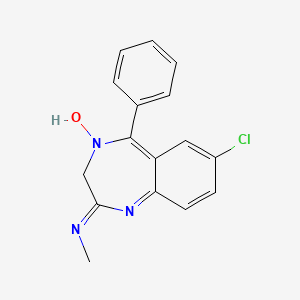
| Formula | C16H14ClN3O |
|---|---|
| Molecular weight | 299.76 g/mol |
| IUPAC name | 7-chloro-4-hydroxy-N-methyl-5-phenyl-3H-1,4-benzodiazepin-2-imine |
| CAS | 58-25-3 |
| PubChem CID | 2712 |
| InChIKey | ANTSCNMPPGJYLG-UHFFFAOYSA-N |
| logP | 2.95 (XLogP 2.4) |
| Polar surface area | 50.46 Ų |
| H-bond acceptors / donors | 3 / 1 |
| Drug-likeness (QED) | 0.65 |
| Lipinski violations | 0 |
SMILES
CNC1=Nc2ccc(Cl)cc2C(c2ccccc2)=[N+]([O-])C1Biology & Pharmacokinetics
Pharmacokinetics
| BBB penetrant | Yes |
|---|
Enzyme interactions
| Enzyme | Role | Detail |
|---|---|---|
| CYP1A2 | Inhibitor | — |
| CYP1A2 | Substrate | — |
| CYP2B6 | Inhibitor | — |
| CYP2C19 | Substrate | — |
| CYP2C8 | Inhibitor | — |
| CYP2C9 | Inhibitor | — |
| CYP2C9 | Substrate | — |
| CYP3A4 | Substrate | — |
Transporters
BCRP (Inhibitor)BSEP (Inhibitor)BSEP (Inhibitor)MRP1 (Inhibitor)MRP2 (Inhibitor)MRP3 (Inhibitor)MRP4 (Inhibitor)OATP1B1 (Inhibitor)OATP1B3 (Inhibitor)P-gp (Inhibitor)P-gp (Substrate)
Drug–drug interactions (85, DDInter)
| Interacting drug | Severity | Management |
|---|---|---|
| Codeine | major | |
| Hydrocodone | major | |
| Morphine | major | |
| Morphine (liposomal) | major | |
| Aldesleukin | moderate | |
| Alimemazine | moderate | |
| Amyl Nitrite | moderate | |
| Anagrelide | moderate | |
| Azatadine | moderate | |
| Azelastine (nasal) | moderate | |
| Brimonidine (ophthalmic) | moderate | |
| Brimonidine (topical) | moderate | |
| Brompheniramine | moderate | |
| Bupropion | moderate | |
| Carbinoxamine | moderate | |
| Cetirizine | moderate | |
| Chlorphenesin | moderate | |
| Chlorpheniramine | moderate | |
| Cimetidine | moderate | |
| Clarithromycin | moderate | |
| Clemastine | moderate | |
| Clofedanol | moderate | |
| Cyclizine | moderate | |
| Cyproheptadine | moderate | |
| Dexbrompheniramine | moderate | |
| Dextromethorphan | moderate | |
| Diazoxide | moderate | |
| Diphenhydramine | moderate | |
| Disulfiram | moderate | |
| Doxepin | moderate | |
| Doxepin (topical) | moderate | |
| Doxylamine | moderate | |
| Dronabinol | moderate | |
| Erythromycin | moderate | |
| Ethanol | moderate | |
| Flumazenil | moderate | |
| Fostamatinib | moderate | |
| Ifosfamide | moderate | |
| Imatinib | moderate | |
| Iodide I-123 | moderate |
Showing 40 of 85.
Registered Products (4)
| Brand | Form / strength | Pack | Agent | Citizen (JOD) |
|---|---|---|---|---|
| Poxidium F.C Tablets | Film-Coated Tablet 5 mg, 2.5 mg | 30 tab pack varies | Hikma Pharmaceuticals Co.Ltd/Jordan | 1.400 |
| Limbitrol | Tablet 5 mg, 12.5 mg | 30 tab | ORIENT DRUG STORE CO | 2.700 |
| Librax 5mg/2.5mg | Tablet 5 mg, 2.5 mg | 30 tab | Khoury Drug Store | 3.570 |
| Poxidium Tablets | Tablet 5 mg, 2.5 mg | 1000 tab pack varies | Hikma Pharmaceuticals Co.Ltd/Jordan | 22.800 |