Clopidogrel
Active form: Clopidogrel Metabolite H4.
JFDA label: PLAVIX TAB
- Diminished antiplatelet effect in patients with two loss-of-function alleles of the CYP2C19 gene:
Mechanism of Action
Clopidogrel requires in vivo biotransformation to an active thiol metabolite. The active metabolite irreversibly blocks the P2Y12 component of ADP receptors on the platelet surface, which prevents activation of the GPIIb/IIIa receptor complex, thereby reducing platelet aggregation. Platelets blocked by clopidogrel are affected for the remainder of their lifespan (~7-10 days).
Indications
Approved
- Acute ST-segment elevation myocardial infarction
- Acute coronary syndrome
- Recent myocardial infarction, recent stroke, or established peripheral arterial disease
- Unstable angina/non-ST-segment elevation myocardial infarction
Off-label
- Adjunctive therapy to support reperfusion with primary percutaneous coronary intervention
- Atrial fibrillation (primary prevention of thromboembolism)
- Coronary artery bypass graft (CABG) surgery (secondary prevention)
- Non-ST-elevation acute coronary syndromes in patients with allergy or major gastrointestinal intolerance to aspirin
- Percutaneous coronary intervention (PCI), non-acute coronary syndrome (ie, stable ischemic heart disease)
- Peripheral artery percutaneous transluminal angioplasty
- Secondary prevention of cardiovascular disease (patients with diabetes and an aspirin allergy)
- Symptomatic carotid artery stenosis (including recent carotid endarterectomy)
Contraindications
Source: Lexicomp
- Additional contraindications (not in US labeling): Significant liver impairment or cholestatic jaundice Absolute
- Hypersensitivity (eg, anaphylaxis) to clopidogrel or any component of the formulation Absolute
- active pathological bleeding (eg, peptic ulcer, intracranial hemorrhage) Absolute
- concomitant use of repaglinide Absolute
Adverse Reactions
Blood and lymphatic system disorders (3)
Common major hemorrhage · Minor hemorrhage
Not Known Hematoma
Gastrointestinal disorders (1)
Common Gastrointestinal hemorrhage
Respiratory, thoracic and mediastinal disorders (1)
Not Known Epistaxis
Dosing
Source: Lexicomp
Warnings & Precautions
Source: Lexicomp
Bleeding
Clopidogrel increases the risk of bleeding. Use is contraindicated in patients with active pathological bleeding (eg, peptic ulcer, intracranial hemorrhage). Additional risk factors for bleeding include age ≥75 years, propensity to bleed (eg, recent trauma or surgery, recent or recurrent GI bleeding, active peptic ulcer disease, severe hepatic impairment), body weight • Thienopyridine hypersensitivity: Because of structural similarities, cross-reactivity has been reported among the thienopyridines (clopidogrel, prasugrel, and ticlopidine); use with caution or avoid in patients with hypersensitivity or hematologic reactions to previous thienopyridine use. Use of clopidogrel is contraindicated in patients with hypersensitivity to clopidogrel. Although desensitization may be considered for mild-to-moderate hypersensitivity, do not desensitize patients with prior life-threatening allergic reactions to clopidogrel (eg, toxic epidermal necrolysis, exfoliative dermatitis, Stevens-Johnson syndrome, TTP) (Lokhandwala 2011).
Thrombotic thrombocytopenic purpura (TTP)
Cases of TTP (usually occurring within the first 2 weeks of therapy), resulting in some fatalities, have been reported; urgent plasmapheresis is required. Disease-related concerns:
Lacunar stroke
In patients with recent lacunar stroke (within 180 days), the use of clopidogrel in addition to aspirin did not significantly reduce the incidence of the primary outcome of stroke recurrence (any ischemic stroke or intracranial hemorrhage) compared to aspirin alone; the use of clopidogrel in addition to aspirin did however increase the risk of major hemorrhage and the rate of all-cause mortality (SPS3 Investigators, 2012).
Renal impairment
Use with caution in patients with moderate to severe renal impairment (experience is limited). Concurrent drug therapy issues:
Drug-drug interactions
Potentially significant interactions may exist, requiring dose or frequency adjustment, additional monitoring, and/or selection of alternative therapy. Consult drug interactions database for more detailed information. Special populations:
CYP2C19 poor metabolizers
Effectiveness of clopidogrel results from its antiplatelet activity, which is dependent on its conversion to an active metabolite by the CYP-450 system, principally CYP2C19. In patients who are homozygous for nonfunctional alleles of the CYP2C19 genes (termed “CYP2C19 poor metabolizers”), clopidogrel at recommended doses forms less of the active metabolite and has a reduced effect on platelet activity. Tests are available to identify patients who are CYP2C19 poor metabolizers. Consider use of another platelet P2Y12 inhibitor in patients identified as CYP2C19 poor metabolizers. Genetic testing may be considered prior to initiating clopidogrel in patients at moderate or high risk for poor outcomes (eg, PCI in patients with extensive and/or very complex disease). The optimal dose for CYP2C19 poor metabolizers has yet to be determined. After initiation of clopidogrel, functional testing (eg, VerifyNow® P2Y12 assay) may also be done to determine clopidogrel responsiveness (Holmes, 2010).
Lower GI bleed patients
An individualized and multidisciplinary approach should be utilized to determine therapy discontinuation and management in patients with acute lower GI bleed (LGIB) who are on antiplatelet medications; risk of ongoing bleeding should be weighed with risk of thromboembolic events. In patients receiving dual antiplatelet therapy (aspirin plus P2Y12 receptor blocker [eg, clopidogrel, prasugrel, ticagrelor, ticlopidine]) or thienopyridine monotherapy, the thienopyridine should generally be resumed as soon as possible and at least within 7 days, taking into account control of bleeding and cardiovascular risk (aspirin should not be discontinued); however, dual antiplatelet therapy should not be discontinued in the 90 days post-acute coronary syndrome or 30 days post-coronary stenting (Strate 2016).
Surgical patients
In patients undergoing elective surgery, consider discontinuing 5 days before surgery (except in patients with cardiac stents that have not completed their full course of dual antiplatelet therapy; patient-specific situations need to be discussed with cardiologist; AHA/ACC/SCAI/ACS/ADA Science Advisory provides recommendations) (Grines 2007). Elective noncardiac surgery should not be performed in patients in whom dual antiplatelet therapy (DAPT) will need to be discontinued perioperatively within 30 days following bare metal stent (BMS) placement or within 12 months after drug-eluting stent (DES) placement. In patients undergoing urgent non-cardiac surgery during the first 4 to 6 weeks after BMS or DES placement, continue DAPT. In patients with stents undergoing surgery that requires discontinuation of the P2Y12 inhibitor (eg, clopidogrel), continue aspirin and re-start the P2Y12 inhibitor as soon as possible after surgery (ACC/AHA [Fleisher 2014]). In patients undergoing elective CABG, discontinue clopidogrel at least 5 days before procedure; when urgent CABG is necessary, the ACCF/AHA CABG guidelines recommend discontinuation for at least 24 hours prior to surgery (ACCF/AHA [Hillis 2011]). The ACCF/AHA STEMI guidelines recommend discontinuation for at least 24 hours prior to on-pump CABG if possible; off-pump CABG may be performed within 24 hours of clopidogrel administration if the benefits of prompt revascularization outweigh the risks of bleeding (ACCF/AHA [O'Gara 2013])
Coronary artery stents
Premature interruption of therapy may result in stent thrombosis with subsequent fatal and nonfatal MI. Duration of therapy, in general, is determined by the type of stent placed (bare metal or drug eluting) and whether an ACS event was ongoing at the time of placement (ACC/AHA [Levine 2016]; AHA/ACC/SCAI/ACS/ADA [Grines 2007]).
Pregnancy & Lactation
Pregnancy
Adverse events have not been observed in animal reproduction studies. Information related to use during pregnancy is limited (Bauer 2012; DeSantis 2011; Myers 2011).
Lactation
It is not known if clopidogrel is present in breast milk. Due to the potential for serious adverse reactions in the nursing infant, the manufacturer recommends a decision be made whether to discontinue nursing or to discontinue the drug, taking into account the importance of treatment to the mother.
LactMed: monitor the infant.
Monitoring
| Clinical pearl | Signs of bleeding; hemoglobin and hematocrit periodically. |
|---|
Chemistry & Properties
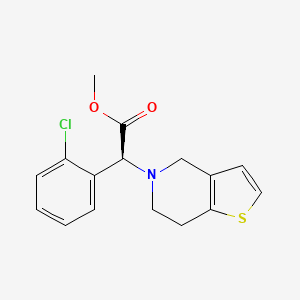
| Formula | C16H16ClNO2S |
|---|---|
| Molecular weight | 321.83 g/mol |
| IUPAC name | methyl (2S)-2-(2-chlorophenyl)-2-(6,7-dihydro-4H-thieno[3,2-c]pyridin-5-yl)acetate |
| CAS | 113665-84-2 |
| PubChem CID | 60606 |
| InChIKey | GKTWGGQPFAXNFI-HNNXBMFYSA-N |
| logP | 3.67 (XLogP 3.8) |
| Polar surface area | 29.54 Ų |
| H-bond acceptors / donors | 4 / 0 |
| Drug-likeness (QED) | 0.81 |
| Lipinski violations | 0 |
SMILES
COC(=O)[C@H](c1ccccc1Cl)N1CCc2sccc2C1Biology & Pharmacokinetics
Pharmacokinetics
| BBB penetrant | No |
|---|
Enzyme interactions
| Enzyme | Role | Detail |
|---|---|---|
| CYP | Substrate | — |
| CYP1A2 | Inhibitor | — |
| CYP1A2 | Substrate | — |
| CYP2B6 | Inhibitor | Ki 0.6502957234256936 µM |
| CYP2B6 | Substrate | — |
| CYP2C19 | Inhibitor | Ki 14.299999999999986 µM |
| CYP2C19 | Substrate | — |
| CYP2C8 | Inhibitor | — |
| CYP2C9 | Inhibitor | — |
| CYP2C9 | Substrate | — |
| CYP2D6 | Inhibitor | — |
| CYP2D6 | Substrate | — |
| CYP3A4 | Inhibitor | — |
| CYP3A4 | Substrate | — |
Transporters
BCRP (Inhibitor)BCRP (Inhibitor)BSEP (Inhibitor)MRP1 (Inhibitor)OATP1B1 (Inhibitor)OATP1B1 (Inhibitor)OATP1B3 (Inhibitor)OATP1B3 (Inhibitor)P-gp (Inhibitor)MDR1 (Substrate)P-gp (Substrate)
Drug–drug interactions (100+, DDInter)
| Interacting drug | Severity | Management |
|---|---|---|
| Abciximab | major | |
| Acalabrutinib | major | |
| Anisindione | major | |
| Apixaban | major | |
| Ardeparin | major | |
| Argatroban | major | |
| Avapritinib | major | |
| Betrixaban | major | |
| Cabozantinib | major | |
| Cangrelor | major | |
| Caplacizumab | major | |
| Cobicistat | major | |
| Dalteparin | major | |
| Danaparoid | major | |
| Dasatinib | major | |
| Deferasirox | major | |
| Defibrotide | major | |
| Desirudin | major | |
| Dicoumarol | major | |
| Drotrecogin alfa | major | |
| Edoxaban | major | |
| Enoxaparin | major | |
| Eptifibatide | major | |
| Esomeprazole | major | |
| Fluconazole | major | |
| Fluoxetine | major | |
| Fluvoxamine | major | |
| Fondaparinux | major | |
| Ibritumomab tiuxetan | major | |
| Ibrutinib | major | |
| Inotersen | major | |
| Lepirudin | major | |
| Loperamide | major | |
| Mifepristone | major | |
| Omacetaxine mepesuccinate | major | |
| Omeprazole | major | |
| Ozanimod | major | |
| Panobinostat | major | |
| Pioglitazone | major | |
| Ponatinib | major |
Showing 40 of 100+.
Registered Products (21)
| Brand | Form / strength | Pack | Agent | Citizen (JOD) |
|---|---|---|---|---|
| Instaclop | Tablet 75 mg | 30 tab | Sahar Drug Store | 7.810 |
| Platloc | Tablet (as Clopidogrel bisulfate) 75 mg | 28 tab pack varies | Al-Taqqadom Pharmaceutical Industries | 7.830 |
| Clopidocor | Tablet 75 mg | 28 tab | Nabulsi Drug Store | 8.330 |
| Platloc | Tablet (as Clopidogrel bisulfate) 75 mg | 30 tab pack varies | Al-Taqqadom Pharmaceutical Industries | 8.390 |
| Thrombo 75 mg F.C Tab | Film-Coated Tablet 75 mg | 30 tab | AL-Faiasel Drug Store | 8.390 |
| Trombex 75 F.C. Tablet | Film-Coated Tablet 75 mg | 30 tab | Hayat Pharmaceutical Industries CO.PLC/JORDAN | 8.390 |
| Plagin 75mg F.C Tab | Film-Coated Tablet 75 mg | 30 tab pack varies | UNITED PHARM.MFG.CO.LTD(UPM)/JORDAN | 9.460 |
| Aggrix | Tablet 75 mg | 28 tab pack varies | MIDDLE EAST PHARMA&CHEMICAL IND/JORDAN | 10.070 |
| Antiplex Tablet | Tablet 75 mg | 30 tab pack varies | Dar Al Dawa Development and Investment Co Ltd/Jordan | 10.790 |
| Clovex | Tablet 75 (as Hydrogen Sulfate) mg | 30 tab | Jordan Sweden Medical & Sterilization Co. | 10.790 |
| Platil | Tablet (as Bisulphate)75 mg | 30 tab pack varies | Pharma International Company/ Jordan | 10.790 |
| Thrombonil | Tablet 75 mg | 30 tab pack varies | JORDAN RIVER PHARMA.IND(JORIVER)/JORDAN | 10.790 |
| PLAVIX TAB | Tablet 75 mg | 28 tab | UNITED PHARM.MFG.CO.LTD(UPM)/JORDAN | 11.190 |
| Platil | Tablet (as Bisulphate)75 mg | 60 tab pack varies | Pharma International Company/ Jordan | 20.500 |
| Platloc | Tablet (as Clopidogrel bisulfate) 75 mg | 84 tab pack varies | Al-Taqqadom Pharmaceutical Industries | 22.080 |
| Aggrix | Tablet 75 mg | 280 tab pack varies | MIDDLE EAST PHARMA&CHEMICAL IND/JORDAN | 90.630 |
| Platil | Tablet (as Bisulphate)75 mg | 500 tab pack varies | Pharma International Company/ Jordan | 156.390 |
| Antiplex Tablet | Tablet 75 mg | 500 tab pack varies | Dar Al Dawa Development and Investment Co Ltd/Jordan | 156.460 |
| Plagin 75mg F.C Tab | Film-Coated Tablet 75 mg | 500 tab pack varies | UNITED PHARM.MFG.CO.LTD(UPM)/JORDAN | 156.460 |
| Platloc | Tablet (as Clopidogrel bisulfate) 75 mg | 1050 tab pack varies | Al-Taqqadom Pharmaceutical Industries | 249.580 |
| Thrombonil | Tablet 75 mg | 1000 tab pack varies | JORDAN RIVER PHARMA.IND(JORIVER)/JORDAN | 305.720 |