Enzalutamide
JFDA label: Xtandi 40mg
Mechanism of Action
Antagonist of Androgen receptor — Androgen Receptor antagonist
| Target | Action | Gene / class |
|---|---|---|
| Androgen receptor efficacy | ANTAGONIST | AR |
Indications
Approved
- Prostate cancer, metastatic
Contraindications
Source: Lexicomp
- Additional contraindications (not in the US labeling): Hypersensitivity to enzalutamide or any component of the formulation Absolute
- women who are lactating Absolute
Adverse Reactions
Cardiac disorders (2)
Very Common hypertension · Peripheral edema
Nervous system disorders (14)
Very Common dizziness · falling · Fatigue · headache
Common altered mental status · anxiety · cauda equina syndrome · hallucination · hypoesthesia · insomnia · Myasthenia · paresthesia · restless leg syndrome · spinal cord compression
Hepatobiliary disorders (1)
Common Increased serum bilirubin
Renal and urinary disorders (2)
Common Hematuria · pollakiuria
Blood and lymphatic system disorders (2)
Very Common Neutropenia
Common Thrombocytopenia
Metabolism and nutrition disorders (3)
Very Common Hot flash · weight loss
Common Gynecomastia
Gastrointestinal disorders (5)
Very Common Constipation · decreased appetite · diarrhea · nausea
Common Dysgeusia
Skin and subcutaneous tissue disorders (2)
Common Pruritus · xeroderma
Musculoskeletal and connective tissue disorders (6)
Very Common arthralgia · back pain · musculoskeletal pain · Weakness
Common Bone fracture · stiffness
Infections and infestations (1)
Common Infection
Respiratory, thoracic and mediastinal disorders (4)
Very Common dyspnea · Upper respiratory tract infection
Common epistaxis · Lower respiratory tract infection
Dosing
Source: Lexicomp
Warnings & Precautions
Source: Lexicomp
Posterior reversible encephalopathy syndrome
Posterior reversible encephalopathy syndrome (PRES) has been reported in patients receiving enzalutamide. PRES is a neurological disorder which may present with rapidly evolving symptoms (headache, seizure, lethargy, confusion, blindness, and other visual/neurologic disturbances) with or without associated hypertension. PRES diagnosis may be confirmed with magnetic resonance imagining (MRI). Discontinue enzalutamide in patients who develop PRES.
Seizures
Seizures were observed in clinical trials; patients with predisposing risk factors for seizures were generally excluded from these studies. The onset of seizure ranged from ~1 to 20 months after treatment initiation. Enzalutamide was permanently discontinued in patients experiencing seizures; seizures resolved upon therapy cessation. In a study designed to assess seizure risk in patients with predisposing factors, 2.2% of patients who received enzalutamide experienced a seizure; after the first seizure resolved, a few of those patients experienced a second seizure with continued enzalutamide treatment. It is not known if antiepileptic medications can prevent enzalutamide-related seizures. Patients in the study had one or more predisposing factors, including the use of concomitant medications that may lower the seizure threshold, history of traumatic brain or head injury, history of cerebrovascular accident/transient ischemic attack, and Alzheimer disease, meningioma, or leptomeningeal disease from prostate cancer, unexplained loss of consciousness within the last 12 months, prior seizure history, presence of a space occupying brain lesion, history of arteriovenous malformation, or history of brain infection; some patients had more than one risk factor. Advise patients of the risk of seizures during enzalutamide treatment and of the risk of engaging in activities where sudden loss of consciousness could cause serious harm to themselves or others. Discontinue enzalutamide perma
Spermatogenesis
May cause hypospermatogenesis; may impair male fertility. Disease-related concerns:
Cardiovascular disease
Androgen-deprivation therapy may increase the risk for cardiovascular disease (Levine 2010). An increase in systolic and diastolic blood pressures has been observed (Scher 2012); may worsen preexisting hypertension. Concurrent drug therapy issues:
Drug-drug interactions
Potentially significant interactions may exist, requiring dose or frequency adjustment, additional monitoring, and/or selection of alternative therapy. Consult drug interactions database for more detailed information. Dosage forms specific issues:
Sorbitol
May contain sorbitol.
Pregnancy & Lactation
Pregnancy
Enzalutamide is contraindicated in pregnant women and is not indicated for use in women. Adverse effects were observed in animal reproduction studies. Enzalutamide is an androgen receptor inhibitor; based on the mechanism of action, fetal harm and potential loss of pregnancy would be expected. Male patients with female partners of reproductive potential should use effective contraception during treatment and for 3 months after the last enzalutamide dose and should use a condom if having intercourse with a pregnant woman. May impair male fertility.
Lactation
Enzalutamide is not indicated for use in women.
Monitoring
| Clinical pearl | Monitor for signs/symptoms of seizure, loss of consciousness, dizziness, and hallucinations; CBC with differential and liver function tests (baseline and periodic); additional INR monitoring (if on warfarin); blood pressure (baseline and periodic), signs/symptoms of posterior reversible encephalopathy syndrome. Monitor adherence. |
|---|
Chemistry & Properties
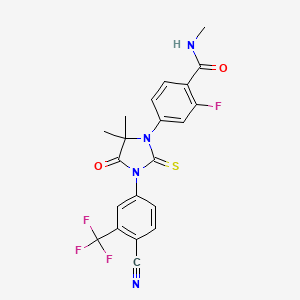
| Formula | C21H16F4N4O2S |
|---|---|
| Molecular weight | 464.44 g/mol |
| IUPAC name | 4-[3-[4-cyano-3-(trifluoromethyl)phenyl]-5,5-dimethyl-4-oxo-2-sulfanylideneimidazolidin-1-yl]-2-fluoro-N-methylbenzamide |
| CAS | 915087-33-1 |
| PubChem CID | 15951529 |
| InChIKey | WXCXUHSOUPDCQV-UHFFFAOYSA-N |
| logP | 3.99 (XLogP 3.6) |
| Polar surface area | 76.44 Ų |
| H-bond acceptors / donors | 4 / 1 |
| Drug-likeness (QED) | 0.55 |
| Lipinski violations | 0 |
SMILES
CNC(=O)c1ccc(N2C(=S)N(c3ccc(C#N)c(C(F)(F)F)c3)C(=O)C2(C)C)cc1FBiology & Pharmacokinetics
Pharmacokinetics predicted
| Bioavailability | 10.0% |
|---|---|
| Half-life | 0.867 h |
| Volume of distribution | 1.186 L/kg |
| Protein binding | 96.4% |
| BBB penetrant | No |
Enzyme interactions
| Enzyme | Role | Detail |
|---|---|---|
| CYP1A2 | Substrate | — |
| CYP2C19 | Inhibitor | — |
| CYP2C19 | Substrate | — |
| CYP2C8 | Inhibitor | — |
| CYP2C9 | Inhibitor | — |
| CYP3A4 | Substrate | — |
Receptor binding (top 1)
| Target | Action | Affinity |
|---|---|---|
| Androgen receptor (AR) | Antagonist | pIC50 7.4 |
Transporters
BCRP (Inhibitor)BCRP (Inhibitor)BSEP (Inhibitor)MDR1 (Inhibitor)MRP1 (Inhibitor)MRP2 (Inhibitor)OAT3 (Inhibitor)OATP1B1 (Inhibitor)OATP1B1 (Inhibitor)OATP1B3 (Inhibitor)OATP1B3 (Inhibitor)OCT1 (Inhibitor)OCT2 (Inhibitor)P-gp (Inhibitor)BCRP (Substrate)MDR1 (Substrate)OAT1 (Substrate)OATP1B1 (Substrate)OATP1B3 (Substrate)P-gp (Substrate)
Drug–drug interactions (100+, DDInter)
| Interacting drug | Severity | Management |
|---|---|---|
| Abemaciclib | major | |
| Abiraterone | major | |
| Acalabrutinib | major | |
| Alpelisib | major | |
| Amiodarone | major | |
| Amisulpride | major | |
| Amlodipine | major | |
| Anagrelide | major | |
| Apixaban | major | |
| Apremilast | major | |
| Arsenic trioxide | major | |
| Artemether | major | |
| Avapritinib | major | |
| Avatrombopag | major | |
| Axitinib | major | |
| Bedaquiline | major | |
| Benzhydrocodone | major | |
| Bepridil | major | |
| Bictegravir | major | |
| Boceprevir | major | |
| Bortezomib | major | |
| Bosutinib | major | |
| Brigatinib | major | |
| Bupropion | major | |
| Buspirone | major | |
| Butorphanol | major | |
| Cabozantinib | major | |
| Capmatinib | major | |
| Ceritinib | major | |
| Cisapride | major | |
| Citalopram | major | |
| Clozapine | major | |
| Cobicistat | major | |
| Cobimetinib | major | |
| Copanlisib | major | |
| Crizotinib | major | |
| Daclatasvir | major | |
| Darolutamide | major | |
| Dasatinib | major | |
| Deflazacort | major |
Showing 40 of 100+.
Registered Products (4)
| Brand | Form / strength | Pack | Agent | Citizen (JOD) |
|---|---|---|---|---|
| Xtandi | Tablet 40 mg | 112 tab | Ibn Rushd Drug Store | — |
| Xylutide | Capsule 40 mg | 120 cap | شركة مستودع ادوية جرينلاند | — |
| Zaltrone | Tablet Enzalutamide 80 mg | 60 tab | Hikma Pharmaceuticals Amman-Jordan | — |
| Zaltrone | Tablet Enzalutamide 40 mg | 120 tab | Hikma Pharmaceuticals Amman-Jordan | — |