Esmolol
JFDA label: Esobloc 100mg/10ml
Mechanism of Action
Class II antiarrhythmic: Competitively blocks response to beta1-adrenergic stimulation with little or no effect of beta2-receptors except at high doses, no intrinsic sympathomimetic activity, no membrane stabilizing activity
Indications
Approved
- Intraoperative and postoperative tachycardia and/or hypertension
- Noncompensatory sinus tachycardia
- Supraventricular tachycardia (SVT)
Off-label
- Acute coronary syndromes (arrhythmia/rate control)
- Cardiogenic shock
- Electroconvulsive therapy (attenuation of adrenergic response)
- Hypertensive emergencies
- Intubation (attenuation of adrenergic response)
- Thyroid storm or thyrotoxicosis
- Thyrotoxicosis
Contraindications
Source: Lexicomp
- Additional contraindications (not in US labeling): Patients requiring inotropic agents and/or vasopressors to maintain cardiac output and systolic blood pressure Absolute
- Hypersensitivity to esmolol or any component of the formulation Absolute
- IV administration of calcium channel blockers (eg, verapamil) in close proximity to esmolol (ie, while effects of other drug are still present) Absolute
- cardiogenic shock Absolute
- decompensated heart failure Absolute
- heart block greater than first degree (except in patients with a functioning artificial ventricular pacemaker) Absolute
- hypotension Absolute
- pulmonary hypertension Absolute
- right ventricular failure secondary to pulmonary hypertension Absolute
- severe sinus bradycardia Absolute
- sick sinus syndrome Absolute
- untreated pheochromocytoma Absolute
Adverse Reactions
Cardiac disorders (1)
Common Peripheral ischemia
Nervous system disorders (5)
Common agitation · confusion · Dizziness · drowsiness · headache
Gastrointestinal disorders (2)
Common Nausea · vomiting
General disorders and administration site conditions (1)
Common Infusion site reaction
Other (3)
Very Common asymptomatic hypotension · Cardiovascular: Decreased blood pressure · symptomatic hypotension
Dosing
Source: Lexicomp
Warnings & Precautions
Source: Lexicomp
Anaphylactic reactions
Use caution with history of severe anaphylaxis to allergens; patients taking beta-blockers may become more sensitive to repeated challenges. Treatment of anaphylaxis (eg, epinephrine) in patients taking beta-blockers may be ineffective or promote undesirable effects.
Extravasation
Vesicant; ensure proper needle or catheter placement prior to and during infusion. Avoid extravasation. Extravasation can lead to skin necrosis and sloughing; avoid infusions into small veins or through a butterfly catheter.
Hyperkalemia
Esmolol has been associated with elevations in serum potassium and development of hyperkalemia especially in patients with risk factors (eg, renal impairment); monitor serum potassium during therapy.
Hypotension
Can commonly occur; patients need close blood pressure monitoring. If an unacceptable drop in blood pressure occurs, reduction in dose or discontinuation may reverse hypotension (usually within 30 minutes). Disease-related concerns:
Bronchospastic disease
In general, patients with bronchospastic disease should not receive beta-blockers; however, esmolol, with B1 selectivity, has been used cautiously with close monitoring.
Conduction abnormality
Can cause bradycardia including sinus pause, heart block, severe bradycardia, and cardiac arrest. Consider preexisting conditions such as first degree AV block, sick sinus syndrome, or other conduction disorders before initiating; use is contraindicated in patients with sick sinus syndrome or second- or third-degree AV block (except in patients with a functioning artificial ventricular pacemaker).
Diabetes
Use with caution in patients with diabetes mellitus; may potentiate hypoglycemia and/or mask signs and symptoms.
Heart failure (HF)
Use with caution in patients with compensated heart failure and monitor for a worsening of the condition. Use is contraindicated in patients with decompensated heart failure.
Myasthenia gravis
Use with caution in patients with myasthenia gravis.
Peripheral vascular disease (PVD) and Raynaud's disease
Can precipitate or aggravate symptoms of arterial insufficiency in patients with PVD and Raynaud's disease. Use with caution and monitor for progression of arterial obstruction.
Pheochromocytoma (untreated)
Adequate alpha-blockade is required prior to use of any beta-blocker.
Renal impairment
Use with caution in patients with renal impairment; active metabolite retained.
Thyroid disease
May mask signs of hyperthyroidism (eg, tachycardia). If hyperthyroidism is suspected, carefully manage and monitor; abrupt withdrawal may exacerbate symptoms of hyperthyroidism or precipitate thyroid storm. Concurrent drug therapy issues:
Calcium channel blockers
Use with caution in patients on concurrent verapamil or diltiazem; bradycardia or heart block can occur (may be fatal). Use is contraindicated when IV calcium channel blockers have been administered in close proximity to esmolol (ie, while effects of other drug are still present).
Cardiac glycosides
Use with caution in patients receiving digoxin; bradycardia or heart block can occur. Special populations:
Elderly
Bradycardia may be observed more frequently in elderly patients (>65 years of age); dosage reductions may be necessary. Other warnings/precautions:
Abrupt withdrawal
Beta-blocker therapy should not be withdrawn abruptly (particularly in patients with CAD), but gradually tapered to avoid acute tachycardia, hypertension, and/or ischemia. Severe exacerbation of angina, ventricular arrhythmias, and myocardial infarction (MI) have been reported following abrupt withdrawal of beta-blocker therapy. Temporary but prompt resumption of beta-blocker therapy may be indicated with worsening of angina or acute coronary insufficiency.
Hypertension associated with hypothermia
Use esmolol with caution in patients with hypertension associated with hypothermia; monitor vital signs closely and titrate esmolol slowly.
Hypovolemic patients
Avoid use in patients with hypovolemia; treat hypovolemia first, otherwise, use of esmolol may attenuate reflex tachycardia and further increase the risk of hypotension.
Pregnancy & Lactation
Pregnancy
Adverse events were observed in some animal reproduction studies. Esmolol has been shown to cause fetal bradycardia. Adverse fetal/neonatal events have also been observed with the chronic use of beta-blockers during pregnancy; however, esmolol is a short-acting beta-blocker and not indicated for chronic use. Esmolol is approved for the treatment of supraventricular tachycardia (SVT); however, other agents are preferred in pregnant women (ACC/AHA/HRS [Page 2015]).
Lactation
It is not known if esmolol is present in breast milk. Due to the potential for serious adverse reactions in the breastfeeding infant, the manufacturer recommends a decision be made whether to discontinue breastfeeding or to discontinue the drug, taking into account the importance of treatment to the mother. The short half-life and the fact that it is not intended for chronic use should limit any potential exposure to the breastfeeding infant.
Monitoring
| Clinical pearl | Blood pressure, MAP, heart rate, continuous ECG, respiratory rate, IV site; serum potassium (especially with renal impairment); consult individual institutional policies and procedures |
|---|
Chemistry & Properties
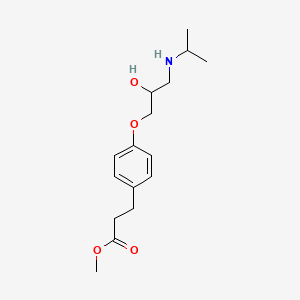
| Formula | C16H25NO4 |
|---|---|
| Molecular weight | 295.38 g/mol |
| IUPAC name | methyl 3-[4-[2-hydroxy-3-(propan-2-ylamino)propoxy]phenyl]propanoate |
| CAS | 81147-92-4 |
| PubChem CID | 59768 |
| InChIKey | AQNDDEOPVVGCPG-UHFFFAOYSA-N |
| logP | 1.53 (XLogP 1.9) |
| Polar surface area | 67.79 Ų |
| H-bond acceptors / donors | 5 / 2 |
| Drug-likeness (QED) | 0.68 |
| Lipinski violations | 0 |
SMILES
COC(=O)CCc1ccc(OCC(O)CNC(C)C)cc1Biology & Pharmacokinetics
Pharmacokinetics predicted
| Bioavailability | 70.0% |
|---|---|
| Half-life | 1.294 h |
| Volume of distribution | 1.349 L/kg |
| Protein binding | 44.7% |
| BBB penetrant | No |
Enzyme interactions
| Enzyme | Role | Detail |
|---|---|---|
| CYP1A2 | Substrate | — |
| CYP2C19 | Substrate | — |
| CYP2D6 | Substrate | — |
| CYP3A4 | Substrate | — |
Transporters
BCRP (Inhibitor)BSEP (Inhibitor)MATE1 (Inhibitor)MRP1 (Inhibitor)OATP1B1 (Inhibitor)OATP1B3 (Inhibitor)OCT1 (Inhibitor)P-gp (Inhibitor)P-gp (Substrate)
Drug–drug interactions (100+, DDInter)
| Interacting drug | Severity | Management |
|---|---|---|
| Aminophylline | major | |
| Ceritinib | major | |
| Dolasetron | major | |
| Dyphylline | major | |
| Fingolimod | major | |
| Methacholine | major | |
| Oxtriphylline | major | |
| Siponimod | major | |
| Theophylline | major | |
| Acetohexamide | moderate | |
| Aldesleukin | moderate | |
| Alectinib | moderate | |
| Alimemazine | moderate | |
| Amifostine | moderate | |
| Brigatinib | moderate | |
| Brimonidine (ophthalmic) | moderate | |
| Brimonidine (topical) | moderate | |
| Bupropion | moderate | |
| Canagliflozin | moderate | |
| Chlorphenesin | moderate | |
| Chlorpropamide | moderate | |
| Cimetidine | moderate | |
| Codeine | moderate | |
| Crizotinib | moderate | |
| Dapagliflozin | moderate | |
| Diatrizoate | moderate | |
| Diclofenac | moderate | |
| Diphenhydramine | moderate | |
| Doxepin | moderate | |
| Doxepin (topical) | moderate | |
| Dronabinol | moderate | |
| Empagliflozin | moderate | |
| Ephedrine | moderate | |
| Epinephrine | moderate | |
| Epoprostenol | moderate | |
| Ertugliflozin | moderate | |
| Ethanol | moderate | |
| Flurbiprofen | moderate | |
| Formoterol | moderate | |
| Gadobenic acid | moderate |
Showing 40 of 100+.
Registered Products (2)
| Brand | Form / strength | Pack | Agent | Citizen (JOD) |
|---|---|---|---|---|
| Esobloc | Vial 100 mg/10 ml | 1 vial | Hikma Pharmaceuticals Co.Ltd/Jordan | — |
| Pol-esmolol | Infusion 10 mg/ml | 250 ml | JAWEDA INT. DRUD STORE | — |