Famotidine
JFDA label: Famodar ABR Tablets
Mechanism of Action
Antagonist of Histamine H2 receptor — Histamine H2 receptor antagonist
| Target | Action | Gene / class |
|---|---|---|
| Histamine H2 receptor efficacy | ANTAGONIST | HRH2 |
Indications
Approved
- Duodenal ulcer
- Gastric ulcer
- Gastroesophageal reflux disease
- Heartburn (OTC only)
- Pathological hypersecretory conditions
Off-label
- Gastritis (symptomatic relief)
- Reducing gastrointestinal risks of NSAIDs and antiplatelet therapies
- Refractory urticaria, treatment
- Stress ulcer prophylaxis in critically-ill patients
Contraindications
Source: Lexicomp
- Hypersensitivity to famotidine, other H2 antagonists, or any component of the formulation OTC labeling: When used for self-medication (OTC), do not use if trouble or pain when swallowing food, vomiting with blood, or bloody or black stools Absolute
- allergic to other acid reducers Absolute
- coadministration with other acid reducers Absolute
- renal impairment Absolute
Adverse Reactions
Nervous system disorders (3)
Very Common Agitation (Gastrointestinal: Vomiting (1% to 10%: · dizziness · Headache
Gastrointestinal disorders (3)
Very Common constipation · Diarrhea · necrotizing enterocolitis (very low birth weight neonates; Guillet 2006)
Dosing
Source: Lexicomp
Warnings & Precautions
Source: Lexicomp
ECG changes
Prolonged QT interval has been reported in patients with renal dysfunction. The FDA has received reports of torsades de pointes occurring with famotidine (Poluzzi 2009).
Vitamin B12 deficiency
Prolonged treatment (≥2 years) may lead to vitamin B12 malabsorption and subsequent vitamin B12 deficiency. The magnitude of the deficiency is dose-related and the association is stronger in females and those younger in age ( Disease-related concerns:
Gastric malignancy
Relief of symptoms does not preclude the presence of a gastric malignancy.
Renal impairment
Use with caution in patients with moderate to severe renal impairment (CrCl Concurrent drug therapy issues:
Drug-drug interactions
Potentially significant interactions may exist, requiring dose or frequency adjustment, additional monitoring, and/or selection of alternative therapy. Consult drug interactions database for more detailed information. Special populations:
Pediatric
Use of gastric acid inhibitors, including proton pump inhibitors and H2 blockers, has been associated with an increased risk for development of acute gastroenteritis and community-acquired pneumonia in pediatric patients (Canani 2006). Dosage form specific issues:
Benzyl alcohol and derivatives
Some dosage forms may contain benzyl alcohol and/or sodium benzoate/benzoic acid; benzoic acid (benzoate) is a metabolite of benzyl alcohol; large amounts of benzyl alcohol (≥99 mg/kg/day) have been associated with a potentially fatal toxicity (“gasping syndrome”) in neonates; the “gasping syndrome” consists of metabolic acidosis, respiratory distress, gasping respirations, CNS dysfunction (including convulsions, intracranial hemorrhage), hypotension, and cardiovascular collapse (AAP ["Inactive" 1997]; CDC 1982); some data suggests that benzoate displaces bilirubin from protein binding sites (Ahlfors 2001); avoid or use dosage forms containing benzyl alcohol and/or benzyl alcohol derivative with caution in neonates. See manufacturer’s labeling. Other warnings/precautions:
OTC labeling
When used for self-medication (OTC), notify health care provider before use if any of the following are present: Frequent chest pain; frequent wheezing particularly with heartburn; nausea/vomiting; unexplained weight loss; stomach pain; heartburn >3 months; heartburn with light-headedness, sweating, or dizziness; chest pain or shoulder pain with shortness of breath; sweating; pain that spreads to arms, neck, or shoulders; light-headedness. Discontinue use and notify health care provider if heartburn continues or worsens, or if use is required >14 days.
Pregnancy & Lactation
Pregnancy
Adverse events have not been observed in animal reproduction studies. Famotidine crosses the placenta (Wang 2013). Due to pregnancy-induced physiologic changes, renal clearance of famotidine may be increased (Wang 2011). Histamine H2 antagonists have been evaluated for the treatment of gastroesophageal reflux disease (GERD) during pregnancy. Agents other than famotidine may be preferred for initial therapy (Richter 2005; van der Woude 2014). Histamine H2 antagonists may be used for aspiration prophylaxis prior to cesarean delivery (ASA 2016).
Lactation
Famotidine is present in breast milk. The relative infant dose (RID) of famotidine is 2.2% when calculated using the highest breast milk concentration located and compared to an infant therapeutic dose of 0.5 mg/kg/day. In general, breastfeeding is considered acceptable when the RID of a medication is The RID of famotidine was calculated using a milk concentration of 0.072 mcg/mL, providing an estimated daily infant dose via breast milk of 0.011 mg/kg/day. This milk concentration was obtaine
Monitoring
| Clinical pearl | CBC, gastric pH, occult blood with GI bleeding |
|---|
Chemistry & Properties
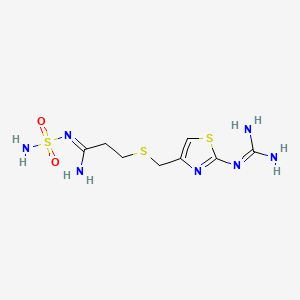
| Formula | C8H15N7O2S3 |
|---|---|
| Molecular weight | 337.46 g/mol |
| IUPAC name | 3-[[2-(diaminomethylideneamino)-1,3-thiazol-4-yl]methylsulfanyl]-N'-sulfamoylpropanimidamide |
| CAS | 76824-35-6 |
| PubChem CID | 5702160 |
| InChIKey | XUFQPHANEAPEMJ-UHFFFAOYSA-N |
| logP | -0.77 (XLogP -0.6) |
| Polar surface area | 175.83 Ų |
| H-bond acceptors / donors | 6 / 4 |
| Drug-likeness (QED) | 0.29 |
| Lipinski violations | 0 |
SMILES
NC(N)=Nc1nc(CSCC/C(N)=N/S(N)(=O)=O)cs1Biology & Pharmacokinetics
Pharmacokinetics predicted
| Bioavailability | 10.0% |
|---|---|
| Half-life | 1.071 h |
| Volume of distribution | 1.326 L/kg |
| Protein binding | 24.3% |
| BBB penetrant | Yes |
Enzyme interactions
| Enzyme | Role | Detail |
|---|---|---|
| CYP3A4 | Substrate | — |
Transporters
ASBT (Inhibitor)BCRP (Inhibitor)BSEP (Inhibitor)BSEP (Inhibitor)MATE1 (Inhibitor)MATE2 (Inhibitor)MRP1 (Inhibitor)MRP2 (Inhibitor)MRP3 (Inhibitor)MRP4 (Inhibitor)NTCP (Inhibitor)OAT1 (Inhibitor)OAT3 (Inhibitor)OATP1B1 (Inhibitor)OATP1B1 (Inhibitor)OATP1B3 (Inhibitor)OATP1B3 (Inhibitor)OCT1 (Inhibitor)OCT2 (Inhibitor)OCT3 (Inhibitor)OCTN2 (Inhibitor)P-gp (Inhibitor)MDR1 (Substrate)OAT (Substrate)OAT1 (Substrate)OAT3 (Substrate)OCT2 (Substrate)P-gp (Substrate)
Drug–drug interactions (100+, DDInter)
| Interacting drug | Severity | Management |
|---|---|---|
| Atazanavir | major | |
| Dasatinib | major | |
| Neratinib | major | |
| Ozanimod | major | |
| Pazopanib | major | |
| Rilpivirine | major | |
| Selpercatinib | major | |
| Siponimod | major | |
| Tizanidine | major | |
| Abarelix | moderate | |
| Abiraterone | moderate | |
| Acalabrutinib | moderate | |
| Acetohexamide | moderate | |
| Adenosine | moderate | |
| Alfuzosin | moderate | |
| Alimemazine | moderate | |
| Aminophylline | moderate | |
| Amiodarone | moderate | |
| Amisulpride | moderate | |
| Amitriptyline | moderate | |
| Amoxapine | moderate | |
| Anagrelide | moderate | |
| Apalutamide | moderate | |
| Apomorphine | moderate | |
| Arformoterol | moderate | |
| Aripiprazole | moderate | |
| Arsenic trioxide | moderate | |
| Asenapine | moderate | |
| Astemizole | moderate | |
| Atomoxetine | moderate | |
| Azithromycin | moderate | |
| Bacampicillin | moderate | |
| Bedaquiline | moderate | |
| Bepridil | moderate | |
| Bicalutamide | moderate | |
| Bosutinib | moderate | |
| Brigatinib | moderate | |
| Buprenorphine | moderate | |
| Cefditoren | moderate | |
| Cefpodoxime | moderate |
Showing 40 of 100+.
Registered Products (35)
| Brand | Form / strength | Pack | Agent | Citizen (JOD) |
|---|---|---|---|---|
| Acifam F.C Tablets | Film-Coated Tablet 10 mg | 10 tab pack varies | MIDDLE EAST PHARMA&CHEMICAL IND/JORDAN | 1.220 |
| Gastrifam F.C. Tab | Film-Coated Tablet 10 mg | 10 tab | Hayat Pharmaceutical Industries CO.PLC/JORDAN | 1.220 |
| Famodar ABR Tablets | Tablet 10 mg | 10 tab pack varies | Dar Al Dawa Development and Investment Co Ltd/Jordan | 1.250 |
| Acifam F.C Tablets | Film-Coated Tablet 20 mg | 20 tab pack varies | MIDDLE EAST PHARMA&CHEMICAL IND/JORDAN | 2.830 |
| Gastrifam FC Tab | Film-Coated Tablet 20 mg | 20 tab pack varies | Hayat Pharmaceutical Industries CO.PLC/JORDAN | 2.830 |
| Gastrifam FC Tab | Film-Coated Tablet 40 mg | 10 tab pack varies | Hayat Pharmaceutical Industries CO.PLC/JORDAN | 2.830 |
| Acifam F.C Tablets | Film-Coated Tablet 40 mg | 10 tab pack varies | MIDDLE EAST PHARMA&CHEMICAL IND/JORDAN | 3.600 |
| Amodine | Tablet 40 mg | 10 tab | THE JORDANIAN PHARMACEUTICAL MANUFACTURING COMPANY/JORDAN | 3.600 |
| ULCERAN TAB | Tablet 40 mg | 10 tab | Khoury Drug Store | 4.060 |
| ULCERAN TAB | Tablet 20 mg | 20 tab | Khoury Drug Store | 4.060 |
| Amodine | Tablet 20 mg | 30 tab | THE JORDANIAN PHARMACEUTICAL MANUFACTURING COMPANY/JORDAN | 4.250 |
| Famodar 20 Tablet | Tablet 20 mg | 20 tab pack varies | Dar Al Dawa Development and Investment Co Ltd/Jordan | 4.500 |
| Famodar Tablet | Tablet 40 mg | 10 tab pack varies | Dar Al Dawa Development and Investment Co Ltd/Jordan | 4.500 |
| Peptifam 20 F.C Tablets | Film-Coated Tablet 20 mg | 20 tab pack varies | UNITED PHARM.MFG.CO.LTD(UPM)/JORDAN | 4.500 |
| Peptifam 40 F.CTablets | Film-Coated Tablet 40 mg | 10 tab | UNITED PHARM.MFG.CO.LTD(UPM)/JORDAN | 4.500 |
| Famodar 20 Tablet | Tablet 20 mg | 30 tab pack varies | Dar Al Dawa Development and Investment Co Ltd/Jordan | 6.750 |
| Gastrifam FC Tab | Film-Coated Tablet 40 mg | 30 tab pack varies | Hayat Pharmaceutical Industries CO.PLC/JORDAN | 7.980 |
| Famodar ABR Tablets | Tablet 10 mg | 400 tab pack varies | Dar Al Dawa Development and Investment Co Ltd/Jordan | 42.500 |
| Acifam F.C Tablets | Film-Coated Tablet 10 mg | 500 tab pack varies | MIDDLE EAST PHARMA&CHEMICAL IND/JORDAN | 46.360 |
| Acifam F.C Tablets | Film-Coated Tablet 20 mg | 500 tab pack varies | MIDDLE EAST PHARMA&CHEMICAL IND/JORDAN | 58.020 |
| Gastrifam FC Tab | Film-Coated Tablet 20 mg | 500 tab pack varies | Hayat Pharmaceutical Industries CO.PLC/JORDAN | 60.140 |
| Famodar 20 Tablet | Tablet 20 mg | 400 tab pack varies | Dar Al Dawa Development and Investment Co Ltd/Jordan | 76.500 |
| Gastrifam FC Tab | Film-Coated Tablet 40 mg | 480 tab pack varies | Hayat Pharmaceutical Industries CO.PLC/JORDAN | 92.330 |
| Famodar 20 Tablet | Tablet 20 mg | 500 tab pack varies | Dar Al Dawa Development and Investment Co Ltd/Jordan | 95.630 |
| Acifam F.C Tablets | Film-Coated Tablet 20 mg | 1000 tab pack varies | MIDDLE EAST PHARMA&CHEMICAL IND/JORDAN | 110.240 |
| Gastrifam FC Tab | Film-Coated Tablet 40 mg | 500 tab pack varies | Hayat Pharmaceutical Industries CO.PLC/JORDAN | 120.280 |
| Acifam F.C Tablets | Film-Coated Tablet 40 mg | 500 tab pack varies | MIDDLE EAST PHARMA&CHEMICAL IND/JORDAN | 136.800 |
| Famodar Tablet | Tablet 40 mg | 400 tab pack varies | Dar Al Dawa Development and Investment Co Ltd/Jordan | 153.000 |
| FAMODAR 40 TAB. | Tablet 40 mg | 500 tab | Dar Al Dawa Development and Investment Co Ltd/Jordan | 171.000 |
| Peptifam 20 F.C Tablets | Film-Coated Tablet 20 mg | 1000 tab pack varies | UNITED PHARM.MFG.CO.LTD(UPM)/JORDAN | 171.000 |
| Gastrifam FC Tab | Film-Coated Tablet 40 mg | 1000 tab pack varies | Hayat Pharmaceutical Industries CO.PLC/JORDAN | 240.550 |
| Acifam F.C Tablets | Film-Coated Tablet 40 mg | 1000 tab pack varies | MIDDLE EAST PHARMA&CHEMICAL IND/JORDAN | 259.920 |
| Peptifam 40 F.C Tablets | Film-Coated Tablet 40 mg | 1000 tab | UNITED PHARM.MFG.CO.LTD(UPM)/JORDAN | 342.000 |
| Gastrifam FC Tab | Film-Coated Tablet 40 mg | 1440 tab pack varies | Hayat Pharmaceutical Industries CO.PLC/JORDAN | 346.390 |
| Famodine | Ampoule 20 mg/2 ml | 5 amp | Hikma Pharmaceuticals Co.Ltd/Jordan | — |