Fenofibrate
Active form: Fenofibric Acid.
JFDA label: Lipanthyl
Mechanism of Action
Agonist of Peroxisome proliferator-activated receptor alpha — Peroxisome proliferator-activated receptor alpha agonist
| Target | Action | Gene / class |
|---|---|---|
| Peroxisome proliferator-activated receptor alpha efficacy | AGONIST | PPARA |
Indications
Approved
- Hypercholesterolemia or mixed dyslipidemia
- Hypertriglyceridemia
Contraindications
Source: Lexicomp
- Additional contraindications (not in US labeling): Pregnancy Absolute
- Hypersensitivity to fenofibrate or fenofibric acid or any component of the formulation Absolute
- active liver disease, including primary biliary cirrhosis and unexplained, persistent liver function abnormality Absolute
- breastfeeding Documentation of allergenic cross-reactivity for fibrates is limited. However, because of similarities in chemical structure and/or pharmacologic actions, the possibility of cross-sensitivity cannot be ruled out with certainty Absolute
- chronic or acute pancreatitis Absolute
- known photoallergy or phototoxic reaction during treatment with fibrates or ketoprofen Lipidil EZ, Lipidil Supra: Additional contraindications: Allergy to soya lecithin, peanut or arachis oil, or related products Absolute
- preexisting gallbladder disease Absolute
- severe renal impairment or end-stage renal disease (ESRD), including those receiving dialysis Absolute
Adverse Reactions
Cardiac disorders (2)
Not Known Pulmonary embolism · thrombophlebitis
Nervous system disorders (2)
Not Known dizziness · Pain
Hepatobiliary disorders (6)
Not Known abnormal hepatic function tests · cholestatic hepatitis · chronic active hepatitis · hepatocellular hepatitis · Increased serum ALT · increased serum AST
Blood and lymphatic system disorders (5)
Not Known Agranulocytosis · decreased hematocrit (acute; levels stabilize with chronic therapy) · decreased hemoglobin (acute; levels stabilize with chronic therapy) · decreased white blood cell count (acute; levels stabilize with chronic therapy) · thrombocytopenia
Gastrointestinal disorders (5)
Not Known Abdominal pain · cholecystitis · constipation · diarrhea · dyspepsia
Skin and subcutaneous tissue disorders (4)
Not Known Skin rash · Stevens-Johnson syndrome · toxic epidermal necrolysis · urticaria
Musculoskeletal and connective tissue disorders (5)
Not Known Arthralgia · increased creatine phosphokinase · limb pain · myalgia · myopathy
Respiratory, thoracic and mediastinal disorders (4)
Not Known Nasopharyngitis · rhinitis · sinusitis · upper respiratory tract infection
Dosing
Source: Lexicomp
Warnings & Precautions
Source: Lexicomp
Cholelithiasis
May cause cholelithiasis; discontinue if gallstones are found upon gallbladder studies.
HDL cholesterol (HDL-C)
A paradoxical, severe, and reversible decrease in HDL-C (as low as 2 mg/dL) with a simultaneous decrease in apolipoprotein A1 has been reported within 2 weeks to years after initiation of fibrate therapy; clinical significance unknown. Monitor HDL-C within a few months of initiation of therapy and discontinue if HDL-C becomes severely depressed; do not restart therapy.
Hematologic effects
May cause mild-to-moderate decreases in hemoglobin, hematocrit and WBC upon initiation of therapy which usually stabilizes with long-term therapy. Agranulocytosis and thrombocytopenia have been reported. Periodic monitoring of blood counts is recommended during the first year of therapy.
Hepatic effects
Hepatic transaminases can become significantly elevated (dose-related); hepatocellular, chronic active, and cholestatic hepatitis have been reported after weeks to several years of therapy. Baseline and regular monitoring of liver function tests is required; discontinue therapy in patients whose enzyme levels persist above 3 times the upper limit of normal.
Hypersensitivity reactions
Acute hypersensitivity reactions (eg, severe skin rash, Stevens-Johnson syndrome, toxic epidermal necrolysis) have been reported.
Myopathy/rhabdomyolysis
Has been associated with rare myositis, myopathy, or rhabdomyolysis; monitor patients closely. Risk increased in the elderly, those receiving concomitant HMG-CoA reductase inhibitors or colchicine, and patients with diabetes mellitus, renal insufficiency, or hypothyroidism. Instruct patients to report unexplained muscle pain, tenderness, weakness, especially if accompanied with malaise or fever; or brown urine. Discontinue therapy in patients who develop markedly elevated CPK concentrations or if myopathy/myositis is suspected or diagnosed.
Pancreatitis
Pancreatitis has been reported with fenofibrate use; may be secondary to a failure of efficacy in patients with severe hypertriglyceridemia, medication side effect, or due to biliary tract stone or sludge formation from bile duct obstruction.
Renal effects
Increases in serum creatinine (>2 mg/dL) have been observed with use; clinical significance unknown. These elevations tend to return to baseline following discontinuation of fenofibrate. Fenofibrate has been shown to increase creatinine production (unknown mechanism) resulting in an equal increase of creatinuria thereby demonstrating that the increase does not reflect a reduction in creatinine clearance (Hottelart 2002). Monitor renal function in patients with renal impairment; consider monitoring renal function in patients with increased risk for developing renal impairment (eg, elderly and patients with diabetes).
Venous thromboembolism (VTE)
Use has been associated with pulmonary embolism (PE) and deep vein thrombosis (DVT). Use with caution in patients with risk factors for VTE. Disease-related concerns:
Cardiovascular disease
Fibric acid derivatives have not demonstrated significant efficacy in altering cardiovascular disease mortality in major clinical studies. In two large randomized controlled clinical trials, neither fenofibrate monotherapy (Keech 2005) nor the addition of fenofibrate to simvastatin (ACCORD Study Group 2010) compared to placebo were shown to reduce cardiovascular disease morbidity and mortality in patients with type 2 diabetes.
Hepatic impairment
Contraindicated in patients with active liver disease, including primary biliary cirrhosis and unexplained persistent liver function abnormalities.
Renal impairment
Use with caution in patients with mild to moderate renal impairment; dosage adjustment required. Contraindicated in patients with severe renal impairment including those receiving dialysis. Avoid use of Triglide in patients with mild or moderate renal impairment. Concurrent drug therapy issues:
Drug-drug interactions
Potentially significant interactions may exist, requiring dose or frequency adjustment, additional monitoring, and/or selection of alternative therapy. Consult drug interactions database for more detailed information.
HMG-CoA reductase inhibitors
Use caution with HMG-CoA reductase inhibitors; may lead to myopathy, rhabdomyolysis. No incremental benefit of combination therapy on cardiovascular morbidity and mortality over statin monotherapy has been established. In combination with HMG-CoA reductase inhibitors, fenofibrate is generally regarded as safer than gemfibrozil due to limited pharmacokinetic interaction with statins. Fenofibrate may be considered in patients on low- or moderate-intensity statin therapy (ie, statin therapy intended to lower LDL-C by 500 mg/dL, outweigh the potential risk for adverse effects (ACC/AHA [Stone 2013]). Special populations:
Elderly
Use with caution in the elderly; dosage adjustment may be required. Dosage form specific issues:
Peanut or arachis oil
Some products may contain peanut or arachis oil; use is contraindicated in patients with a peanut or arachis allergy for applicable formulations.
Soya lecithin
Some products may contain soya lecithin; use is contraindicated in patients with a soya lecithin allergy for applicable formulations. Other warnings/precautions:
Appropriate use
Fenofibrate is not a first- or second-line choice in patients with hypercholesterolemia; other agents may be more suitable (ACC/AHA [Stone 2013]). Secondary causes of hyperlipidemia should be ruled out prior to therapy.
Optimal response
Therapy should be withdrawn if an adequate response is not obtained after 2 to 3 months of therapy at the maximal daily dose. In patients with severe hypertriglyceridemia, the occurrence of pancreatitis may represent a failure of efficacy, a direct effect of the drug, or obstruction of the common bile duct due to biliary tract stone or sludge formation.
Pregnancy & Lactation
Pregnancy
Adverse events were observed in animal reproduction studies. Triglyceride and lipid concentrations increase during pregnancy as required for normal fetal development. When increases are greater than expected, supervised dietary intervention should be initiated. In women who develop very severe hypertriglyceridemia and are at risk for pancreatitis, use of fenofibrate beginning in the second trimester is one intervention that may be considered. Agents other than fenofibrate should be used for hypercholesterolemia (Avis 2009; Berglund 2012; Jacobson 2015; Wong 2015).
Lactation
It is not known if fenofibrate is present in breast milk. Lipids are a normal component of breast milk and the fatty acid component is required for normal infant neurologic development. Maternal diet, as well as other factors, may influence the fatty acid composition (Innis 2014). When treatment for very severe hypertriglyceridemia in breastfeeding women at risk for pancreatitis is needed, therapy with fenofibrate may be considered (Jacobson 2015). When treatment is needed for other indication
Monitoring
| Clinical pearl | Periodic blood counts during first year of therapy. Monitor lipid profile periodically. Monitor LFTs regularly and discontinue therapy if levels remain >3 times normal limits. Monitor renal function in patients with renal impairment or in those at increased risk for developing renal impairment. 2013 ACC/AHA Blood Cholesterol Guideline recommendations (ACC/AHA [Stone 2013]): Evaluate renal status at baseline, within 3 months after initiation, and every 6 months thereafter. |
|---|
Chemistry & Properties
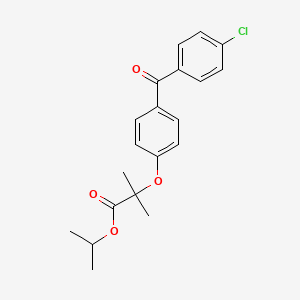
| Formula | C20H21ClO4 |
|---|---|
| Molecular weight | 360.84 g/mol |
| IUPAC name | propan-2-yl 2-[4-(4-chlorobenzoyl)phenoxy]-2-methylpropanoate |
| CAS | 49562-28-9 |
| PubChem CID | 3339 |
| InChIKey | YMTINGFKWWXKFG-UHFFFAOYSA-N |
| logP | 4.68 (XLogP 5.2) |
| Polar surface area | 52.6 Ų |
| H-bond acceptors / donors | 4 / 0 |
| Drug-likeness (QED) | 0.55 |
| Lipinski violations | 0 |
SMILES
CC(C)OC(=O)C(C)(C)Oc1ccc(C(=O)c2ccc(Cl)cc2)cc1Biology & Pharmacokinetics
Pharmacokinetics
| BBB penetrant | No |
|---|
Enzyme interactions
| Enzyme | Role | Detail |
|---|---|---|
| CYP1A2 | Inhibitor | — |
| CYP2B6 | Inhibitor | — |
| CYP2C19 | Inhibitor | — |
| CYP2C8 | Inhibitor | — |
| CYP2C9 | Inhibitor | — |
| CYP3A4 | Substrate | — |
Transporters
BCRP (Inhibitor)BCRP (Inhibitor)BSEP (Inhibitor)BSEP (Inhibitor)MDR1 (Inhibitor)MRP1 (Inhibitor)MRP2 (Inhibitor)MRP3 (Inhibitor)MRP4 (Inhibitor)NTCP (Inhibitor)OAT3 (Inhibitor)OATP1B1 (Inhibitor)OATP1B1 (Inhibitor)OATP1B3 (Inhibitor)OATP1B3 (Inhibitor)OATP2B1 (Inhibitor)OCT1 (Inhibitor)P-gp (Inhibitor)P-gp (Substrate)Transporter(unspecified) (Substrate)
Drug–drug interactions (69, DDInter)
| Interacting drug | Severity | Management |
|---|---|---|
| Dicoumarol | major | |
| Leflunomide | major | |
| Rosuvastatin | major | |
| Simvastatin | major | |
| Siponimod | major | |
| Teriflunomide | major | |
| Warfarin | major | |
| Acetohexamide | moderate | |
| Asparaginase Escherichia coli | moderate | |
| Avatrombopag | moderate | |
| Brentuximab vedotin | moderate | |
| Celecoxib | moderate | |
| Chenodeoxycholic acid | moderate | |
| Chlorpropamide | moderate | |
| Cilostazol | moderate | |
| Clofarabine | moderate | |
| Clopidogrel | moderate | |
| Cyclophosphamide | moderate | |
| Cyclosporine | moderate | |
| Dapsone | moderate | |
| Diclofenac | moderate | |
| Epirubicin | moderate | |
| Esomeprazole | moderate | |
| Fedratinib | moderate | |
| Glimepiride | moderate | |
| Glipizide | moderate | |
| Glyburide | moderate | |
| Ibuprofen | moderate | |
| Idelalisib | moderate | |
| Insulin aspart (aspart protamine) | moderate | |
| Insulin aspart (aspart) | moderate | |
| Insulin degludec | moderate | |
| Insulin detemir | moderate | |
| Insulin glargine | moderate | |
| Insulin glulisine | moderate | |
| Insulin human | moderate | |
| Insulin human (inhalation, rapid acting) | moderate | |
| Insulin human (isophane) | moderate | |
| Insulin human (regular) | moderate | |
| Insulin human (zinc extended) | moderate |
Showing 40 of 69.
Registered Products (6)
| Brand | Form / strength | Pack | Agent | Citizen (JOD) |
|---|---|---|---|---|
| Tryofin | Tablet 160.0 mg | 30 tab | UNITED PHARM.MFG.CO.LTD(UPM)/JORDAN | 5.220 |
| Fastikol | Tablet 200 mg | 30 tab | Dar Al Dawa Development and Investment Co Ltd/Jordan | 5.410 |
| Trigless | Capsule 200 mg | 30 cap | Jordan Sweden Medical & Sterilization Co. | 5.410 |
| Lipanthyl | Capsule 200 mg | 30 cap | Abu Sheikha Drug Store | 6.150 |
| Lipanthyl | Tablet 160 mg | 30 tab | Abu Sheikha Drug Store | 6.320 |
| Pravafen 40mg/160mg | Tablet 160 mg, 40 mg | 30 tab | Salam Drug Store | 13.030 |