Gemfibrozil
JFDA label: Low-lip F.C Tablets
Mechanism of Action
Agonist of Peroxisome proliferator-activated receptor alpha — Peroxisome proliferator-activated receptor alpha agonist
| Target | Action | Gene / class |
|---|---|---|
| Peroxisome proliferator-activated receptor alpha efficacy | AGONIST | PPARA |
Indications
Approved
- Abdominal Pain — Abdominal pain
- Cardiovascular Diseases — cardiovascular disease
- Coronary Disease — coronary artery disease
Off-label
- Alcoholism
- Myocardial Ischemia
- Parkinson Disease
- Smoking Cessation
- Tobacco Use Disorder
Contraindications
Source: Lexicomp
- Additional contraindications (not in the US labeling): Renal dysfunction Absolute
- Hypersensitivity to gemfibrozil or any component of the formulation Absolute
- breastfeeding. Documentation of allergenic cross-reactivity for fibrates is limited. However, because of similarities in chemical structure and/or pharmacologic actions, the possibility of cross-sensitivity cannot be ruled out with certainty Absolute
- concurrent use with cerivastatin Absolute
- concurrent use with dasabuvir, repaglinide, or simvastatin Absolute
- hepatic or severe renal dysfunction Absolute
- preexisting gallbladder disease Absolute
- primary biliary cirrhosis Absolute
Adverse Reactions
Cardiac disorders (1)
Common Atrial fibrillation
Nervous system disorders (2)
Common Fatigue · vertigo
Gastrointestinal disorders (2)
Common Abdominal pain · nausea and vomiting
Skin and subcutaneous tissue disorders (2)
Common Eczema · skin rash
Other (1)
Very Common Gastrointestinal: Dyspepsia
Dosing
Source: Lexicomp
Warnings & Precautions
Source: Lexicomp
Cholelithiasis
May increase risk of cholelithiasis; discontinue if gallstones are found upon gallbladder studies.
Elevated transaminases
Elevations in serum transaminases may be seen with use; periodic monitoring recommended.
Hematologic effects
May cause mild decreases in hemoglobin, hematocrit, and WBC upon initiation which usually stabilizes with long-term therapy. Anemia, leukopenia, thrombocytopenia, and bone marrow hypoplasia have rarely been reported. Periodic monitoring recommended during the first year of therapy.
Malignancy
Possible increased risk of malignancy.
Myopathy/rhabdomyolysis
Has been associated with rare myositis or rhabdomyolysis; patients should be monitored closely. Patients should be instructed to report unexplained muscle pain, tenderness, weakness, or brown urine. Disease-related concerns:
Renal impairment
Use with caution in patients with mild-to-moderate renal impairment; contraindicated in patients with severe impairment. Deterioration has been seen when used in patients with a serum creatinine >2 mg/dL. Concurrent drug therapy issues:
Drug-drug interactions
Potentially significant interactions may exist, requiring dose or frequency adjustment, additional monitoring, and/or selection of alternative therapy. Consult drug interactions database for more detailed information. Other warnings/precautions:
Appropriate use
Secondary causes of hyperlipidemia should be ruled out prior to therapy. Be careful in patient selection, this is not a first- or second-line choice; other agents may be more suitable. Discontinue if lipid response not seen.
Pregnancy & Lactation
Pregnancy
Adverse events have been observed in animal reproduction studies. Gemfibrozil crosses the placenta (Tsai 2004). Triglyceride concentrations increase during pregnancy as required for normal fetal development. When increases are greater than expected, supervised dietary intervention should be initiated. In women who develop very severe hypertriglyceridemia and are at risk for pancreatitis, use of gemfibrozil beginning in the second trimester is one intervention that may be considered (Avis 2009; Berglund 2012; Jacobson 2015; Wong 2015).
Lactation
It is not known if gemfibrozil is present in breast milk. Lipids are a normal component of breast milk and the fatty acid component is required for normal infant neurologic development. Maternal diet, as well as other factors, may influence the fatty acid composition (Innis 2014). When treatment for very severe hypertriglyceridemia in breastfeeding women at risk for pancreatitis is needed, therapy with gemfibrozil may be considered (Jacobson 2015). When treatment is needed for other indication
Monitoring
| Clinical pearl | Serum cholesterol, LFTs periodically, CBC periodically (first year) |
|---|
Chemistry & Properties
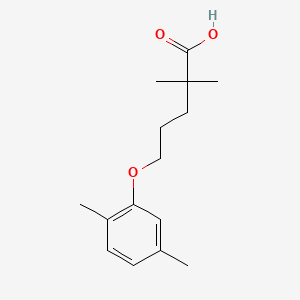
| Formula | C15H22O3 |
|---|---|
| Molecular weight | 250.34 g/mol |
| IUPAC name | 5-(2,5-dimethylphenoxy)-2,2-dimethylpentanoic acid |
| CAS | 25812-30-0 |
| PubChem CID | 3463 |
| InChIKey | HEMJJKBWTPKOJG-UHFFFAOYSA-N |
| logP | 3.57 (XLogP 3.8) |
| Polar surface area | 46.53 Ų |
| H-bond acceptors / donors | 2 / 1 |
| Drug-likeness (QED) | 0.78 |
| Lipinski violations | 0 |
SMILES
Cc1ccc(C)c(OCCCC(C)(C)C(=O)O)c1Biology & Pharmacokinetics
Pharmacokinetics
| BBB penetrant | No |
|---|
Enzyme interactions
| Enzyme | Role | Detail |
|---|---|---|
| CYP2B6 | Inhibitor | — |
| CYP2C19 | Inhibitor | — |
| CYP2C8 | Inhibitor | IC₅₀ 33.32296899997401 µM |
| CYP2C9 | Inhibitor | IC₅₀ 9.6 µM |
| CYP3A4 | Substrate | — |
Transporters
BCRP (Inhibitor)BCRP (Inhibitor)BSEP (Inhibitor)BSEP (Inhibitor)MDR1 (Inhibitor)MRP1 (Inhibitor)MRP2 (Inhibitor)MRP3 (Inhibitor)OAT (Inhibitor)OAT3 (Inhibitor)OATP (Inhibitor)OATP1A2 (Inhibitor)OATP1B1 (Inhibitor)OATP1B1 (Inhibitor)OATP1B3 (Inhibitor)OATP1B3 (Inhibitor)OATP2B1 (Inhibitor)P-gp (Inhibitor)MDR1 (Substrate)OAT1 (Substrate)OAT2 (Substrate)OAT3 (Substrate)P-gp (Substrate)
Drug–drug interactions (63, DDInter)
| Interacting drug | Severity | Management |
|---|---|---|
| Bexarotene | major | |
| Dicoumarol | major | |
| Elagolix | major | |
| Eluxadoline | major | |
| Irinotecan | major | |
| Irinotecan (liposomal) | major | |
| Loperamide | major | |
| Ozanimod | major | |
| Pioglitazone | major | |
| Repaglinide | major | |
| Rosuvastatin | major | |
| Selexipag | major | |
| Simvastatin | major | |
| Siponimod | major | |
| Warfarin | major | |
| Acetohexamide | moderate | |
| Apalutamide | moderate | |
| Artesunate | moderate | |
| Avatrombopag | moderate | |
| Binimetinib | moderate | |
| Celecoxib | moderate | |
| Chenodeoxycholic acid | moderate | |
| Chloroquine | moderate | |
| Chlorpropamide | moderate | |
| Cyclosporine | moderate | |
| Dabrafenib | moderate | |
| Diclofenac | moderate | |
| Enzalutamide | moderate | |
| Glimepiride | moderate | |
| Glipizide | moderate | |
| Glyburide | moderate | |
| Hydroxychloroquine | moderate | |
| Insulin aspart (aspart protamine) | moderate | |
| Insulin aspart (aspart) | moderate | |
| Insulin degludec | moderate | |
| Insulin detemir | moderate | |
| Insulin glargine | moderate | |
| Insulin glulisine | moderate | |
| Insulin human | moderate | |
| Insulin human (inhalation, rapid acting) | moderate |
Showing 40 of 63.
Registered Products (4)
| Brand | Form / strength | Pack | Agent | Citizen (JOD) |
|---|---|---|---|---|
| Lipofor Tablet | Tablet 600 mg | 30 tab | JAWEDA INT. DRUD STORE | 4.410 |
| Low-lip F.C Tablets | Film-Coated Tablet 600 mg | 30 tab pack varies | UNITED PHARM.MFG.CO.LTD(UPM)/JORDAN | 5.220 |
| Lopid | Tablet 600 mg | 30 tab | Khoury Drug Store | 6.300 |
| Low-lip F.C Tablets | Film-Coated Tablet 600 mg | 500 tab pack varies | UNITED PHARM.MFG.CO.LTD(UPM)/JORDAN | 63.080 |