Griseofulvin
JFDA label: Grisovin Tablets
Mechanism of Action
Inhibitor of Tubulin — Tubulin inhibitor
| Target | Action | Gene / class |
|---|---|---|
| Tubulin efficacy | INHIBITOR |
Indications
Approved
- Dermatophyte infections
Antimicrobial Spectrum
Expected / intrinsic spectrum (EUCAST breakpoints & labels) — not local resistance. Source: openfda-label.
Fungi
| Organism | Activity | MIC |
|---|---|---|
| Epidermophyton floccosum | Active | — |
| Microsporum audouinii | Active | — |
| Microsporum canis | Active | — |
| Microsporum gypseum | Active | — |
| Trichophyton crateriform | Active | — |
| Trichophyton crateriformis | Active | — |
| Trichophyton gallinae | Active | — |
| Trichophyton interdigitalis | Active | — |
| Trichophyton megnini | Active | — |
| Trichophyton mentagrophytes | Active | — |
| Trichophyton rubrum | Active | — |
| Trichophyton schoenleini | Active | — |
| Trichophyton sulphureum | Active | — |
| Trichophyton tonsurans | Active | — |
| Trichophyton verrucosum | Active | — |
Class profile
| antifungalClass | Antimitotic |
|---|---|
| targetMolecule | Microtubule assembly (beta-tubulin) |
| isFungicidal | 0 |
| spectrumCandida | Resistant |
| spectrumAspergillus | Resistant |
| spectrumCryptococcus | Resistant |
| spectrumDermatophytes | S (oral only, Trichophyton/Microsporum) |
| resistanceMechanisms | Beta-tubulin mutations,Slow clinical resistance; replaced by terbinafine |
| source | Pappas2016/Lass-Florl2011 |
Contraindications
Source: Lexicomp
- Hypersensitivity to griseofulvin or any component of the formulation Absolute
- hepatic failure Absolute
Adverse Reactions
Nervous system disorders (5)
Not Known Confusion · dizziness · fatigue · headache · insomnia
Hepatobiliary disorders (1)
Not Known Hepatotoxicity
Renal and urinary disorders (1)
Not Known Nephrosis
Blood and lymphatic system disorders (1)
Not Known Granulocytopenia
Gastrointestinal disorders (6)
Not Known Diarrhea · epigastric distress · gastrointestinal hemorrhage · nausea · oral candidiasis · vomiting
Skin and subcutaneous tissue disorders (4)
Not Known Dermatological reaction (erythema multiforme-like drug reaction) · skin photosensitivity · skin rash (most common) · urticaria (most common)
Dosing
Source: Lexicomp
Warnings & Precautions
Source: Lexicomp
Hematologic effects
Leukopenia has been reported (rare); discontinue therapy if granulocytopenia occurs.
Hepatic effects
May cause jaundice and elevated liver function tests or bilirubin (may be serious or even fatal); monitor hepatic function and discontinue therapy if necessary.
Penicillin allergy
Hypersensitivity cross reaction between penicillins and griseofulvin is possible, however, known penicillin-sensitive patients have been treated successfully without complications.
Photosensitivity
Avoid exposure to intense sunlight to prevent photosensitivity reactions.
Skin reactions
Severe skin reactions (eg, Stevens-Johnson syndrome, toxic epidermal necrolysis, erythema multiforme) have been reported (may be serious or even fatal); discontinue use if severe skin reactions occur. Disease-related concerns:
Lupus erythematosus
Development of lupus erythematosus, lupus-like syndromes or exacerbation of existing lupus erythematosus has been reported. Concurrent drug therapy issues:
Drug-drug interactions
Potentially significant interactions may exist, requiring dose or frequency adjustment, additional monitoring, and/or selection of alternative therapy. Consult drug interactions database for more detailed information. Other warnings/precautions:
Appropriate use
Use for the prophylaxis of fungal infections has not been established; not effective for the treatment of tinea versicolor.
Pregnancy & Lactation
Pregnancy
Teratogenic effects have been observed in animal reproduction studies. Griseofulvin crosses the placenta (Pacifici, 2006). Because adverse events have also been observed in humans (two cases of conjoined twins), use during pregnancy is contraindicated. Effective contraception should be used during therapy and for 1 month after therapy is discontinued in women of reproductive potential. Men should avoid fathering a child for at least 6 months after therapy.
Lactation
It is not known if griseofulvin is excreted in breast milk. Due to the potential for serious adverse reactions in the nursing infant, breast-feeding is not recommended.
Monitoring
| Efficacy | Fungal culture and species identification; minimum inhibitory concentration (MIC) where available; clinical response (temperature, imaging for invasive fungal disease) |
|---|---|
| Toxicity | LFTs (hepatotoxicity — azoles in particular); renal function; ECG for QT prolongation (azoles); drug levels if available (itraconazole, voriconazole) |
| Clinical pearl | Voriconazole levels are highly variable due to CYP2C19 polymorphism — TDM recommended (target trough 2–5 mg/L). Check for drug interactions with CYP3A4 substrates. |
| Counseling | Report visual disturbances (voriconazole), jaundice, or rash. Take azoles with food or as directed to optimise absorption. |
Chemistry & Properties
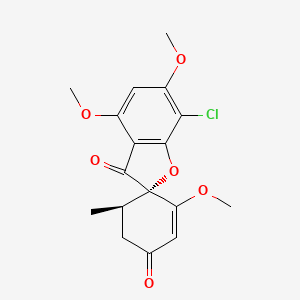
| Formula | C17H17ClO6 |
|---|---|
| Molecular weight | 352.77 g/mol |
| IUPAC name | (2S,5'R)-7-chloro-3',4,6-trimethoxy-5'-methylspiro[1-benzofuran-2,4'-cyclohex-2-ene]-1',3-dione |
| CAS | 126-07-8 |
| PubChem CID | 441140 |
| InChIKey | DDUHZTYCFQRHIY-RBHXEPJQSA-N |
| logP | 2.81 (XLogP 2.2) |
| Polar surface area | 71.06 Ų |
| H-bond acceptors / donors | 6 / 0 |
| Drug-likeness (QED) | 0.83 |
| Lipinski violations | 0 |
SMILES
COC1=CC(=O)C[C@@H](C)[C@]12Oc1c(Cl)c(OC)cc(OC)c1C2=OBiology & Pharmacokinetics
Pharmacokinetics predicted
| Bioavailability | 10.0% |
|---|---|
| Half-life | 0.838 h |
| Volume of distribution | 1.709 L/kg |
| Protein binding | 85.2% |
| BBB penetrant | No |
Enzyme interactions
| Enzyme | Role | Detail |
|---|---|---|
| CYP2C19 | Inhibitor | — |
| CYP2C19 | Substrate | — |
| CYP2C8 | Inhibitor | — |
| CYP2C9 | Inhibitor | — |
Transporters
BCRP (Inhibitor)BSEP (Inhibitor)MRP1 (Inhibitor)OATP1B1 (Inhibitor)OATP1B1 (Inhibitor)OATP1B3 (Inhibitor)OATP1B3 (Inhibitor)P-gp (Inhibitor)P-gp (Substrate)
Drug–drug interactions (100+, DDInter)
| Interacting drug | Severity | Management |
|---|---|---|
| Aminolevulinic acid | major | |
| Dienogest | major | |
| Drospirenone | major | |
| Ethinylestradiol | major | |
| Etonogestrel | major | |
| Levacetylmethadol | major | |
| Levonorgestrel | major | |
| Lumateperone | major | |
| Medroxyprogesterone acetate | major | |
| Norethisterone | major | |
| Norgestimate | major | |
| Norgestrel | major | |
| Ranolazine | major | |
| Abemaciclib | moderate | |
| Acalabrutinib | moderate | |
| Alfentanil | moderate | |
| Alpelisib | moderate | |
| Aminolevulinic acid (topical) | moderate | |
| Amobarbital | moderate | |
| Amprenavir | moderate | |
| Anisindione | moderate | |
| Apixaban | moderate | |
| Apremilast | moderate | |
| Aprepitant | moderate | |
| Aripiprazole | moderate | |
| Armodafinil | moderate | |
| Artemether | moderate | |
| Atazanavir | moderate | |
| Atorvastatin | moderate | |
| Avanafil | moderate | |
| Avapritinib | moderate | |
| Axitinib | moderate | |
| Bedaquiline | moderate | |
| Benzhydrocodone | moderate | |
| Bictegravir | moderate | |
| Boceprevir | moderate | |
| Bosutinib | moderate | |
| Brigatinib | moderate | |
| Buprenorphine | moderate | |
| Buspirone | moderate |
Showing 40 of 100+.
Registered Products (1)
| Brand | Form / strength | Pack | Agent | Citizen (JOD) |
|---|---|---|---|---|
| Grisovin Tablets | Tablet 500 mg | 25 tab | Suleiman Tannous & Sons Co. Ltd | 2.300 |