Ranolazine
JFDA label: Ranexa 375mg
Mechanism of Action
Blocker of Sodium channel protein type 5 subunit alpha — Sodium channel protein type V alpha subunit blocker; Blocker of Sodium channel protein type 4 subunit alpha — Sodium channel protein type IV alpha subunit blocker
| Target | Action | Gene / class |
|---|---|---|
| Sodium channel protein type 4 subunit alpha efficacy | BLOCKER | SCN4A |
| Sodium channel protein type 5 subunit alpha efficacy | BLOCKER | SCN5A |
Indications
Approved
- Chronic angina
Contraindications
Source: Lexicomp
- Hepatic cirrhosis Absolute
- concurrent CYP3A inducers Absolute
- concurrent strong CYP3A inhibitors Absolute
Adverse Reactions
Cardiac disorders (6)
Common Bradycardia · hypotension · orthostatic hypotension · palpitation · peripheral edema · prolonged QT interval on ECG
Nervous system disorders (5)
Common confusion · Dizziness · headache · syncope · vertigo
Renal and urinary disorders (1)
Common Hematuria
Gastrointestinal disorders (7)
Common abdominal pain · anorexia · Constipation · dyspepsia · nausea · vomiting · xerostomia
Skin and subcutaneous tissue disorders (1)
Common Hyperhidrosis
Musculoskeletal and connective tissue disorders (1)
Common Weakness
Eye disorders (1)
Common Blurred vision
Ear and labyrinth disorders (1)
Common Tinnitus
Respiratory, thoracic and mediastinal disorders (1)
Common Dyspnea
Other (24)
Not Known Angioedema · ataxia · decreased glycosylated hemoglobin · decreased T-wave amplitude · dysuria · eosinophilia · hallucination · hypoesthesia · hypoglycemia (diabetic patients) · increased blood urea nitrogen · increased serum creatinine · leukopenia · pancytopenia · paresthesia · pruritus · pulmonary fibrosis · renal failure · skin rash · T-wave changes (notched) · thrombocytopenia · torsade de pointes (Morrow 2007) · tremor · urinary retention · urine discoloration
Dosing
Source: Lexicomp
Warnings & Precautions
Source: Lexicomp
Altered cardiac conduction
Has been shown to prolong QTc interval in a dose/plasma concentration-related manner. At Tmaxfollowing repeat dosing at 1000 mg twice daily, the mean change in QTc is ~6 msec, but 5% of the population (with the highest plasma concentrations) has at least a 15 msec increase. Cirrhotic patients with mild to moderate hepatic impairment demonstrated a 3-fold increase QT prolongation; use is contraindicated in patients with liver cirrhosis. The incidence of symptomatic arrhythmias was similar to placebo in one trial (Morrow 2007). Risk versus benefit should be assessed in patients maintained on a higher dose (>2,000 mg/day) or exposure, concurrent use of other QT-prolonging drugs, potassium-channel variants known to cause QT prolongation, family history of or congenital long QT syndrome, or known acquired QT interval prolongation. Disease-related concerns:
Acute coronary syndrome
Ranolazine will not relieve acute angina episode and has not demonstrated benefit in acute coronary syndrome.
Hepatic impairment
Ranolazine plasma levels increase by 30% in patients with mild (Child-Pugh class A) and by 80% in patients with moderate (Child-Pugh class B) hepatic impairment. Use is contraindicated in patients with cirrhosis.
Renal impairment
Acute renal failure has been observed in some patients with severe renal impairment (CrCl Concurrent drug therapy issues:
Drug-drug interactions
Potentially significant interactions may exist, requiring dose or frequency adjustment, additional monitoring, and/or selection of alternative therapy. Consult drug interactions database for more detailed information. Use is contraindicated with inducers and strong inhibitors of CYP3A. Special populations:
Elderly
Use with caution in patients ≥75 years of age; they may experience more adverse events (including serious adverse events) and drug discontinuations due to adverse events.
Pregnancy & Lactation
Pregnancy
Adverse events have been observed in animal reproduction studies.
Lactation
It is not known if ranolazine is excreted into breast milk. According to the manufacturer, the decision to breastfeed during therapy should take into account the risk of exposure to the infant and the benefits of treatment to the mother.
Monitoring
| Clinical pearl | Baseline and follow up ECG to evaluate QT interval; monitor renal function periodically in patients with moderate to severe renal impairment, particularly for increases in serum creatinine accompanied by increased BUN; consider monitoring blood pressure in patients with renal dysfunction; correct and maintain serum potassium in normal limits |
|---|
Chemistry & Properties
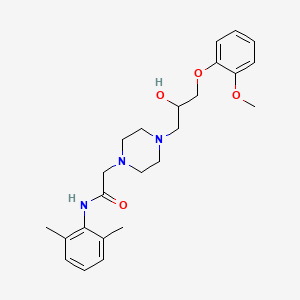
| Formula | C24H33N3O4 |
|---|---|
| Molecular weight | 427.55 g/mol |
| IUPAC name | N-(2,6-dimethylphenyl)-2-[4-[2-hydroxy-3-(2-methoxyphenoxy)propyl]piperazin-1-yl]acetamide |
| CAS | 95635-55-5 |
| PubChem CID | 56959 |
| InChIKey | XKLMZUWKNUAPSZ-UHFFFAOYSA-N |
| logP | 2.31 (XLogP 2.7) |
| Polar surface area | 74.27 Ų |
| H-bond acceptors / donors | 6 / 2 |
| Drug-likeness (QED) | 0.64 |
| Lipinski violations | 0 |
SMILES
COc1ccccc1OCC(O)CN1CCN(CC(=O)Nc2c(C)cccc2C)CC1Biology & Pharmacokinetics
Pharmacokinetics predicted
| Bioavailability | 10.0% |
|---|---|
| Half-life | 1.335 h |
| Volume of distribution | 1.409 L/kg |
| Protein binding | 89.4% |
| BBB penetrant | No |
Enzyme interactions
| Enzyme | Role | Detail |
|---|---|---|
| CYP1A2 | Substrate | — |
| CYP2C19 | Substrate | — |
| CYP3A4 | Substrate | — |
Transporters
BCRP (Inhibitor)BSEP (Inhibitor)MATE1 (Inhibitor)MATE2 (Inhibitor)MDR1 (Inhibitor)MRP1 (Inhibitor)OATP1B1 (Inhibitor)OATP1B1 (Inhibitor)OATP1B3 (Inhibitor)OATP1B3 (Inhibitor)OATP2B1 (Inhibitor)OCT2 (Inhibitor)P-gp (Inhibitor)MDR1 (Substrate)P-gp (Substrate)
Drug–drug interactions (100+, DDInter)
| Interacting drug | Severity | Management |
|---|---|---|
| Aminoglutethimide | major | |
| Anagrelide | major | |
| Apalutamide | major | |
| Aprepitant | major | |
| Arsenic trioxide | major | |
| Betrixaban | major | |
| Bexarotene | major | |
| Cabozantinib | major | |
| Ceritinib | major | |
| Chloroquine | major | |
| Cisapride | major | |
| Clarithromycin | major | |
| Clotrimazole | major | |
| Cobicistat | major | |
| Crizotinib | major | |
| Dabrafenib | major | |
| Dexamethasone | major | |
| Dolasetron | major | |
| Edoxaban | major | |
| Eliglustat | major | |
| Enzalutamide | major | |
| Erythromycin | major | |
| Fedratinib | major | |
| Fingolimod | major | |
| Fluconazole | major | |
| Griseofulvin | major | |
| Halofantrine | major | |
| Hydrocodone | major | |
| Hydroxychloroquine | major | |
| Idelalisib | major | |
| Imatinib | major | |
| Ivosidenib | major | |
| Ketoconazole | major | |
| Lapatinib | major | |
| Lorlatinib | major | |
| Lumacaftor | major | |
| Lumefantrine | major | |
| Macimorelin | major | |
| Mitotane | major | |
| Nilotinib | major |
Showing 40 of 100+.
Registered Products (7)
| Brand | Form / strength | Pack | Agent | Citizen (JOD) |
|---|---|---|---|---|
| RANCV Extended Release Tablets | Tablet 1000 mg | 10 tab pack varies | Manar Drug Store | 1.280 |
| RANCV Extended Release Tablets | Tablet 1000 mg | 30 tab pack varies | Manar Drug Store | 3.610 |
| RAZINE 500mg Extended-Relase Tablet | Tablet Ranolazine 500 mg | 30 tab | Reda Jardaneh Drug Store | 10.400 |
| RAZINE 1000mg Extended Release Tablets | Tablet Ranolazine 1000 mg | 30 tab | Reda Jardaneh Drug Store | 12.880 |
| Ranexa | Tablet 375 mg | 60 tab | ORIENT DRUG STORE CO | 28.310 |
| Ranexa | Tablet 750 mg | 60 tab | ORIENT DRUG STORE CO | 28.310 |
| Ranexa | Tablet 500 mg | 60 tab | ORIENT DRUG STORE CO | 28.310 |