Lorazepam
JFDA label: LORANS TAB
- Risks from concomitant use with opioids:
Mechanism of Action
Positive Allosteric Modulator of GABA-A receptor; anion channel — GABA-A receptor; anion channel positive allosteric modulator
| Target | Action | Gene / class |
|---|---|---|
| GABA-A receptor; anion channel efficacy | POSITIVE ALLOSTERIC MODULATOR |
Indications
Approved
- Anesthesia premedication (parenteral)
- Anesthesia premedication (sublingual) [Canadian product]
- Anxiety (oral)
- Status epilepticus (parenteral)
Off-label
- Agitation in the ICU patient
- Alcohol withdrawal delirium
- Alcohol withdrawal syndrome
- Chemotherapy-associated nausea and vomiting (adjunct or breakthrough) (adults)
- Chemotherapy-associated nausea and vomiting (adjunct or breakthrough) (children/adolescents)
- Chemotherapy-associated nausea and vomiting (anticipatory) (children/adolescents)
- Psychogenic catatonia
- Rapid tranquilization of the agitated patient
- Status epilepticus (infants, children, and adolescents)
Contraindications
Source: Curated · Lexicomp
- Acute angle-closure glaucoma Absolute
- Additional contraindications (not in the US labeling): Myasthenia gravis Absolute
- Hypersensitivity to lorazepam, any component of the formulation, or other benzodiazepines (cross-sensitivity with other benzodiazepines may exist) Absolute
- acute narrow-angle glaucoma Absolute
- intra-arterial injection Absolute
- severe respiratory insufficiency (except during mechanical ventilation) Parenteral: Additional contraindications: Hypersensitivity to polyethylene glycol, propylene glycol, or benzyl alcohol Absolute
- sleep apnea Absolute
- use in premature infants Absolute
Adverse Reactions
Cardiac disorders (1)
Not Known Hypotension
Nervous system disorders (34)
Not Known aggressive behavior · agitation · akathisia · amnesia · anxiety · central nervous system stimulation · coma · disinhibition · disorientation · dizziness · drowsiness · dysarthria · euphoria · excitement · extrapyramidal reaction · fatigue · headache · hostility · hypothermia · irritability · mania · memory impairment · outbursts of anger · psychosis · Sedation · seizures · sleep apnea (exacerbation) · sleep disturbances · slurred speech · stupor · suicidal behavior · suicidal ideation · unsteadiness · vertigo
Hepatobiliary disorders (4)
Not Known Increased serum alkaline phosphatase · increased serum bilirubin · increased serum transaminases · jaundice
Renal and urinary disorders (2)
Not Known Impotence · orgasm disturbance
Blood and lymphatic system disorders (3)
Not Known Agranulocytosis · pancytopenia · thrombocytopenia
Immune system disorders (3)
Not Known anaphylactoid reaction · Anaphylaxis · hypersensitivity reaction
Metabolism and nutrition disorders (3)
Not Known Change in libido · hyponatremia · SIADH
Gastrointestinal disorders (2)
Not Known Changes in appetite · constipation
Skin and subcutaneous tissue disorders (2)
Not Known Alopecia · skin rash
Musculoskeletal and connective tissue disorders (1)
Not Known Weakness
Eye disorders (1)
Not Known Visual disturbances (including diplopia and blurred vision)
General disorders and administration site conditions (2)
Not Known erythema at injection site · Pain at injection site
Respiratory, thoracic and mediastinal disorders (7)
Not Known apnea · exacerbation of obstructive pulmonary disease · hypoventilation · nasal congestion · respiratory depression · Respiratory failure · worsening of sleep apnea
Dosing
Source: Lexicomp
Warnings & Precautions
Source: Lexicomp
Anterograde amnesia
Benzodiazepines have been associated with anterograde amnesia.
CNS depression
May cause CNS depression, which may impair physical or mental abilities; patients must be cautioned about performing tasks which require mental alertness (eg, operating machinery or driving).
Paradoxical reactions
Paradoxical reactions, including hyperactive or aggressive behavior, have been reported with benzodiazepines, particularly in adolescent/pediatric or psychiatric patients. Disease-related concerns:
Drug abuse
Risk of dependence increases in patients with a history of alcohol or drug abuse and those with significant personality disorders; use with caution in these patients. Tolerance, psychological and physical dependence may also occur with higher dosages and prolonged use. The risk of dependence is decreased with short-term treatment (2 to 4 weeks); evaluate the need for continued treatment prior to extending therapy duration.
Hepatic impairment
Use with caution in patients with hepatic impairment, insufficiency, and/or encephalopathy. Dose adjustment (lower doses) may be needed. May worsen hepatic encephalopathy. Parenteral use is not recommended in patients with hepatic failure.
Impaired gag reflex
Use with caution in patients with an impaired gag reflex.
Psychiatric disorders
Preexisting depression may emerge or worsen during therapy. Not recommended for use in primary depressive or psychotic disorders. Should not be used in patients at risk for suicide without adequate antidepressant treatment.
Renal impairment
Use with caution in patients with renal impairment. Parenteral use is not recommended in patients with renal failure.
Respiratory disease
Use with caution in patients with respiratory disease, including COPD or sleep apnea. Benzodiazepines may cause significant respiratory depression. Concurrent drug therapy issues:
Concomitant use with opioids
Concomitant use of benzodiazepines and opioids may result in profound sedation, respiratory depression, coma, and death. Reserve concomitant prescribing of these drugs for use in patients for whom alternative treatment options are inadequate. Limit dosages and durations to the minimum required. Follow patients for signs and symptoms of respiratory depression and sedation. In patients already receiving an opioid analgesic, prescribe a lower initial dose of lorazepam than indicated in the absence of an opioid and titrate based on clinical response. If an opioid is initiated in a patient already taking lorazepam, prescribe a lower initial dose of the opioid and titrate based upon clinical response.
Drug-drug interactions
Potentially significant interactions may exist, requiring dose or frequency adjustment, additional monitoring, and/or selection of alternative therapy. Consult drug interactions database for more detailed information. Special populations:
Debilitated patients
Use with caution in debilitated patients; initial doses should be at the lower end of dosing range.
Fall risk
Use with extreme caution in patients who are at risk of falls; benzodiazepines have been associated with falls and traumatic injury.
Pediatrics
In pediatric and neonatal patients FDA 2016). Dosage form specific issues:
Benzyl alcohol and derivatives
Some dosage forms may contain benzyl alcohol; large amounts of benzyl alcohol (≥99 mg/kg/day) have been associated with a potentially fatal toxicity (“gasping syndrome”) in neonates; the “gasping syndrome” consists of metabolic acidosis, respiratory distress, gasping respirations, CNS dysfunction (including convulsions, intracranial hemorrhage), hypotension, and cardiovascular collapse (AAP ["Inactive" 1997]; CDC 1982); some data suggests that benzoate displaces bilirubin from protein binding sites (Ahlfors 2001); avoid or use dosage forms containing benzyl alcohol with caution in neonates. See manufacturer's labeling.
Polyethylene glycol
Parenteral formulation may contain polyethylene glycol. May be associated with toxicity in high-dose and/or longer-term therapy.
Propylene glycol
Parenteral formulation may contain propylene glycol; large amounts are potentially toxic and have been associated with hyperosmolality, lactic acidosis, seizures and respiratory depression; use caution (AAP 1997; Zar 2007). See manufacturer's labeling. May consider using enteral delivery of lorazepam tablets to decrease the risk of propylene glycol toxicity (Lugo 1999). Other warnings/precautions:
Appropriate use
Does not have analgesic, antidepressant, or antipsychotic properties. Status epilepticus should not be treated with injectable benzodiazepines alone; requires close observation and management and possibly ventilatory support. When used as a component of preanesthesia, monitor for heavy sedation and airway obstruction; equipment necessary to maintain airway and ventilatory support should be available.
Hypnotic
Appropriate use: As a hypnotic, should be used only after evaluation of potential causes of sleep disturbance. Failure of sleep disturbance to resolve after 7 to 10 days may indicate psychiatric or medical illness. A worsening of insomnia or the emergence of new abnormalities of thought or behavior may represent unrecognized psychiatric or medical illness and requires immediate and careful evaluation.
Tolerance
Lorazepam is a short half-life benzodiazepine. Duration of action after a single dose is determined by redistribution rather than metabolism. Tolerance develops to the sedative, hypnotic, and anticonvulsant effects. It does not develop to the anxiolytic effects (Vinkers 2012). Chronic use of this agent may increase the perioperative benzodiazepine dose needed to achieve desired effect.
Withdrawal
Rebound or withdrawal symptoms may occur following abrupt discontinuation or large decreases in dose. Use caution when reducing dose or withdrawing therapy; decrease slowly and monitor for withdrawal symptoms. Flumazenil may cause acute withdrawal in patients receiving long-term benzodiazepine therapy.
Pregnancy & Lactation
Pregnancy
Caution
IV lorazepam first-line for status epilepticus in pregnancy. Avoid chronic use
Lactation
Lorazepam is present in breast milk. The relative infant dose (RID) of lorazepam is 2.4% to 4.7% when calculated using the highest breast milk concentration located following benzodiazepine monotherapy with lorazepam and compared to an infant therapeutic dose of 0.15 to 0.3 mg/kg/day (0.05 mg/kg/dose every 4 to 8 hours). In general, breastfeeding is considered acceptable when the RID is In general, sedation, lethargy, irritability, poor weight gain, and apnea have been reported in breastfed in
Monitoring
| Clinical pearl | Respiratory and cardiovascular status, blood pressure, heart rate, symptoms of anxiety Long-term therapy: CBC, liver function tests, LDH High-dose or continuous IV use or IV use in patients with renal impairment: Clinical signs of propylene glycol toxicity, serum creatinine, BUN, serum lactate, osmolal gap; Note: An osmolal gap of ≥10 was predictive of elevated propylene glycol concentrations; values of ≥12 suggest propylene glycol toxicity (Barnes 2006; Yahwak 2008) Critically-ill patients: Monitor depth of sedation with either the Richmond Agitation-Sedation Scale (RASS) or Sedation-Agitation Scale (SAS) (Barr 2013) |
|---|
Chemistry & Properties
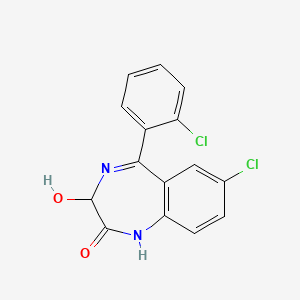
| Formula | C15H10Cl2N2O2 |
|---|---|
| Molecular weight | 321.16 g/mol |
| IUPAC name | 7-chloro-5-(2-chlorophenyl)-3-hydroxy-1,3-dihydro-1,4-benzodiazepin-2-one |
| CAS | 846-49-1 |
| PubChem CID | 3958 |
| InChIKey | DIWRORZWFLOCLC-UHFFFAOYSA-N |
| logP | 3.1 (XLogP 2.4) |
| Polar surface area | 61.69 Ų |
| H-bond acceptors / donors | 3 / 2 |
| Drug-likeness (QED) | 0.85 |
| Lipinski violations | 0 |
SMILES
O=C1Nc2ccc(Cl)cc2C(c2ccccc2Cl)=NC1OBiology & Pharmacokinetics
Pharmacokinetics
| BBB penetrant | Yes (logBB 0.44) |
|---|
Enzyme interactions
| Enzyme | Role | Detail |
|---|---|---|
| CYP1A2 | Inhibitor | — |
| CYP1A2 | Substrate | — |
| CYP3A4 | Substrate | — |
Transporters
BCRP (Inhibitor)BSEP (Inhibitor)MRP1 (Inhibitor)OATP1B1 (Inhibitor)OATP1B3 (Inhibitor)P-gp (Inhibitor)P-gp (Substrate)
Drug–drug interactions (70, DDInter)
| Interacting drug | Severity | Management |
|---|---|---|
| Codeine | major | |
| Hydrocodone | major | |
| Morphine | major | |
| Morphine (liposomal) | major | |
| Aldesleukin | moderate | |
| Alimemazine | moderate | |
| Amyl Nitrite | moderate | |
| Azatadine | moderate | |
| Azelastine (nasal) | moderate | |
| Binimetinib | moderate | |
| Brimonidine (ophthalmic) | moderate | |
| Brimonidine (topical) | moderate | |
| Brompheniramine | moderate | |
| Bupropion | moderate | |
| Carbinoxamine | moderate | |
| Cetirizine | moderate | |
| Chlorphenesin | moderate | |
| Chlorpheniramine | moderate | |
| Clemastine | moderate | |
| Clofedanol | moderate | |
| Cyproheptadine | moderate | |
| Dexbrompheniramine | moderate | |
| Dextromethorphan | moderate | |
| Diazoxide | moderate | |
| Diphenhydramine | moderate | |
| Doxepin (topical) | moderate | |
| Doxylamine | moderate | |
| Dronabinol | moderate | |
| Ethanol | moderate | |
| Flumazenil | moderate | |
| Ifosfamide | moderate | |
| Iodide I-123 | moderate | |
| Iodide I-131 | moderate | |
| Levocetirizine | moderate | |
| Lidocaine | moderate | |
| Lorlatinib | moderate | |
| Meclizine | moderate | |
| Mepyramine | moderate | |
| Methdilazine | moderate | |
| Metoclopramide | moderate |
Showing 40 of 70.
Registered Products (1)
| Brand | Form / strength | Pack | Agent | Citizen (JOD) |
|---|---|---|---|---|
| LORANS TAB | Tablet 1 mg | 50 tab | Khoury Drug Store | 1.710 |