Mirabegron
JFDA label: Betmiga Prolonged Release Tab
Mechanism of Action
Agonist of Beta-3 adrenergic receptor — Beta-3 adrenergic receptor agonist
| Target | Action | Gene / class |
|---|---|---|
| Beta-3 adrenergic receptor efficacy | AGONIST | ADRB3 |
Indications
Approved
- Overactive bladder
Contraindications
Source: Lexicomp
- Additional contraindications (not in U.S. labeling): Severe uncontrolled hypertension (systolic blood pressure ≥180 mm Hg and/or diastolic blood pressure ≥110 mm Hg) Absolute
- Hypersensitivity to mirabegron or any component of the formulation Absolute
Adverse Reactions
Cardiac disorders (1)
Common Tachycardia
Nervous system disorders (2)
Common dizziness · Headache
Renal and urinary disorders (2)
Common cystitis · Urinary tract infection
Gastrointestinal disorders (4)
Common abdominal pain · Constipation · diarrhea · xerostomia
Musculoskeletal and connective tissue disorders (2)
Common arthralgia · Back pain
Infections and infestations (1)
Common Influenza
Other (1)
Very Common Cardiovascular: Hypertension
Respiratory, thoracic and mediastinal disorders (2)
Common Nasopharyngitis · sinusitis
Dosing
Source: Lexicomp
Warnings & Precautions
Source: Lexicomp
Angioedema
Angioedema of the face, lips, tongue, and/or larynx has been reported; some cases have occurred after the first dose. May be life-threatening. Immediately discontinue and institute supportive care if the tongue, hypopharynx, or larynx is involved.
Blood pressure effects
Dose-related increases in blood pressure have been reported; monitor blood pressure periodically during therapy. Not recommended in patients with severe uncontrolled hypertension (SBP ≥180 and/or DBP ≥110 mm Hg); if used in patients with controlled and less severe hypertension, use with caution and monitor blood pressure closely; exacerbation of preexisting hypertension has been reported. Disease-related concerns:
Bladder flow obstruction
Use with caution in patients with bladder outlet obstruction (BOO); the risk of urinary retention may be increased.
Hepatic impairment
Use with caution in patients with mild to moderate hepatic impairment; dosage adjustment is required in patients with moderate hepatic impairment. Use is not recommended in severe hepatic impairment.
QT prolongation
Use with caution in patients with a history of QT interval prolongation or those receiving medications known to prolong the QT interval. In one thorough QT study, supratherapeutic doses prolonged the QTc interval based on the individual subject-specific correction method (QTcI) in females but not in males (Malik 2012). In general, mirabegron at the recommended dose has a low risk of QT interval prolongation (Sanford 2013).
Renal impairment
Use with caution in patients with renal impairment; dosage adjustment is required in patients with severe renal impairment. Use is not recommended in ESRD. Concurrent drug therapy issues:
Drug-drug interactions
Potentially significant interactions may exist, requiring dose or frequency adjustment, additional monitoring, and/or selection of alternative therapy. Consult drug interactions database for more detailed information.
Pregnancy & Lactation
Pregnancy
Adverse effects have been observed in some animal reproduction studies.
Lactation
Mirabegron is expected to be excreted in breast milk. Because of the potential for serious adverse reactions in the nursing infant, the manufacturer recommends a decision be made whether to discontinue nursing or the drug, taking into account the importance of treatment to the mother.
Monitoring
| Clinical pearl | Monitor blood pressure at baseline and then periodically during therapy |
|---|
Chemistry & Properties
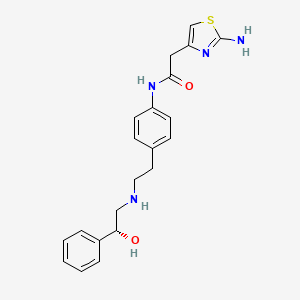
| Formula | C21H24N4O2S |
|---|---|
| Molecular weight | 396.52 g/mol |
| IUPAC name | 2-(2-amino-1,3-thiazol-4-yl)-N-[4-[2-[[(2R)-2-hydroxy-2-phenylethyl]amino]ethyl]phenyl]acetamide |
| CAS | 223673-61-8 |
| PubChem CID | 9865528 |
| InChIKey | PBAPPPCECJKMCM-IBGZPJMESA-N |
| logP | 2.77 (XLogP 2.1) |
| Polar surface area | 100.27 Ų |
| H-bond acceptors / donors | 6 / 4 |
| Drug-likeness (QED) | 0.42 |
| Lipinski violations | 0 |
SMILES
Nc1nc(CC(=O)Nc2ccc(CCNC[C@H](O)c3ccccc3)cc2)cs1Biology & Pharmacokinetics
Pharmacokinetics predicted
| Bioavailability | 70.0% |
|---|---|
| Half-life | 1.364 h |
| Volume of distribution | 22.201 L/kg |
| Protein binding | 62.6% |
| BBB penetrant | Yes |
Enzyme interactions
| Enzyme | Role | Detail |
|---|---|---|
| CYP2C8 | Inhibitor | — |
| CYP2D6 | Inhibitor | — |
| CYP3A4 | Inhibitor | — |
| CYP3A4 | Substrate | — |
Receptor binding (top 1)
| Target | Action | Affinity |
|---|---|---|
| β2-adrenoceptor (ADRB2) | Agonist | pEC50 5.0 |
Transporters
BCRP (Inhibitor)BSEP (Inhibitor)MDR1 (Inhibitor)MRP1 (Inhibitor)OATP1B1 (Inhibitor)OATP1B3 (Inhibitor)OCT(unspecified) (Inhibitor)OCT1 (Inhibitor)OCT2 (Inhibitor)P-gp (Inhibitor)MDR1 (Substrate)OATP1A2 (Substrate)OATP2B1 (Substrate)OCT(unspecified) (Substrate)OCT1 (Substrate)OCT2 (Substrate)OCT3 (Substrate)P-gp (Substrate)PEPT2 (Substrate)
Drug–drug interactions (67, DDInter)
| Interacting drug | Severity | Management |
|---|---|---|
| Eliglustat | major | |
| Tamoxifen | major | |
| Venetoclax | major | |
| Binimetinib | moderate | |
| Chlorpheniramine | moderate | |
| Codeine | moderate | |
| Dexfenfluramine | moderate | |
| Dextromethorphan | moderate | |
| Diphenhydramine | moderate | |
| Doxepin | moderate | |
| Fenfluramine | moderate | |
| Fostamatinib | moderate | |
| Glasdegib | moderate | |
| Glycerol phenylbutyrate | moderate | |
| Lorcaserin | moderate | |
| Lusutrombopag | moderate | |
| Metoclopramide | moderate | |
| Pirfenidone | moderate | |
| Promethazine | moderate | |
| Talazoparib | moderate | |
| Trospium | moderate | |
| Aminoglutethimide | minor | |
| Apalutamide | minor | |
| Aprepitant | minor | |
| Bexarotene | minor | |
| Bicalutamide | minor | |
| Ceritinib | minor | |
| Chloramphenicol | minor | |
| Cimetidine | minor | |
| Clarithromycin | minor | |
| Clotrimazole | minor | |
| Cobicistat | minor | |
| Crizotinib | minor | |
| Cyclosporine | minor | |
| Dabrafenib | minor | |
| Dasatinib | minor | |
| Deferasirox | minor | |
| Dexamethasone | minor | |
| Elagolix | minor | |
| Entrectinib | minor |
Showing 40 of 67.
Registered Products (2)
| Brand | Form / strength | Pack | Agent | Citizen (JOD) |
|---|---|---|---|---|
| Betmiga Prolonged Release Tab | Tablet 25 mg | 30 tab | Ibn Rushd Drug Store | 32.630 |
| Betmiga Prolonged Release Tab | Tablet 50 mg | 30 tab | Ibn Rushd Drug Store | 32.630 |