Nebivolol
JFDA label: Nebilet Tablets
Mechanism of Action
Highly-selective inhibitor of beta1-adrenergic receptors; at doses ≤10 mg nebivolol preferentially blocks beta1-receptors. Nebivolol, unlike other beta-blockers, also produces an endothelium-derived nitric oxide-dependent vasodilation resulting in a reduction of systemic vascular resistance.
Indications
Approved
- Chronic kidney disease (CKD) and hypertension
- Coronary artery disease (CAD) and hypertension
- Hypertension
Contraindications
Source: Lexicomp
- Additional contraindications (not in US labeling): Severe peripheral arterial circulatory disorders Absolute
- Hypersensitivity to nebivolol or any component of the formulation Absolute
- cardiogenic shock Absolute
- decompensated heart failure Absolute
- heart block greater than first-degree (except in patients with a functioning artificial pacemaker) Absolute
- rare hereditary conditions of Galactose intolerance, Lapp lactase deficiency or glucose-galactose malabsorption Absolute
- severe bradycardia Absolute
- severe hepatic impairment (Child-Pugh class C) Absolute
- sick sinus syndrome (unless a permanent pacemaker is in place) Absolute
- sinoatrial block Absolute
Adverse Reactions
Cardiac disorders (3)
Common bradycardia · chest pain · Peripheral edema
Nervous system disorders (5)
Common dizziness · fatigue · Headache · insomnia · paresthesia
Renal and urinary disorders (1)
Common Increased blood urea nitrogen
Blood and lymphatic system disorders (1)
Common Decreased platelet count
Metabolism and nutrition disorders (4)
Common Decreased HDL cholesterol · hypercholesterolemia · increased serum triglycerides · increased uric acid
Gastrointestinal disorders (3)
Common abdominal pain · Diarrhea · nausea
Skin and subcutaneous tissue disorders (1)
Common Skin rash
Musculoskeletal and connective tissue disorders (1)
Common Weakness
Respiratory, thoracic and mediastinal disorders (1)
Common Dyspnea
Dosing
Source: Lexicomp
Warnings & Precautions
Source: Lexicomp
Anaphylactic reactions
Use caution with history of severe anaphylaxis to a variety of allergens; patients taking beta-blockers may become more sensitive to repeated challenges. Treatment of anaphylaxis (eg, epinephrine) in patients taking beta-blockers may be ineffective or promote undesirable effects. Disease-related concerns:
Bronchospastic disease
In general, patients with bronchospastic disease should not receive beta-blockers; for patients with bronchospastic disease who do not respond to or cannot tolerate other therapies, initial low doses of beta1-selective nebivolol may be employed and used cautiously with close monitoring. Ensure patient has an inhaled beta2-agonist immediately available.
Diabetes
Use with caution in patients with diabetes mellitus; may potentiate hypoglycemia and/or mask signs and symptoms.
Heart failure (HF)
Note: Nebivolol has not been shown to reduce morbidity or mortality in the general HF population; only beta-blockers proven to reduce mortality (ie, bisoprolol, carvedilol, or extended-release metoprolol succinate) should be used in the treatment of heart failure. Use with caution in patients with compensated HF and monitor for a worsening of the condition. If condition worsens, consider temporary discontinuation or dosage reduction of nebivolol. Patients should be stabilized on HF regimen prior to initiation of beta-blocker. Beta-blocker therapy should be initiated at very low doses with gradual and very careful titration. Adjustment of other medications (ACE inhibitors and/or diuretics) may be required.
Hepatic impairment
Use with caution in patients with hepatic impairment; dosage adjustment required with moderate impairment (Child-Pugh class B). Use is contraindicated in patients with Child-Pugh class C hepatic impairment.
Myasthenia gravis
Use with caution in patients with myasthenia gravis.
Peripheral vascular disease (PVD) and Raynaud's disease
Can precipitate or aggravate symptoms of arterial insufficiency in patients with PVD and Raynaud's disease. Use with caution and monitor for progression of arterial obstruction.
Pheochromocytoma (untreated)
Adequate alpha-blockade is required prior to use of any beta-blocker.
Psoriasis
Beta-blocker use has been associated with induction or exacerbation of psoriasis, but cause and effect have not been firmly established.
Psychiatric disease
Use with caution in patients with a history of psychiatric illness; may cause or exacerbate CNS depression.
Renal impairment
Use with caution in patients with renal impairment; dosage adjustment required with severe renal impairment (CrCl • Thyroid disease: May mask signs of hyperthyroidism (eg, tachycardia). If thyrotoxicosis is suspected, carefully manage and monitor; abrupt withdrawal may exacerbate symptoms of hyperthyroidism or precipitate thyroid storm. Concurrent drug therapy issues:
Drug-drug interactions
Potentially significant interactions may exist, requiring dose or frequency adjustment, additional monitoring, and/or selection of alternative therapy. Consult drug interactions database for more detailed information. Special populations:
Elderly
Bradycardia may be observed more frequently in elderly patients (>65 years of age); dosage reductions may be necessary. Other warnings/precautions:
Abrupt withdrawal
Beta-blocker therapy should not be withdrawn abruptly (particularly in patients with coronary artery disease), but gradually tapered over 1-2 weeks to avoid acute tachycardia, hypertension, and/or ischemia. Severe exacerbation of angina, ventricular arrhythmias, and myocardial infarction (MI) have been reported following abrupt withdrawal of beta-blocker therapy. Temporary but prompt resumption of beta-blocker therapy may be indicated with worsening of angina or acute coronary insufficiency.
Major surgery
Chronic beta-blocker therapy should not be routinely withdrawn prior to major surgery.
Pregnancy & Lactation
Pregnancy
Adverse events have been observed in some animal reproduction studies. Adverse events, such as fetal/neonatal bradycardia, hypoglycemia, reduced birth weight, have been observed following in utero exposure to beta-blockers as a class. Adequate facilities for monitoring infants at birth is generally recommended. Untreated chronic maternal hypertension and preeclampsia are also associated with adverse events in the fetus, infant, and mother (ACOG 2015; Magee 2014). Although beta-blockers may be used when treatment of hypertension in pregnancy is indicated, agents other than nebivolol are preferred (ACOG 2013; Magee 2014; Regitz-Zagrosek 2011).
Lactation
It is not known if nebivolol is excreted into breast milk. Breast-feeding is not recommended by the manufacturer due to the potential for beta-blockers to produce serious effects on nursing infants, especially bradycardia.
Monitoring
| Clinical pearl | Blood pressure, ECG; serum glucose (in diabetic patients) |
|---|
Chemistry & Properties
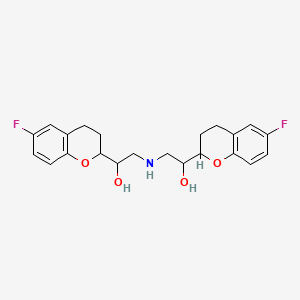
| Formula | C22H25F2NO4 |
|---|---|
| Molecular weight | 405.44 g/mol |
| IUPAC name | 1-(6-fluoro-3,4-dihydro-2H-chromen-2-yl)-2-[[2-(6-fluoro-3,4-dihydro-2H-chromen-2-yl)-2-hydroxyethyl]amino]ethanol |
| CAS | 118457-14-0 |
| PubChem CID | 71301 |
| InChIKey | KOHIRBRYDXPAMZ-UHFFFAOYSA-N |
| logP | 2.36 (XLogP 3.0) |
| Polar surface area | 70.95 Ų |
| H-bond acceptors / donors | 5 / 3 |
| Drug-likeness (QED) | 0.69 |
| Lipinski violations | 0 |
SMILES
OC(CNCC(O)C1CCc2cc(F)ccc2O1)C1CCc2cc(F)ccc2O1Biology & Pharmacokinetics
Pharmacokinetics
| BBB penetrant | Yes (logBB 0.57) |
|---|
Enzyme interactions
| Enzyme | Role | Detail |
|---|---|---|
| CYP2C19 | Substrate | — |
| CYP2D6 | Inhibitor | — |
Transporters
BCRP (Inhibitor)BSEP (Inhibitor)BSEP (Inhibitor)MDR1 (Inhibitor)MRP1 (Inhibitor)MRP2 (Inhibitor)MRP3 (Inhibitor)MRP4 (Inhibitor)OATP1B1 (Inhibitor)OATP1B3 (Inhibitor)P-gp (Inhibitor)MDR1 (Substrate)P-gp (Substrate)
Drug–drug interactions (100+, DDInter)
| Interacting drug | Severity | Management |
|---|---|---|
| Aminophylline | major | |
| Ceritinib | major | |
| Dolasetron | major | |
| Dyphylline | major | |
| Fingolimod | major | |
| Oxtriphylline | major | |
| Siponimod | major | |
| Theophylline | major | |
| Abiraterone | moderate | |
| Acetohexamide | moderate | |
| Aldesleukin | moderate | |
| Alectinib | moderate | |
| Alimemazine | moderate | |
| Amifostine | moderate | |
| Atropine | moderate | |
| Betamethasone | moderate | |
| Brigatinib | moderate | |
| Brimonidine (ophthalmic) | moderate | |
| Brimonidine (topical) | moderate | |
| Budesonide | moderate | |
| Bupropion | moderate | |
| Calcium Phosphate | moderate | |
| Calcium acetate | moderate | |
| Calcium carbonate | moderate | |
| Calcium citrate | moderate | |
| Calcium glubionate anhydrous | moderate | |
| Calcium gluconate | moderate | |
| Calcium lactate | moderate | |
| Canagliflozin | moderate | |
| Celecoxib | moderate | |
| Chlorphenesin | moderate | |
| Chlorpropamide | moderate | |
| Clidinium | moderate | |
| Cobicistat | moderate | |
| Codeine | moderate | |
| Corticotropin | moderate | |
| Crizotinib | moderate | |
| Dacomitinib | moderate | |
| Dapagliflozin | moderate | |
| Deflazacort | moderate |
Showing 40 of 100+.
Registered Products (7)
| Brand | Form / strength | Pack | Agent | Citizen (JOD) |
|---|---|---|---|---|
| NEBUNTA 5 | Tablet Nebivolol Hcl 5.45 mg | 30 tab | Reda Jardaneh Drug Store | 3.620 |
| NEBILOL 5 | Tablet 5 mg | 30 tab | Omicron Pharma | 3.670 |
| Nebimac 5 | Tablet 5.45 mg | 28 tab | Sun Set Drug Store | 3.690 |
| Nebal | Tablet Nebivolol Hcl 5.45 mg | 30 tab | Sana Pharmaceutical Industry Company | 4.280 |
| Nebilet Tablets | Tablet 5.45 mg | 28 tab | ORIENT DRUG STORE CO | 5.740 |
| Nebilet Plus 5mg/12.5mg | Tablet 12.5 mg, 5 mg | 30 tab | ORIENT DRUG STORE CO | 5.990 |
| Nebilet Plus 5mg/25mg | Tablet 25 mg, 5 mg | 30 tab | ORIENT DRUG STORE CO | 5.990 |