Nintedanib
JFDA label: Ofev 100 mg
Mechanism of Action
Inhibits multiple receptor tyrosine kinases (RTKs) and nonreceptor tyrosine kinases (nRTKs), including platelet-derived growth factor (PDGFR alpha and PDGFR beta); fibroblast growth factor receptor (FGFR1, FGFR2, FGFR3); vascular endothelial growth factor (VEGFR1, VEGFR2, and VEGFR3); and Fms-like tyrosine kinase-3 (FLT3). Nintedanib binds competitively to the adenosine triphosphate (ATP) binding pocket of these receptors and blocks the intracellular signaling which is crucial for the proliferation, migration, and transformation of fibroblasts.
Indications
Approved
- Idiopathic pulmonary fibrosis
Contraindications
Source: Lexicomp
- Additional contraindications (not in US labeling): Hypersensitivity to nintedanib, peanut, or soya or any component of the formulation Absolute
- There are no contraindications listed in the manufacturer's labeling Absolute
Adverse Reactions
Cardiac disorders (3)
Common arterial thrombosis · Hypertension · myocardial infarction
Nervous system disorders (1)
Common Headache
Hepatobiliary disorders (1)
Very Common Increased liver enzymes
Blood and lymphatic system disorders (1)
Common Hemorrhage
Metabolism and nutrition disorders (2)
Common hypothyroidism · Weight loss
Gastrointestinal disorders (5)
Very Common abdominal pain · decreased appetite · Diarrhea · nausea · vomiting
Respiratory, thoracic and mediastinal disorders (1)
Common Bronchitis
Dosing
Source: Lexicomp
Warnings & Precautions
Source: Lexicomp
Bleeding
May increase the risk of bleeding. Use in patients with known risk of bleeding only if the benefit outweighs the risk. Serious and nonserious bleeding events (some fatal) have been reported during postmarketing.
Cardiovascular effects
Arterial thromboembolic events, including MI, have been reported. Use caution in patients at high cardiovascular risk, including in patients with known coronary artery disease. Consider treatment interruption in patients who develop signs or symptoms of acute myocardial ischemia.
GI effects
Diarrhea, nausea, and vomiting may occur. Diarrhea occurred in over 50% of nintedanib-treated patients, and was generally of mild to moderate intensity and occurred within the first 3 months of treatment. Treat with appropriate supportive care (eg, adequate hydration, antidiarrheals, antiemetics); dose reduction and/or treatment interruption may be required. If GI effects do not resolve, discontinue treatment. In addition, nintedanib may increase the risk of GI perforation; cases of GI perforation (some fatal) have been reported during postmarketing. Use caution when treating patients who have had recent abdominal surgery, previous history of diverticular disease or who are receiving concomitant corticosteroids or NSAIDs; only use in patients at risk of perforation if the benefit outweighs the risk. It has been recommended to wait at least 4 weeks following abdominal surgery before initiating therapy (OFEV Canadian product labeling 2017). Discontinue if perforation develops.
Hepatic effects
Serious and nonserious cases of drug-induced liver injury (including severe liver injury with fatal outcome) have been reported. Hepatic effects usually occurred within the first 3 months of treatment. Elevations of ALT, AST, GGT, alkaline phosphatase, and bilirubin were usually reversible with dose modification or interruption. Risk may be increased in patients with a low body weight ( Concurrent drug therapy issues:
Drug-drug interactions
Potentially significant interactions may exist, requiring dose or frequency adjustment, additional monitoring, and/or selection of alternative therapy. Consult drug interactions database for more detailed information. Special populations:
Hepatic impairment
Nintedanib is primarily eliminated through biliary/fecal excretion; use is not recommended in patients with moderate or severe hepatic impairment. Dose reduction is recommended in patients with mild impairment; if adverse reactions occur, consider treatment interruption or discontinuation.
Smokers
Smoking may decrease exposure to nintedanib; patients should stop smoking prior to treatment and avoid smoking during therapy.
Pregnancy & Lactation
Pregnancy
Based on the mechanism of action and adverse events observed in animal reproduction studies, nintedanib may be expected to cause fetal harm if used during pregnancy. Women of reproductive potential should use adequate contraception during therapy; pregnancy status should be obtained before treatment and pregnancy should be avoided; effective contraception should be used during therapy and for at least 3 months after the last dose. Based on animal studies, nintedanib may reduce female fertility.
Lactation
It is not known if nintedanib is present in breast milk. Due to the potential for serious adverse reactions in the breastfeeding infant, breastfeeding is not recommended by the manufacturer.
Monitoring
| Clinical pearl | Obtain liver function tests prior to initiation of treatment, at regular intervals during the first 3 months of treatment, and periodically thereafter or as clinically indicated; obtain pregnancy test prior to treatment. Monitor for GI events (eg, diarrhea, nausea, vomiting), arterial thromboembolic events, bleeding, and GI perforation. |
|---|
Chemistry & Properties
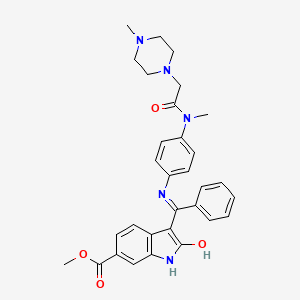
| Formula | C31H33N5O4 |
|---|---|
| Molecular weight | 539.64 g/mol |
| IUPAC name | methyl 2-hydroxy-3-[N-[4-[methyl-[2-(4-methylpiperazin-1-yl)acetyl]amino]phenyl]-C-phenylcarbonimidoyl]-1H-indole-6-carboxylate |
| CAS | 656247-17-5 |
| PubChem CID | 135423438 |
| InChIKey | XZXHXSATPCNXJR-ZIADKAODSA-N |
| logP | 3.62 (XLogP 4.3) |
| Polar surface area | 94.22 Ų |
| H-bond acceptors / donors | 7 / 2 |
| Drug-likeness (QED) | 0.35 |
| Lipinski violations | 1 |
SMILES
COC(=O)c1ccc2c(c1)NC(=O)/C2=C(\Nc1ccc(N(C)C(=O)CN2CCN(C)CC2)cc1)c1ccccc1Biology & Pharmacokinetics
Pharmacokinetics
| BBB penetrant | No |
|---|
Enzyme interactions
| Enzyme | Role | Detail |
|---|---|---|
| CYP1A2 | Substrate | — |
Receptor binding (top 9)
| Target | Action | Affinity |
|---|---|---|
| fms related receptor tyrosine kinase 4 (FLT4) | Inhibitor | pIC50 7.9 |
| kinase insert domain receptor (KDR) | Inhibitor | pIC50 7.7 |
| fms related receptor tyrosine kinase 1 (FLT1) | Inhibitor | pIC50 7.5 |
| fibroblast growth factor receptor 2 (FGFR2) | Inhibitor | pIC50 7.4 |
| platelet derived growth factor receptor alpha (PDGFRA) | Inhibitor | pIC50 7.2 |
| platelet derived growth factor receptor beta (PDGFRB) | Inhibitor | pIC50 7.2 |
| fibroblast growth factor receptor 1 (FGFR1) | Inhibitor | pIC50 7.2 |
| fibroblast growth factor receptor 3 (FGFR3) | Inhibitor | pIC50 7.0 |
| fibroblast growth factor receptor 4 (FGFR4) | Inhibitor | pIC50 6.2 |
Transporters
BCRP (Inhibitor)BSEP (Inhibitor)MDR1 (Inhibitor)MRP1 (Inhibitor)OATP1B1 (Inhibitor)OATP1B3 (Inhibitor)OCT1 (Inhibitor)P-gp (Inhibitor)MDR1 (Substrate)OCT1 (Substrate)P-gp (Substrate)
Drug–drug interactions (100+, DDInter)
| Interacting drug | Severity | Management |
|---|---|---|
| Carbamazepine | major | |
| Dexamethasone | major | |
| Drotrecogin alfa | major | |
| Fosphenytoin | major | |
| Leflunomide | major | |
| Lomitapide | major | |
| Lorlatinib | major | |
| Lumacaftor | major | |
| Mipomersen | major | |
| Mitotane | major | |
| Pexidartinib | major | |
| Phenobarbital | major | |
| Phenytoin | major | |
| Primidone | major | |
| Rifampicin | major | |
| St. John's Wort | major | |
| Teriflunomide | major | |
| Tipranavir | major | |
| Abametapir (topical) | moderate | |
| Abciximab | moderate | |
| Abiraterone | moderate | |
| Acetylsalicylic acid | moderate | |
| Alpelisib | moderate | |
| Alteplase | moderate | |
| Amiodarone | moderate | |
| Anagrelide | moderate | |
| Anisindione | moderate | |
| Anistreplase | moderate | |
| Antithrombin Alfa | moderate | |
| Antithrombin III human | moderate | |
| Apalutamide | moderate | |
| Apixaban | moderate | |
| Ardeparin | moderate | |
| Argatroban | moderate | |
| Asparaginase Erwinia chrysanthemi | moderate | |
| Asparaginase Escherichia coli | moderate | |
| Atazanavir | moderate | |
| Bedaquiline | moderate | |
| Bepridil | moderate | |
| Betrixaban | moderate |
Showing 40 of 100+.
Registered Products (2)
| Brand | Form / strength | Pack | Agent | Citizen (JOD) |
|---|---|---|---|---|
| Ofev | Capsule 100 mg | 60 cap | The Jordan Drugstore Co | — |
| Ofev | Capsule 150 mg | 60 cap | The Jordan Drugstore Co | — |