Olaparib
JFDA label: Lynparza
Mechanism of Action
Inhibitor of PARP 1, 2 and 3 — PARP 1, 2 and 3 inhibitor
| Target | Action | Gene / class |
|---|---|---|
| PARP 1, 2 and 3 efficacy | INHIBITOR |
Indications
Approved
- Breast cancer, metastatic (BRCA-mutated, HER2-negative)
- Ovarian cancer, advanced (BRCA-mutated)
- Ovarian cancer, recurrent (maintenance)
Contraindications
Source: Lexicomp
- Hypersensitivity to olaparib or any component of the formulation Absolute
- There are no contraindications listed in the manufacturer's US labeling Absolute
Adverse Reactions
Cardiac disorders (3)
Very Common Hypertension · Peripheral edema, headache, dizziness, abdominal pain, vomiting, diarrhea, dysgeusia, dyspepsia, constipation, decreased appetite, stomatitis · venous thrombosis (including pulmonary embolism)
Nervous system disorders (4)
Very Common Anxiety · depression · insomnia · peripheral neuropathy
Renal and urinary disorders (5)
Very Common Dysuria · Increased serum creatinine · urinary incontinence · Urinary tract infection, decreased absolute lymphocyte count, decreased white blood cell count, decreased neutrophils, anemia, decreased platelet count · vulvovaginal disease
Blood and lymphatic system disorders (1)
Very Common Myelodysplastic syndrome
Metabolism and nutrition disorders (2)
Very Common Hot flash · hyperglycemia
Skin and subcutaneous tissue disorders (2)
Very Common Pruritus · xeroderma (including eczema)
Musculoskeletal and connective tissue disorders (5)
Very Common arthralgia · back pain · musculoskeletal pain · myalgia · Weakness
Infections and infestations (1)
Very Common Influenza
Respiratory, thoracic and mediastinal disorders (6)
Very Common cough · dyspnea (Miscellaneous: Fever (1% to ≤10%: · Nasopharyngitis · respiratory tract infection · rhinitis · sinusitis
Dosing
Source: Lexicomp
Warnings & Precautions
Source: Lexicomp
Bone marrow suppression
Anemia, neutropenia, thrombocytopenia, and lymphopenia have been reported. Monitor complete blood counts at baseline and monthly thereafter; do not initiate olaparib until any hematologic toxicity caused by previous chemotherapy has resolved to ≤ grade 1. If prolonged hematologic toxicity occurs during therapy, interrupt treatment and monitor blood counts weekly until recovered; if counts do not recover to ≤ grade 1 after 4 weeks, further evaluation (including bone marrow and cytogenetic analyses) is necessary.
GI toxicity
Nausea and vomiting (usually mild to moderate) may commonly occur.
Hypersensitivity
Hypersensitivity reactions, including rash and dermatitis, have been reported.
Pulmonary toxicity
Pneumonitis (including some fatalities) has occurred rarely. Interrupt treatment for new or worsening respiratory symptoms such as cough, dyspnea, fever, wheezing, or radiologic abnormalities; evaluate promptly. Discontinue treatment if pneumonitis is confirmed.
Secondary malignancy
Myelodysplastic syndrome/acute myeloid leukemia (MDS/AML) have been reported (rarely) in clinical trials and long-term follow up, mostly in patients with documented BRCA mutation. Most MDS/AML cases were fatal. Additional cases of MDS/AML have been reported in patients treated with olaparib in combination studies. The duration of olaparib therapy prior to development of the secondary cancers ranged from 2 years; all patients had received prior chemotherapy with platinum agents and/or other DNA-damaging medications, including radiation; some of these patients had a prior history of more than one primary malignancy or bone marrow dysplasia. If prolonged hematologic toxicity occurs and blood counts do not recover to ≤ grade 1 after 4 weeks, further evaluation (including bone marrow and cytogenetic analyses) is necessary. If MDS/AML is confirmed, discontinue therapy. Disease-related concerns:
Renal impairment
Monitor closely for toxicity in patients with mild or moderate renal impairment. Dosage adjustment is recommended for moderate impairment. Concurrent drug therapy issues:
Drug-drug interactions
Potentially significant interactions may exist, requiring dose or frequency adjustment, additional monitoring, and/or selection of alternative therapy. Consult drug interactions database for more detailed information. Dosage form specific issues:
Dosage form selection
Olaparib is available as 100 mg and 150 mg tablets and as 50 mg capsules. Do not substitute the 50 mg capsules for the 100 mg or 150 mg tablets on a mg-per-mg basis due to differences in dosing and bioavailability. Other warnings/precautions:
BRCA-mutation status
Select patients for the treatment of advanced ovarian cancer or HER2-negative metastatic breast cancer based on the presence of deleterious or suspected deleterious BRCA-mutations. Information on approved tests for the detection of BRCA-mutations may be found at http://www.fda.gov/companiondiagnostics.
Pregnancy & Lactation
Pregnancy
Adverse events were observed in animal reproduction studies at doses less than human exposure. Based on animal reproduction studies and the mechanism of action, olaparib may be expected to cause adverse events to the fetus. Women of reproductive potential should use highly effective contraception during therapy and for at least 6 months after the last olaparib dose. In women of reproductive potential, pregnancy testing is recommended prior to treatment initiation. Males with female partners of reproductive potential or female partners who are pregnant should use effective contraception during treatment and for 3 months after the last olaparib dose; male patients also should not donate sperm during therapy and for 3 months following the last olaparib dose.
Lactation
It is not known if olaparib is present in breast milk. Due to the potential for serious adverse reactions in the breastfed infant, the manufacturer recommends that lactating women should not breastfeed during treatment and for 1 month after the last olaparib dose.
Monitoring
| Clinical pearl | BRCA-mutation status (breast and advanced ovarian cancers); complete blood count at baseline and monthly thereafter, or as clinically indicated (weekly until recovery for prolonged hematologic toxicity), renal function, pregnancy test (prior to treatment initiation in women of reproductive potential); monitor for signs/symptoms of acute myeloid leukemia/myelodysplastic syndrome (AML/MDS) and pneumonitis. Monitor adherence. |
|---|
Chemistry & Properties
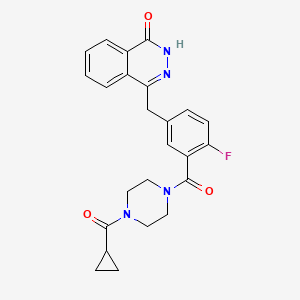
| Formula | C24H23FN4O3 |
|---|---|
| Molecular weight | 434.47 g/mol |
| IUPAC name | 4-[[3-[4-(cyclopropanecarbonyl)piperazine-1-carbonyl]-4-fluorophenyl]methyl]-2H-phthalazin-1-one |
| CAS | 763113-22-0 |
| PubChem CID | 23725625 |
| InChIKey | FDLYAMZZIXQODN-UHFFFAOYSA-N |
| logP | 2.35 (XLogP 1.9) |
| Polar surface area | 86.37 Ų |
| H-bond acceptors / donors | 4 / 1 |
| Drug-likeness (QED) | 0.68 |
| Lipinski violations | 0 |
SMILES
O=C(c1cc(Cc2n[nH]c(=O)c3ccccc23)ccc1F)N1CCN(C(=O)C2CC2)CC1Biology & Pharmacokinetics
Pharmacokinetics predicted
| Bioavailability | 70.0% |
|---|---|
| Half-life | 0.855 h |
| Volume of distribution | 0.528 L/kg |
| Protein binding | 96.4% |
| BBB penetrant | No |
Enzyme interactions
| Enzyme | Role | Detail |
|---|---|---|
| CYP2C19 | Inhibitor | — |
| CYP2C19 | Substrate | — |
| CYP2C8 | Inhibitor | — |
| CYP2C9 | Inhibitor | — |
| CYP2C9 | Substrate | — |
| CYP3A4 | Substrate | — |
Receptor binding (top 3)
| Target | Action | Affinity |
|---|---|---|
| poly(ADP-ribose) polymerase 2 (PARP2) | Inhibitor | pIC50 9.0 |
| poly(ADP-ribose) polymerase 1 (PARP1) | Inhibitor | pIC50 8.3 |
| poly (ADP-ribose) polymerase 3 (PARP3) | Inhibitor | pKd 8.2 |
Transporters
BCRP (Inhibitor)BCRP (Inhibitor)BSEP (Inhibitor)MATE1 (Inhibitor)MDR1 (Inhibitor)MRP1 (Inhibitor)MRP2 (Inhibitor)OAT1 (Inhibitor)OATP1B1 (Inhibitor)OATP1B1 (Inhibitor)OATP1B3 (Inhibitor)OATP1B3 (Inhibitor)OCT1 (Inhibitor)OCT2 (Inhibitor)P-gp (Inhibitor)BCRP (Substrate)MDR1 (Substrate)OATP1B1 (Substrate)OATP1B3 (Substrate)P-gp (Substrate)
Drug–drug interactions (100+, DDInter)
| Interacting drug | Severity | Management |
|---|---|---|
| Adalimumab | major | |
| Amprenavir | major | |
| Apalutamide | major | |
| Aprepitant | major | |
| Armodafinil | major | |
| Atazanavir | major | |
| Bacillus calmette-guerin substrain tice live antigen | major | |
| Baricitinib | major | |
| Berotralstat | major | |
| Boceprevir | major | |
| Bosentan | major | |
| Carbamazepine | major | |
| Cenobamate | major | |
| Ceritinib | major | |
| Certolizumab pegol | major | |
| Ciprofloxacin | major | |
| Cladribine | major | |
| Clarithromycin | major | |
| Clozapine | major | |
| Cobicistat | major | |
| Conivaptan | major | |
| Crizotinib | major | |
| Dalfopristin | major | |
| Darunavir | major | |
| Deferiprone | major | |
| Delavirdine | major | |
| Dexamethasone | major | |
| Diltiazem | major | |
| Dronedarone | major | |
| Duvelisib | major | |
| Efavirenz | major | |
| Enzalutamide | major | |
| Erythromycin | major | |
| Etanercept | major | |
| Etravirine | major | |
| Fingolimod | major | |
| Fluconazole | major | |
| Fosamprenavir | major | |
| Fosaprepitant | major | |
| Fosnetupitant | major |
Showing 40 of 100+.
Registered Products (2)
| Brand | Form / strength | Pack | Agent | Citizen (JOD) |
|---|---|---|---|---|
| Lynparza | Tablet 100 mg | 56 tab | Shawi & Rushedat Drug Store | — |
| Lynparza | Tablet 150 mg | 56 tab | Shawi & Rushedat Drug Store | — |