Pasireotide
JFDA label: Signifor 0.3 mg Solution for Inj
Mechanism of Action
Pasireotide is a cyclohexapeptide somatostatin analog, which is a peptide inhibitor of multiple endocrine, neuroendocrine, and exocrine mechanisms. In patients with Cushing disease, pasireotide binds to somatostatin receptor (sst1-5), with high affinity for the sst1, sst2, sst3 subtypes, and highest affinity for the sst5 subtype, resulting in inhibition of ACTH secretion which leads to decreased cortisol secretion. In patients with acromegaly, pasireotide binds to sst2 and sst5, resulting in decreased GH and IGF-1.
Indications
Approved
- Acromegaly (Signifor LAR)
- Cushing disease (Signifor)
Contraindications
Source: Lexicomp
- Hypersensitivity to pasireotide or any component of the formulation Absolute
- NYHA Class III to IV heart failure Absolute
- There are no contraindications listed in the manufacturer’s labeling Absolute
- cardiogenic shock Absolute
- congenital long QT syndrome or baseline QTc interval ≥500 ms Absolute
- moderate or severe hepatic impairment (Child-Pugh B or C) Absolute
- second- or third-degree atrioventricular (AV) block, sinoatrial block, sick sinus syndrome (unless patient has a functioning pacemaker) Absolute
- severe bradycardia Absolute
- uncontrolled diabetes (HbA1c ≥8%) despite receiving anti-diabetic therapy Absolute
Adverse Reactions
Cardiac disorders (6)
Very Common Peripheral edema
Common atrioventricular block · Hypertension · hypotension · prolonged Q-T interval on ECG · sinus bradycardia
Nervous system disorders (6)
Very Common anxiety · fatigue · Headache · insomnia
Common Dizziness · vertigo
Hepatobiliary disorders (3)
Very Common Increased serum ALT
Common Increased serum AST · increased serum bilirubin
Blood and lymphatic system disorders (3)
Very Common elevated glycosylated hemoglobin · Prolonged prothrombin time
Common Anemia
Metabolism and nutrition disorders (11)
Very Common diabetes mellitus · hypercholesterolemia · Hyperglycemia · hypoglycemia · increased gamma-glutamyl transferase
Common adrenal insufficiency · hypokalemia · hypothyroidism · impaired glucose tolerance · Increased serum glucose · weight loss
Gastrointestinal disorders (12)
Very Common abdominal distension · abdominal pain · cholelithiasis · decreased appetite · Diarrhea · increased serum amylase · increased serum lipase · nausea · upper abdominal pain
Common constipation · pancreatitis · vomiting
Skin and subcutaneous tissue disorders (3)
Very Common Alopecia
Common Pruritus · xeroderma
Musculoskeletal and connective tissue disorders (6)
Very Common increased creatine phosphokinase · myalgia · Weakness
Common Arthralgia · back pain · limb pain
Infections and infestations (1)
Very Common Influenza
General disorders and administration site conditions (1)
Very Common Injection site reactions
Respiratory, thoracic and mediastinal disorders (3)
Very Common Nasopharyngitis
Common cough · Upper respiratory tract infection
Dosing
Source: Lexicomp
Warnings & Precautions
Source: Lexicomp
Cardiac disorders
Bradycardia and QT prolongation have been observed with therapy. Use with caution in patients with preexisting cardiac disease, patients with risk factors for bradycardia (eg, high-grade heart block, history of significant bradycardia, receiving concomitant drugs known to cause bradycardia), and/or patients at risk for QT prolongation (eg, congenital long QT, recent MI, heart failure, unstable angina, hypokalemia, hypomagnesemia, receiving concomitant drugs known to cause QT prolongation). Obtain baseline electrocardiogram (ECG) prior to therapy and consider continued monitoring during therapy for an effect on the QTc interval. Correct hypokalemia, hypomagnesemia, and/or hypocalcemia prior to therapy and monitor during therapy.
Cholelithiasis
May impair gallbladder, leading to gallstone formation; monitor patients for cholelithiasis.
Hepatic effects
Increased liver enzymes have been reported; ALT, AST, and bilirubin should be monitored per recommendations in manufacturer’s labeling. May require dosage interruption to investigate probable cause of confirmed or rising liver enzyme values; patients with significant elevations in liver function tests require more frequent monitoring and extensive monitoring (ALT, AST, alkaline phosphatase, total bilirubin).
Hyperglycemia/diabetes
Inhibition of insulin and glucagon secretion may affect glucose regulation, leading to hyperglycemia (sometimes severe). Exacerbation of glycemia occurred in the majority of patients during the initial months of therapy, including patients with normal glucose levels at baseline; diabetes and prediabetes has also been observed. Patients with poor baseline glycemic control are at higher risk of developing severe hyperglycemia. Assess fasting blood glucose (FBG) levels and/or hemoglobin A1c (HbA1c) prior to initiation of therapy. Patients should also do self-monitoring of blood glucose and/or FBG for the first few months of therapy, after dose increases, and periodically during use. If hyperglycemia occurs, initiation or dosage adjustment of antidiabetic therapy is recommended; if uncontrolled hyperglycemia persists despite antidiabetic therapy, consider dosage reduction or discontinuation of pasireotide.
Hypocortisolism
Suppression of the adrenocorticotropic hormone (ACTH) from therapy may lead to hypocortisolism in Cushing disease. Monitor all patients for signs or symptoms of hypocortisolism (eg, anorexia, fatigue, hypoglycemia, hyponatremia, hypotension, nausea, vomiting, weakness). If symptoms occur, consider stopping or reducing the dose until symptoms improve. Glucocorticoid replacement therapy may also be needed temporarily.
Hypothyroidism
Decreases (slight) in thyroid function have been observed during therapy; monitor thyroid function tests prior to therapy and periodically during therapy. Disease-related concerns:
Diabetes
Prior to initiation, patients with poorly controlled or uncontrolled diabetes should have antidiabetic therapy optimized; exacerbation of glycemia commonly occurs with pasireotide use.
Hepatic impairment
Use with caution in patients with hepatic impairment; lower doses are recommended at therapy initiation in patients with moderate impairment (Child-Pugh class B). Use not recommended in patients with severe impairment (Child-Pugh class C). Concurrent drug therapy issues:
Drug-drug interactions
Potentially significant interactions may exist, requiring dose or frequency adjustment, additional monitoring, and/or selection of alternative therapy. Consult drug interactions database for more detailed information. Other warnings/precautions:
Appropriate use
Acromegaly: Signifor LAR: For intramuscular (IM) use; do not administer intravenously (IV). Must be reconstituted and administered by a trained health care provider. Therapy may cause inhibition of additional pituitary hormones (other than GH/IGF-1); additional monitoring for pituitary deficiency is advised (eg, thyroid, adrenal, gonadal) prior to initiation of therapy and periodically thereafter.
Appropriate use
Cushing disease: Signifor: For subcutaneous injection. Evaluate for treatment response with 24-hour urinary free cortisol levels and/or improvement in symptoms. Maximum reduction in urinary free cortisol levels is usually seen by 2 months of therapy. Therapy may cause inhibition of additional pituitary hormones (other than ACTH); additional monitoring for pituitary deficiency is advised (eg, thyroid-stimulating hormone [TSH], free T4, GH, IGF-1), particularly in patients who have undergone transsphenoidal surgery and pituitary irradiation who are at an increased risk for deficiency.
Pregnancy & Lactation
Pregnancy
Adverse events have been observed in animal reproduction studies. Fertility may be improved with treatment in females of reproductive potential following normalization of serum cortisol (in patients with Cushing disease), and the reduction in growth hormone and normalization of insulin-like growth factor (in patients with acromegaly).
Lactation
It is not known if pasireotide is present in breast milk. According to the manufacturer, the decision to breastfeed during therapy should consider the risk of infant exposure, the benefits of breastfeeding to the infant, and benefits of treatment to the mother.
Monitoring
| Clinical pearl | Acromegaly (Signifor LAR): Serum GH and IGF-1; fasting plasma glucose (FBG) and hemoglobin A1c (HbA1c) (prior to initiation and after treatment discontinuation as clinically appropriate); plasma glucose (weekly for the first 3 months of therapy, the first 4 to 6 weeks after dose increases, and periodically thereafter); ECG (baseline; 21 days after injection in patients at high risk; consider continued monitoring during treatment); serum potassium and magnesium (prior to and periodically during therapy); thyroid function (baseline then periodically); adrenal function (prior to and periodically during therapy); gonadal function (prior to and periodically during therapy); signs and symptoms of adrenal insufficiency; heart rate (patients with cardiac disease and/or risk factor for bradycardia); monitor periodically for cholelithiasis. Liver function tests: Prior to initiation, after the first 2 to 3 weeks, then monthly for 3 months and as clinically indicated; during therapy, discontinue if clinically significant liver impairment develops and monitor liver function until resolution. Cushing disease (Signifor): Urinary free cortisol (24-hour); FBG and HbA1c (prior to initiation); FBG and/or self-monitoring glucose (weekly for first 2 to 3 months, as well as over the first 2 to 4 weeks after any dose increase, then periodically during therapy), and FBG or HbA1c (following discontinuation as clinically appropriate); serum GH and IGF-1 (baseline then periodically); thyroid functi |
|---|
Chemistry & Properties
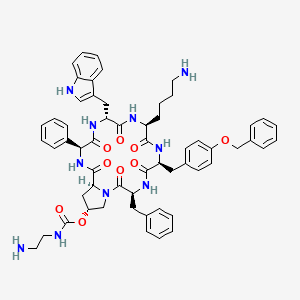
| Formula | C58H66N10O9 |
|---|---|
| Molecular weight | 1047.23 g/mol |
| IUPAC name | [(3S,6S,9S,12R,15S,18S,20R)-9-(4-aminobutyl)-3-benzyl-12-(1H-indol-3-ylmethyl)-2,5,8,11,14,17-hexaoxo-15-phenyl-6-[(4-phenylmethoxyphenyl)methyl]-1,4,7,10,13,16-hexazabicyclo[16.3.0]henicosan-20-yl] N-(2-aminoethyl)carbamate |
| CAS | 396091-73-9 |
| PubChem CID | 9941444 |
| InChIKey | VMZMNAABQBOLAK-DBILLSOUSA-N |
SMILES
NCCCC[C@@H]1NC(=O)[C@@H](Cc2c[nH]c3ccccc23)NC(=O)[C@H](c2ccccc2)NC(=O)[C@@H]2C[C@@H](OC(=O)NCCN)CN2C(=O)[C@H](Cc2ccccc2)NC(=O)[C@H](Cc2ccc(OCc3ccccc3)cc2)NC1=OBiology & Pharmacokinetics
Pharmacokinetics predicted
| Bioavailability | 70.0% |
|---|---|
| Half-life | 1.385 h |
| Volume of distribution | 0.803 L/kg |
| Protein binding | 79.4% |
| BBB penetrant | No |
Enzyme interactions
| Enzyme | Role | Detail |
|---|---|---|
| CYP2C19 | Substrate | — |
| CYP2D6 | Substrate | — |
| CYP3A4 | Inhibitor | — |
Receptor binding (top 4)
| Target | Action | Affinity |
|---|---|---|
| SST5 receptor (SSTR5) | Agonist | pIC50 9.8 |
| SST2 receptor (SSTR2) | Agonist | pIC50 9.0 |
| SST3 receptor (SSTR3) | Agonist | pIC50 8.8 |
| SST1 receptor (SSTR1) | Agonist | pIC50 8.0 |
Transporters
BCRP (Inhibitor)BSEP (Inhibitor)MRP1 (Inhibitor)OATP1B1 (Inhibitor)OATP1B3 (Inhibitor)P-gp (Inhibitor)P-gp (Substrate)
Drug–drug interactions (100+, DDInter)
| Interacting drug | Severity | Management |
|---|---|---|
| Abarelix | major | |
| Abiraterone | major | |
| Adenosine | major | |
| Alfuzosin | major | |
| Alimemazine | major | |
| Amiodarone | major | |
| Amisulpride | major | |
| Amitriptyline | major | |
| Amoxapine | major | |
| Anagrelide | major | |
| Apalutamide | major | |
| Apomorphine | major | |
| Arsenic trioxide | major | |
| Asenapine | major | |
| Astemizole | major | |
| Atomoxetine | major | |
| Azithromycin | major | |
| Bedaquiline | major | |
| Bepridil | major | |
| Bicalutamide | major | |
| Bosutinib | major | |
| Buprenorphine | major | |
| Cabozantinib | major | |
| Ceritinib | major | |
| Chloroquine | major | |
| Chlorpromazine | major | |
| Cilostazol | major | |
| Ciprofloxacin | major | |
| Cisapride | major | |
| Citalopram | major | |
| Clarithromycin | major | |
| Clofazimine | major | |
| Clomipramine | major | |
| Clozapine | major | |
| Copper oxodotreotide Cu-64 | major | |
| Crizotinib | major | |
| Dasatinib | major | |
| Daunorubicin | major | |
| Daunorubicin (liposomal) | major | |
| Degarelix | major |
Showing 40 of 100+.
Registered Products (3)
| Brand | Form / strength | Pack | Agent | Citizen (JOD) |
|---|---|---|---|---|
| Signifor 0.3 mg Solution for Inj | Powder for Injection 0.3 mg | 6 amp | The Jordan Drugstore Co | — |
| Signifor 0.6 mg Solution For Inj | Injection 0.6 mg/ml | 6 amp | The Jordan Drugstore Co | — |
| Signifor 0.9 mg Solution For Inj | Powder for Injection 0.9 mg | 6 amp | The Jordan Drugstore Co | — |