Rivastigmine
JFDA label: Exelon Cap
Mechanism of Action
Inhibitor of Cholinesterases; ACHE & BCHE — Cholinesterases; ACHE & BCHE inhibitor
| Target | Action | Gene / class |
|---|---|---|
| Cholinesterases; ACHE & BCHE efficacy | INHIBITOR |
Indications
Approved
- Alzheimer dementia
- Oral
- Parkinson disease dementia
- Transdermal
Off-label
- Dementia with Lewy bodies
Contraindications
Source: Lexicomp
- Additional contraindications (not in US labeling): Severe hepatic impairment Absolute
- Hypersensitivity to rivastigmine, other carbamate derivatives, or any component of the formulation Absolute
- history of application-site reactions with rivastigmine patch Absolute
- history of severe skin reactions (eg, allergic dermatitis [disseminated], Stevens-Johnson syndrome) with oral or transdermal rivastigmine Absolute
Adverse Reactions
Cardiac disorders (2)
Common Hypertension · syncope
Nervous system disorders (19)
Very Common agitation · Dizziness · falling · headache
Common abnormal gait · aggressive behavior · anxiety · cogwheel rigidity · confusion · depression · drowsiness · drug-induced Parkinson disease · exacerbation of Parkinson disease · Fatigue · hallucination · insomnia · malaise · psychomotor agitation · restlessness
Renal and urinary disorders (2)
Common urinary incontinence · Urinary tract infection
Metabolism and nutrition disorders (2)
Very Common Weight loss
Common Dehydration
Gastrointestinal disorders (9)
Very Common abdominal pain · anorexia · diarrhea · Nausea · vomiting
Common decreased appetite · Dyspepsia · sialorrhea · upper abdominal pain
Skin and subcutaneous tissue disorders (1)
Common Diaphoresis
Musculoskeletal and connective tissue disorders (5)
Very Common Tremor
Common bradykinesia · dyskinesia · hypokinesia · Weakness
General disorders and administration site conditions (4)
Very Common Application site erythema
Common application site irritation · Application site pruritus · application site rash
Dosing
Source: Lexicomp
Warnings & Precautions
Source: Lexicomp
Allergic dermatitis
Disseminated allergic dermatitis has been reported following both oral and transdermal administration. Discontinue use of all routes of rivastigmine therapy in patients who develop disseminated allergic dermatitis. Use of the transdermal patch may result in allergic contact dermatitis; discontinue therapy if an intense local reaction occurs (eg, increasing erythema, edema, papules, vesicles) and if symptoms do not improve after 48 hours of patch removal. If therapy is still required, oral rivastigmine may be used following negative allergy testing; some patients may not be able to take rivastigmine in any form.
CNS depression
May cause CNS depression, which may impair physical or mental abilities; patients must be cautioned about performing tasks that require mental alertness (eg, operating machinery or driving).
Extrapyramidal effects
May exacerbate or induce extrapyramidal symptoms; worsening of symptoms (eg, tremor) in patients with Parkinson disease has been observed.
GI effects
Significant nausea/vomiting/diarrhea or anorexia/weight loss/decreased appetite are associated with use; occurs more frequently in women and during the titration phase. The incidence and severity of these reactions are dose-related; dehydration may result from prolonged vomiting or diarrhea. Monitor weight during therapy.
Vagotonic effects
Rivastigmine may have vagotonic effects which may cause bradycardia and/or heart block with or without a history of cardiac disease. Use with caution in patients with sick-sinus syndrome, bradycardia, or other supraventricular conduction abnormalities. Alzheimer treatment guidelines consider bradycardia to be a relative contraindication for use of centrally-active cholinesterase inhibitors. Disease-related concerns:
Peptic ulcer disease
Use with caution in patients at risk of ulcer disease (eg, previous history or NSAID use); may increase gastric acid secretion. Monitor for symptoms active or occult bleeding.
Respiratory disease
Use with caution in patients with COPD and/or asthma.
Seizure disorder
Use with caution in patients with a history of seizure disorder.
Urinary tract obstruction
Use with caution in patients with bladder outlet obstruction or prostatic hyperplasia; cholinomimetics may cause or worsen outflow obstructions, including possible exacerbation of BPH symptoms. Concurrent drug therapy issues:
Drug-drug interactions
Potentially significant interactions may exist, requiring dose or frequency adjustment, additional monitoring, and/or selection of alternative therapy. Consult drug interactions database for more detailed information. Special populations:
Body weight (low/high)
Systemic exposure may be increased in patients 100 kg. Consider dose reduction if toxicities develop in patients • Smokers: Nicotine increases the clearance of rivastigmine by 23%. Dosage form specific issues:
Transdermal patch
May contain conducting metal (eg, aluminum); remove patch prior to MRI. Other warnings/precautions:
Appropriate use
Postmarketing cases of overdose (including rare fatalities) have been reported in association with medication errors/improper use of rivastigmine transdermal patches. No more than 1 patch should be applied daily and existing patch must be removed prior to applying new patch.
Initiation/interruption of therapy
Should be started at lowest dose and titrated; if treatment is interrupted for >3 days, reinstate at the lowest daily dose.
Pregnancy & Lactation
Pregnancy
Adverse events have not been observed in animal reproduction studies.
Lactation
It is not known if rivastigmine is excreted in breast milk. Due to the potential for serious adverse reactions in the nursing infant, the manufacturer recommends a decision be made whether to discontinue nursing or to discontinue the drug, taking into account the importance of treatment to the mother.
Monitoring
| Clinical pearl | Cognitive function at periodic intervals, symptoms of GI intolerance, weight |
|---|
Chemistry & Properties
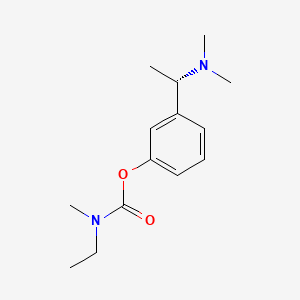
| Formula | C14H22N2O2 |
|---|---|
| Molecular weight | 250.34 g/mol |
| IUPAC name | [3-[(1S)-1-(dimethylamino)ethyl]phenyl] N-ethyl-N-methylcarbamate |
| CAS | 123441-03-2 |
| PubChem CID | 77991 |
| InChIKey | XSVMFMHYUFZWBK-NSHDSACASA-N |
| logP | 2.76 (XLogP 2.3) |
| Polar surface area | 32.78 Ų |
| H-bond acceptors / donors | 3 / 0 |
| Drug-likeness (QED) | 0.82 |
| Lipinski violations | 0 |
SMILES
CCN(C)C(=O)Oc1cccc([C@H](C)N(C)C)c1Biology & Pharmacokinetics
Pharmacokinetics
| BBB penetrant | Yes (logBB 0.88) |
|---|
Enzyme interactions
| Enzyme | Role | Detail |
|---|---|---|
| CYP1A2 | Substrate | — |
| CYP2C19 | Substrate | — |
| CYP2C9 | Substrate | — |
| CYP2D6 | Substrate | — |
| CYP3A4 | Substrate | — |
Receptor binding (top 2)
| Target | Action | Affinity |
|---|---|---|
| butyrylcholinesterase (BCHE) | Inhibitor | pIC50 7.4 |
| acetylcholinesterase (Yt blood group) (ACHE) | Inhibitor | pIC50 5.4 |
Transporters
BCRP (Inhibitor)BSEP (Inhibitor)MRP1 (Inhibitor)OATP1B1 (Inhibitor)OATP1B3 (Inhibitor)P-gp (Inhibitor)P-gp (Substrate)
Drug–drug interactions (100+, DDInter)
| Interacting drug | Severity | Management |
|---|---|---|
| Bupropion | major | |
| Iohexol | major | |
| Iopamidol | major | |
| Ozanimod | major | |
| Siponimod | major | |
| Abarelix | moderate | |
| Acrivastine | moderate | |
| Alectinib | moderate | |
| Alimemazine | moderate | |
| Anagrelide | moderate | |
| Arsenic trioxide | moderate | |
| Astemizole | moderate | |
| Atropine | moderate | |
| Atropine (ophthalmic) | moderate | |
| Azatadine | moderate | |
| Bosutinib | moderate | |
| Brigatinib | moderate | |
| Brompheniramine | moderate | |
| Cabozantinib | moderate | |
| Carbinoxamine | moderate | |
| Ceritinib | moderate | |
| Chlorcyclizine | moderate | |
| Chloroquine | moderate | |
| Chlorpheniramine | moderate | |
| Cilostazol | moderate | |
| Cimetidine | moderate | |
| Cisapride | moderate | |
| Clarithromycin | moderate | |
| Clemastine | moderate | |
| Clidinium | moderate | |
| Crizotinib | moderate | |
| Cyclizine | moderate | |
| Cyproheptadine | moderate | |
| Dasatinib | moderate | |
| Daunorubicin | moderate | |
| Daunorubicin (liposomal) | moderate | |
| Degarelix | moderate | |
| Dexbrompheniramine | moderate | |
| Dicyclomine | moderate | |
| Diphenhydramine | moderate |
Showing 40 of 100+.
Registered Products (24)
| Brand | Form / strength | Pack | Agent | Citizen (JOD) |
|---|---|---|---|---|
| Rivetal | Tablet 1.5 mg | 28 tab | Orient Montreal Drug Store | 6.840 |
| Rivalon | Capsule 1.5 mg | 30 cap | JORDAN RIVER PHARMA.IND(JORIVER)/JORDAN | 8.950 |
| Stegmex | Tablet 1.5 mg | 30 tab | Jordan Sweden Medical & Sterilization Co. | 8.950 |
| Rivetal | Tablet 3 mg | 28 tab | Orient Montreal Drug Store | 9.840 |
| Rivetal | Tablet 4.5 mg | 28 tab | Orient Montreal Drug Store | 11.380 |
| Rivetal | Tablet 6 mg | 28 tab | Orient Montreal Drug Store | 11.780 |
| Exelon Cap | Capsule 1.5 mg | 28 cap | The Jordan Drugstore Co | 11.940 |
| Rivalon | Capsule 3.0 mg | 30 cap | JORDAN RIVER PHARMA.IND(JORIVER)/JORDAN | 14.680 |
| Stegmex | Capsule 3 mg | 30 cap | Jordan Sweden Medical & Sterilization Co. | 14.680 |
| Rivalon | Capsule 4.5 mg | 30 cap | JORDAN RIVER PHARMA.IND(JORIVER)/JORDAN | 20.410 |
| Stegmex | Tablet 4.5 mg | 30 tab | Jordan Sweden Medical & Sterilization Co. | 20.410 |
| Rivalon | Capsule 6.0 mg | 30 cap | JORDAN RIVER PHARMA.IND(JORIVER)/JORDAN | 25.060 |
| Stegmex | Capsule 6 mg | 30 cap | Jordan Sweden Medical & Sterilization Co. | 25.060 |
| Exelon Cap | Capsule 3 mg | 28 cap | The Jordan Drugstore Co | 25.080 |
| Stegmex | Injection 2 mg/ml | 100 ml | Jordan Sweden Medical & Sterilization Co. | 28.150 |
| Exelon Cap | Capsule 4.5 mg | 28 cap | The Jordan Drugstore Co | 30.060 |
| Exelon Cap | Capsule 6 mg | 28 cap | The Jordan Drugstore Co | 32.630 |
| Trivacin 4.6mg/24h | Patch 4.6 mg | 30 patch | Khoury Drug Store | 38.880 |
| Trivacin 9.5mg/24h | Patch 9.5 mg | 30 patch | Khoury Drug Store | 38.880 |
| Rivaxel 13.3 mg/24 H Trandermal Patch | Patch 13.3 mg/24h | 30 | Hikma Pharmaceuticals Co.Ltd/Jordan | 46.240 |
| Rivaxel 4.6 mg/24 H Trandermal Patch | Patch 4.6 mg/24h | 30 | Hikma Pharmaceuticals Co.Ltd/Jordan | 46.240 |
| Rivaxel 9.5 mg/24 H Trandermal Patch | Patch 9.5 mg/24h | 30 | Hikma Pharmaceuticals Co.Ltd/Jordan | 46.240 |
| Exelon Patch 10 | Patch 9.5 mg/24hr | 30 patch | The Jordan Drugstore Co | 73.130 |
| Exelon Patch 5 | Patch 4.6 mg/24h | 30 Transdermal Patch | The Jordan Drugstore Co | 73.130 |