Thiotepa
JFDA label: Tiplex 15mg
- Myelosuppression: Thiotepa may cause severe marrow suppression, and high doses may cause marrow ablation with resulting infection or bleeding. Monitor hematologic laboratory parameters. Hematopoietic
Mechanism of Action
Inhibitor of DNA — DNA inhibitor
| Target | Action | Gene / class |
|---|---|---|
| DNA efficacy | INHIBITOR |
Indications
Approved
- Beta-thalassemia, class 3
Off-label
- Hematopoietic stem cell transplant (HSCT) for CNS malignancy
- Leptomeningeal metastases (intrathecal)
Contraindications
Source: Lexicomp
- Known hypersensitivity (allergy) to thiotepa or any component of the formulation Absolute
- concomitant use with live or attenuated vaccines (Tepadina) Absolute
Adverse Reactions
Nervous system disorders (5)
Not Known Dizziness · fatigue · headache · Intracranial hemorrhage · seizure
Hepatobiliary disorders (3)
Not Known Increased serum ALT · increased serum AST · increased serum bilirubin
Renal and urinary disorders (5)
Not Known Cystitis · dysuria · hemorrhagic cystitis · inhibition of Spermatogenesis · urinary retention
Blood and lymphatic system disorders (4)
Not Known Anemia · hemorrhage · neutropenia · thrombocytopenia
Immune system disorders (2)
Not Known Anaphylactic shock · hypersensitivity reaction
Metabolism and nutrition disorders (1)
Not Known Amenorrhea
Gastrointestinal disorders (5)
Not Known Abdominal pain · anorexia · Mucositis · nausea · vomiting
Skin and subcutaneous tissue disorders (6)
Not Known Alopecia · contact dermatitis · dermatitis · skin depigmentation · Skin rash · urticaria
Musculoskeletal and connective tissue disorders (1)
Not Known Weakness
Eye disorders (2)
Not Known Blurred vision · conjunctivitis
Infections and infestations (2)
Not Known Cytomegalovirus disease · Infection
General disorders and administration site conditions (2)
Not Known Febrile reaction · Pain at injection site
Respiratory, thoracic and mediastinal disorders (4)
Not Known Asthma · laryngeal edema · Pneumonia · wheezing
Dosing
Source: Lexicomp
Warnings & Precautions
Source: Lexicomp
Bone marrow suppression
Myelosuppression (leukopenia, thrombocytopenia, and anemia) may commonly occur, particularly when used as part of the preparative regimen for hematopoietic stem cell transplantation (HSCT) or in patients with compromised bone marrow function. Do not initiate the HSCT conditioning regimen if a stem cell donor is not available. Monitor blood counts closely. Monitor for infection or bleeding; death due to septicemia and hemorrhage has occurred. Myelosuppression (including fatal cases) has also been reported with intravesicular administration (due to systemic absorption).
CNS effects
Fatal encephalopathy has been reported in patients receiving high-dose thiotepa. Headache, apathy, psychomotor retardation, disorientation, confusion, amnesia, hallucinations, drowsiness, somnolence, seizures, coma, inappropriate behavior, and forgetfulness have also been reported (may be dose dependent). If severe or life-threatening central nervous system toxicity occurs, discontinue treatment and manage as necessary. CNS toxicity, including seizures and intracranial hemorrhage was reported in pediatric patients who receive the recommended dose in combination with busulfan and cyclophosphamide as a stem cell conditioning regimen for beta thalassemia; do not exceed the recommended dose.
Dermatologic toxicity
In patients receiving high-dose thiotepa, the parent drug and/or its active metabolites may be partially excreted through the skin. Thiotepa may cause skin discoloration, pruritus, blistering, desquamation, and peeling (may be more severe in skin folds, groin, axillae, and neck areas, and under dressings). Change occlusive dressing and clean covered skin at least twice daily during and for 48 hours after thiotepa administration (when used as a component of the HSCT preparative regimen). Patients should shower/bathe in water twice daily through 48 hours after receiving thiotepa. Change bed sheets daily. Accidental thiotepa exposure is also associated with skin reactions; wash skin thoroughly with soap and water and flush mucous membranes if skin and/or mucous membrane contact occurs.
GI toxicity
In children, thiotepa is associated with a high emetic potential at doses ≥300 mg/m2 (Dupuis 2011) and is associated with a moderate emetic potential (depending on dose/indication) in adults (Hesketh 2017; Roila 2016); antiemetics are recommended to prevent nausea and vomiting. Thiotepa is also associated with mucositis.
Hepatic sinusoidal obstruction syndrome
Hepatic sinusoidal obstruction syndrome (SOS, also called veno-occlusive disease [VOD]) may occur in patients receiving thiotepa in combination with busulfan and cyclophosphamide as a preparative regimen prior to HSCT. Monitor serum transaminases, bilirubin and for signs/symptoms of hepatic SOS through day +28 of stem cell transplant; provide supportive care if SOS develops.
Hypersensitivity
Clinically significant hypersensitivity reactions (including anaphylaxis) have occurred. If an anaphylactic or other clinically significant hypersensitivity reaction occurs, discontinue thiotepa treatment and initiate appropriate supportive management. Monitor until resolution of symptoms.
Secondary malignancies
Thiotepa is potentially carcinogenic; myelodysplastic syndrome and acute myeloid leukemia (AML) have been reported. There is an increased risk of secondary malignancies with thiotepa use. Disease-related concerns:
Hepatic impairment
Use with caution in patients with hepatic impairment; thiotepa is extensively hepatically metabolized; moderate (bilirubin >1.5 to 3 times ULN and any AST) or severe (bilirubin >3 times ULN and any AST) impairment may result in increased plasma concentrations and increased toxicity. Monitor closely.
Renal impairment
Use with caution in patients with renal impairment; decreased renal excretion may result in increased thiotepa and TEPA plasma concentrations and increased toxicity. Monitor closely. Concurrent drug therapy issues:
Drug-drug interactions
Potentially significant interactions may exist, requiring dose or frequency adjustment, additional monitoring, and/or selection of alternative therapy. Consult drug interactions database for more detailed information.
Vaccines
Do not administer live or attenuated viral or bacterial vaccines until the immunosuppressive effects of thiotepa have resolved. Other warnings/precautions:
Intrathecal safety
When used for intrathecal administration (off-label route), should not be prepared during the preparation of any other agents. After preparation, keep intrathecal medications in an isolated location or container clearly marked with a label identifying as "intrathecal" use only. Delivery of intrathecal medications to the patient should only be with other medications also intended for administration into the central nervous system (Jacobson 2009).
Pregnancy & Lactation
Pregnancy
Adverse events were observed in animal reproduction studies. Based on the mechanism of action, thiotepa may cause fetal harm if used in pregnant women. Verify pregnancy status in women of reproductive potential prior to therapy initiation. Effective contraception should be used during treatment and for at least 6 months after the final dose. Males with female partners of reproductive potential should use effective contraception during therapy and for at least 1 year after the final dose. Both male and female fertility may be affected by thiotepa administration.
Lactation
It is not known if thiotepa is present in breast milk. Due to the potential for serious adverse reactions in the breastfed infant, breastfeeding is not recommended by the manufacturer.
Monitoring
| Clinical pearl | CBC with differential and platelet count frequently throughout therapy; renal and liver function tests; signs/symptoms of hypersensitivity reactions, dermatologic toxicity, hepatic sinusoidal obstruction syndrome, and CNS toxicity |
|---|
Chemistry & Properties
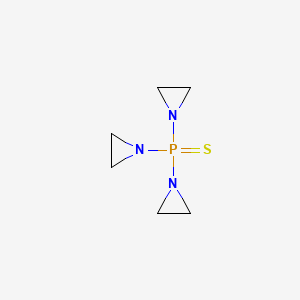
| Formula | C6H12N3PS |
|---|---|
| Molecular weight | 189.22 g/mol |
| IUPAC name | tris(aziridin-1-yl)-sulfanylidene-lambda5-phosphane |
| CAS | 52-24-4 |
| PubChem CID | 5453 |
| InChIKey | FOCVUCIESVLUNU-UHFFFAOYSA-N |
| logP | 0.16 (XLogP 0.5) |
| Polar surface area | 9.03 Ų |
| H-bond acceptors / donors | 1 / 0 |
| Drug-likeness (QED) | 0.46 |
| Lipinski violations | 0 |
SMILES
S=P(N1CC1)(N1CC1)N1CC1Biology & Pharmacokinetics
Pharmacokinetics predicted
| Bioavailability | 10.0% |
|---|---|
| Half-life | 2.199 h |
| Volume of distribution | 1.285 L/kg |
| Protein binding | 3.0% |
| BBB penetrant | Yes |
Enzyme interactions
| Enzyme | Role | Detail |
|---|---|---|
| CYP1A2 | Substrate | — |
| CYP2B6 | Inhibitor | Ki 7.476966369704569 µM |
| CYP2B6 | Substrate | — |
| CYP2C19 | Substrate | — |
| CYP2C8 | Inhibitor | — |
| CYP3A4 | Substrate | — |
Receptor binding (top 1)
| Target | Action | Affinity |
|---|---|---|
| CYP2B6 (CYP2B6) | Inhibitor | pKi 5.3 |
Transporters
BCRP (Inhibitor)BSEP (Inhibitor)BSEP (Inhibitor)MRP1 (Inhibitor)MRP2 (Inhibitor)MRP3 (Inhibitor)MRP4 (Inhibitor)OATP1B1 (Inhibitor)OATP1B1 (Inhibitor)OATP1B3 (Inhibitor)OATP1B3 (Inhibitor)OATP2B1 (Inhibitor)P-gp (Inhibitor)P-gp (Substrate)
Drug–drug interactions (100+, DDInter)
| Interacting drug | Severity | Management |
|---|---|---|
| Adalimumab | major | |
| Bacillus calmette-guerin substrain tice live antigen | major | |
| Baricitinib | major | |
| Busulfan | major | |
| Carboplatin | major | |
| Carmustine | major | |
| Certolizumab pegol | major | |
| Chlorambucil | major | |
| Cisplatin | major | |
| Cladribine | major | |
| Clozapine | major | |
| Cyclophosphamide | major | |
| Deferiprone | major | |
| Etanercept | major | |
| Fingolimod | major | |
| Golimumab | major | |
| Ifosfamide | major | |
| Infliximab | major | |
| Leflunomide | major | |
| Lomustine | major | |
| Lurbinectedin | major | |
| Measles virus vaccine live attenuated | major | |
| Mechlorethamine | major | |
| Melphalan | major | |
| Mumps virus strain B level jeryl lynn live antigen | major | |
| Nalidixic acid | major | |
| Natalizumab | major | |
| Ozanimod | major | |
| Rotavirus vaccine | major | |
| Rubella virus vaccine | major | |
| Samarium (153Sm) lexidronam | major | |
| Siponimod | major | |
| Smallpox (Vaccinia) Vaccine, Live | major | |
| Streptozocin | major | |
| Talimogene laherparepvec | major | |
| Teriflunomide | major | |
| Thalidomide | major | |
| Tofacitinib | major | |
| Typhoid vaccine (live) | major | |
| Upadacitinib | major |
Showing 40 of 100+.
Registered Products (1)
| Brand | Form / strength | Pack | Agent | Citizen (JOD) |
|---|---|---|---|---|
| Tiplex | Vial 15 mg | 1 vial | Hikma Pharmaceuticals Co.Ltd/Jordan | — |