Topotecan
JFDA label: Topotecan Hospira
- Bone marrow suppression:
Mechanism of Action
Binds to topoisomerase I and stabilizes the cleavable complex so that religation of the cleaved DNA strand cannot occur. This results in the accumulation of cleavable complexes and single-strand DNA breaks. Topotecan acts in S phase of the cell cycle.
Indications
Approved
- Cervical cancer, recurrent or resistant
- Injection
- Oral
- Ovarian cancer, metastatic
- Small cell lung cancer, relapsed
Off-label
- Acute myeloid leukemia (induction in older adults)
- CNS malignancy, relapsed/refractory
- Ewing sarcoma
- Neuroblastoma, relapsed/refractory
- Ovarian cancer, metastatic (off-label [weekly] dosing)
- Primary CNS lymphoma, relapsed or refractory
- Rhabdomyosarcoma
Class profile
| mechanismClass | Plant alkaloid (camptothecin, topoisomerase I inhibitor) |
|---|---|
| targetMolecule | Topoisomerase I |
| targetPathway | DNA replication |
| generation | Classic |
| primaryTumors | Ovarian,SCLC,Cervical |
| resistanceMechanisms | ABCG2/BCRP efflux,MDR1/P-gp efflux,Topoisomerase I downregulation |
| source | NCCN/OncoKB/Goodman&Gilman13ed |
Contraindications
Source: Lexicomp
- Additional contraindications (not in the US labeling): Severe renal impairment (CrCl Absolute
- Severe hypersensitivity to topotecan or any component of the formulation Absolute
Adverse Reactions
Nervous system disorders (1)
Very Common Fatigue
Hepatobiliary disorders (1)
Common Increased liver enzymes
Blood and lymphatic system disorders (5)
Very Common Anemia · febrile neutropenia · neutropenia · neutropenic infection · thrombocytopenia
Gastrointestinal disorders (5)
Very Common anorexia · diarrhea · Nausea · vomiting
Common Abdominal pain
Skin and subcutaneous tissue disorders (1)
Very Common Alopecia
Musculoskeletal and connective tissue disorders (1)
Common Weakness
General disorders and administration site conditions (2)
Common Fever · sepsis
Respiratory, thoracic and mediastinal disorders (1)
Common Dyspnea
Dosing
Source: Lexicomp
Warnings & Precautions
Source: Lexicomp
Bone marrow suppression
May cause severe myelosuppression. Monitor blood counts frequently. Do NOT administer to patients with baseline neutrophils 3 and platelets 3. The dose-limiting toxicity is bone marrow suppression (primarily neutropenia); may also cause thrombocytopenia and anemia. Grade 3 and 4 events were common. Severe myelotoxicity has also been reported when used in combination with cisplatin. Neutropenia is not cumulative over time. The median duration of neutropenia and thrombocytopenia was 7 days and 5 days, respectively. Nadir neutrophil and platelet counts occurred at a median of 15 days (when administered orally). In a clinical study comparing IV to oral topotecan, G-CSF support was administered in a higher percentage of patients receiving oral topotecan (Eckardt 2007). Bone marrow suppression may require dosage reduction and/or growth factor support.
Extravasation
Extravasation injuries have been reported (some severe); if extravasation occurs, discontinue infusion immediately and manage appropriately. Ensure proper needle or catheter placement prior to and during infusion. Avoid extravasation.
Gastrointestinal toxicity
Diarrhea has been reported with oral topotecan; may be severe (requiring hospitalization); educate patients on early recognition and proper management, including diet changes, increase in fluid intake, antidiarrheals, and antibiotics. The median time to onset of diarrhea (grade 2 or worse) was 9 days. The incidence of diarrhea may be higher in the elderly. Do not administer in patients with grade 3 or 4 diarrhea; reduce dose upon recovery to ≤ grade 1 toxicity.
Interstitial lung disease (ILD)
ILD (with fatalities) has been reported; monitor for pulmonary signs/symptoms (eg, dyspnea, fever, cough, hypoxia) and discontinue use in patients with confirmed ILD diagnosis. Risk factors for ILD include a history of ILD, pulmonary fibrosis, lung cancer, thoracic radiation, and the use of colony-stimulating factors or medication with pulmonary toxicity.
Neutropenic enterocolitis
Topotecan-induced neutropenia may lead to typhlitis (neutropenic enterocolitis), including fatalities; should be considered in patients presenting with neutropenia, fever, and abdominal pain. Disease-related concerns:
Renal impairment
Use with caution in patients with renal impairment; may require dose adjustment. Concurrent drug therapy issues:
Drug-drug interactions
Potentially significant interactions may exist, requiring dose or frequency adjustment, additional monitoring, and/or selection of alternative therapy. Consult drug interactions database for more detailed information. Topotecan exposure is increased when oral topotecan is used concurrently with P-glycoprotein inhibitors; avoid concurrent use. Other warnings/precautions:
Safety issue
Topotecan overdoses have been reported; potential causes include omission of the leading zero and missing the decimal point when prescribing, preparing, and administering. Recommended intravenous doses should generally not exceed 4 mg in adults; verify dose prior to administration.
Pregnancy & Lactation
Pregnancy
Adverse effects were observed in animal reproduction studies. May cause fetal harm in pregnant women. Women of childbearing potential should use highly effective contraception to prevent pregnancy during treatment and for at least 1 month after therapy discontinuation. Males with female partners of childbearing potential should use highly effective contraception during treatment and for 3 months after therapy discontinuation. Topotecan may have both acute and long-term effects on fertility in women; fertility in males may be impaired due to effects on spermatogenesis.
Lactation
It is not known if topotecan is present in breast milk. Due to the potential for serious adverse reactions in the breastfeeding infant, the manufacturer recommends to discontinue breastfeeding in women who are receiving topotecan.
Monitoring
| Efficacy | Tumour response (RECIST criteria, tumour markers, imaging); progression-free survival; performance status (ECOG/Karnofsky) |
|---|---|
| Toxicity | CBC with differential (nadir timing depends on agent); LFTs; renal function; ECG (QT for relevant agents); echocardiogram for cardiotoxic agents (anthracyclines, trastuzumab); cumulative dose tracking for dose-limited toxicities |
| Clinical pearl | Treatment response is assessed after 2–3 cycles. Grade 3–4 toxicities typically require dose reduction or interruption per protocol-defined criteria. |
| Counseling | Attend all scheduled blood tests and imaging appointments. Report fever > 38°C (risk of neutropaenic sepsis — medical emergency), unusual bleeding, or new pain immediately. |
Chemistry & Properties
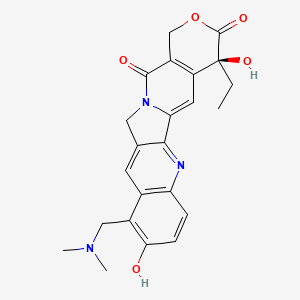
| Formula | C23H23N3O5 |
|---|---|
| Molecular weight | 421.45 g/mol |
| IUPAC name | (19S)-8-[(dimethylamino)methyl]-19-ethyl-7,19-dihydroxy-17-oxa-3,13-diazapentacyclo[11.8.0.02,11.04,9.015,20]henicosa-1(21),2,4(9),5,7,10,15(20)-heptaene-14,18-dione |
| CAS | 123948-87-8 |
| PubChem CID | 60700 |
| InChIKey | UCFGDBYHRUNTLO-QHCPKHFHSA-N |
| logP | 1.85 (XLogP 0.5) |
| Polar surface area | 104.89 Ų |
| H-bond acceptors / donors | 8 / 2 |
| Drug-likeness (QED) | 0.49 |
| Lipinski violations | 0 |
SMILES
CC[C@@]1(O)C(=O)OCc2c1cc1n(c2=O)Cc2cc3c(CN(C)C)c(O)ccc3nc2-1Biology & Pharmacokinetics
Pharmacokinetics
| BBB penetrant | Yes (logBB -0.42) |
|---|
Enzyme interactions
| Enzyme | Role | Detail |
|---|---|---|
| CYP1A2 | Substrate | — |
| CYP3A4 | Inhibitor | IC₅₀ 1.5211000000000006 µM |
| CYP3A4 | Substrate | — |
Transporters
BCRP (Inhibitor)BCRP (Inhibitor)BSEP (Inhibitor)MATE1 (Inhibitor)MATE2 (Inhibitor)MDR1 (Inhibitor)MRP1 (Inhibitor)OATP1B1 (Inhibitor)OATP1B1 (Inhibitor)OATP1B3 (Inhibitor)OATP1B3 (Inhibitor)OATP2B1 (Inhibitor)OCT2 (Inhibitor)P-gp (Inhibitor)BCRP (Substrate)MATE1 (Substrate)MATE2 (Substrate)MDR1 (Substrate)MRP1 (Substrate)MRP2 (Substrate)MRP4 (Substrate)OATP1B1 (Substrate)P-gp (Substrate)Transporter(unspecified) (Substrate)
Drug–drug interactions (100+, DDInter)
| Interacting drug | Severity | Management |
|---|---|---|
| Adalimumab | major | |
| Bacillus calmette-guerin substrain tice live antigen | major | |
| Baricitinib | major | |
| Carboplatin | major | |
| Certolizumab pegol | major | |
| Cisplatin | major | |
| Clozapine | major | |
| Deferiprone | major | |
| Etanercept | major | |
| Fingolimod | major | |
| Golimumab | major | |
| Infliximab | major | |
| Leflunomide | major | |
| Measles virus vaccine live attenuated | major | |
| Mumps virus strain B level jeryl lynn live antigen | major | |
| Natalizumab | major | |
| Oxaliplatin | major | |
| Ozanimod | major | |
| Rotavirus vaccine | major | |
| Rubella virus vaccine | major | |
| Samarium (153Sm) lexidronam | major | |
| Siponimod | major | |
| Smallpox (Vaccinia) Vaccine, Live | major | |
| Talimogene laherparepvec | major | |
| Teriflunomide | major | |
| Thalidomide | major | |
| Tofacitinib | major | |
| Typhoid vaccine (live) | major | |
| Upadacitinib | major | |
| Varicella Zoster Vaccine (Recombinant) | major | |
| Yellow Fever Vaccine | major | |
| Abemaciclib | moderate | |
| Acalabrutinib | moderate | |
| Aflibercept | moderate | |
| Aldesleukin | moderate | |
| Alefacept | moderate | |
| Alemtuzumab | moderate | |
| Alpelisib | moderate | |
| Altretamine | moderate | |
| Anakinra | moderate |
Showing 40 of 100+.
Registered Products (2)
| Brand | Form / strength | Pack | Agent | Citizen (JOD) |
|---|---|---|---|---|
| Hycamtin 4mg Powder For Solution For Infusion | Infusion 4 mg | 5 | Nabulsi Drug Store | — |
| Topotecan Hospira | Vial 4 mg/4 ml | 5 vial | Petra Drug Store | — |