Vortioxetine
JFDA label: Brintellix 15 mg
- Suicidal thoughts and behaviors:
Mechanism of Action
Inhibits reuptake of serotonin (5-HT); also has agonist activity at the 5-HT1A receptor and antagonist activity at the 5-HT3 receptor.
Indications
Approved
- Major depressive disorder
Contraindications
Source: Lexicomp
- Hypersensitivity (eg, angioedema) to vortioxetine or any component of the formulation Absolute
- initiation of vortioxetine in a patient receiving linezolid or intravenous methylene blue Absolute
- use of MAO inhibitors intended to treat psychiatric disorders (concurrently or within 21 days of discontinuing vortioxetine or within 14 days of discontinuing the MAO inhibitor) Absolute
Adverse Reactions
Nervous system disorders (4)
Very Common Female sexual disorder · male sexual disorder
Common abnormal dreams · Dizziness
Gastrointestinal disorders (6)
Very Common Nausea
Common constipation · Diarrhea · flatulence · vomiting · xerostomia
Skin and subcutaneous tissue disorders (1)
Common Pruritus
Dosing
Source: Lexicomp
Warnings & Precautions
Source: Lexicomp
Suicidal thinking/behavior
Antidepressants increase the risk of suicidal thinking and behavior in children, adolescents, and young adults (18 to 24 years) with major depressive disorder (MDD) and other psychiatric disorders; consider risk prior to prescribing. Short-term studies did not show an increased risk in patients >24 years and showed a decreased risk in patients ≥65 years. Closely monitor patients for clinical worsening, suicidality, or unusual changes in behavior, particularly during the initial 1 to 2 months of therapy or during periods of dosage adjustments (increases or decreases); the patient’s family or caregiver should be instructed to closely observe the patient and communicate condition with health care provider. A medication guide concerning the use of antidepressants should be dispensed with each prescription. Vortioxetine is not approved for use in children. The possibility of a suicide attempt is inherent in major depression and may persist until remission occurs. Worsening depression and severe abrupt suicidality that are not part of the presenting symptoms may require discontinuation or modification of drug therapy. Use caution in high-risk patients during initiation of therapy. Prescriptions should be written for the smallest quantity consistent with good patient care. The patient's family or caregiver should be alerted to monitor patients for the emergence of suicidality and associated behaviors such as anxiety, agitation, panic attacks, insomnia, irritability, hostility, aggre
Bleeding risk
May impair platelet aggregation resulting in increased risk of bleeding events, particularly if used concomitantly with aspirin, NSAIDs, warfarin or other anticoagulants. Bleeding related to antidepressant use has been reported to range from relatively minor bruising and epistaxis to life-threatening hemorrhage.
CNS depression
May cause CNS depression, which may impair physical or mental abilities; patients must be cautioned about performing tasks that require mental alertness (eg, operating machinery or driving).
Fractures
Bone fractures have been associated with antidepressant treatment. Consider the possibility of a fragility fracture if an antidepressant-treated patient presents with unexplained bone pain, point tenderness, swelling, or bruising (Rabenda, 2013; Rizzoli, 2012).
Ocular effects
May cause mild pupillary dilation which in susceptible individuals can lead to an episode of narrow-angle glaucoma. Consider evaluating patients who have not had an iridectomy for narrow-angle glaucoma risk factors.
Serotonin syndrome
Potentially life-threatening serotonin syndrome (SS) has occurred with serotonergic antidepressants (eg, SSRIs, SNRIs), particularly when used in combination with other serotonergic agents (eg, triptans, TCAs, fentanyl, lithium, tramadol, buspirone, St John's wort, tryptophan) or agents that impair metabolism of serotonin (eg, MAO inhibitors intended to treat psychiatric disorders, other MAO inhibitors [ie, linezolid and intravenous methylene blue]). Monitor patients closely for signs of SS such as mental status changes (eg, agitation, hallucinations, delirium, coma); autonomic instability (eg, tachycardia, labile blood pressure, diaphoresis); neuromuscular changes (eg, tremor, rigidity, myoclonus); GI symptoms (eg, nausea, vomiting, diarrhea); and/or seizures. Discontinue treatment (and any concomitant serotonergic agent) immediately if signs/symptoms arise.
SIADH and hyponatremia
Serotonergic drugs have been associated with the development of SIADH; hyponatremia has been reported (including severe cases with serum sodium Disease-related concerns:
Mania/hypomania
May precipitate a mixed/manic episode in patients at risk for bipolar disorder. Use with caution in patients with a family history of bipolar disorder, mania, or hypomania. Patients presenting with depressive symptoms should be screened for bipolar disorder. Vortioxetine is not FDA approved for the treatment of bipolar depression.
Seizure disorders
Use with caution in patients with seizure disorders, a prior history of seizure disorder, or conditions predisposing to seizures; seizures (rare) have been reported in patients without a prior history of seizures. Concurrent drug therapy issues:
Drug-drug interactions
Potentially significant interactions may exist, requiring dose or frequency adjustment, additional monitoring, and/or selection of alternative therapy. Consult drug interactions database for more detailed information. Other warnings/precautions:
Discontinuation syndrome
Abrupt discontinuation or interruption of antidepressant therapy has been associated with a discontinuation syndrome. Symptoms arising may vary with antidepressant however commonly include nausea, vomiting, diarrhea, headaches, lightheadedness, dizziness, diminished appetite, sweating, chills, tremors, paresthesias, fatigue, somnolence, and sleep disturbances (eg, vivid dreams, insomnia). Less common symptoms include electric shock-like sensations, cardiac arrhythmias (more common with tricyclic antidepressants), myalgias, parkinsonism, arthralgias, and balance difficulties. Psychological symptoms may also emerge such as agitation, anxiety, akathisia, panic attacks, irritability, aggressiveness, worsening of mood, dysphoria, mood lability, hyperactivity, mania/hypomania, depersonalization, decreased concentration, slowed thinking, confusion, and memory or concentration difficulties. Greater risks for developing a discontinuation syndrome have been associated with antidepressants with shorter half-lives, longer durations of treatment, and abrupt discontinuation. For antidepressants of short or intermediate half-lives, symptoms may emerge within 2 to 5 days after treatment discontinuation and last 7 to 14 days (APA 2010; Fava 2006; Haddad 2001; Shelton 2001; Warner 2006).
Pregnancy & Lactation
Pregnancy
Nonteratogenic effects in the newborn following SSRI/SNRI exposure late in the third trimester include respiratory distress, cyanosis, apnea, seizures, temperature instability, feeding difficulty, vomiting, hypoglycemia, hypo- or hypertonia, hyper-reflexia, jitteriness, irritability, constant crying, and tremor. Symptoms may be due to the toxicity of the SSRIs/SNRIs or a discontinuation syndrome and may be consistent with serotonin syndrome associated with SSRI treatment. Persistent pulmonary hypertension of the newborn (PPHN) has also been reported with SSRI exposure. The ACOG recommends that therapy with SSRIs or SNRIs during pregnancy be individualized; treatment of depression during pregnancy should incorporate the clinical expertise of the mental health clinician, obstetrician, primary health care provider, and pediatrician (ACOG 2008). According to the American Psychiatric Association (APA), the risks of medication treatment should be weighed against other treatment options and
Lactation
It is not known if vortioxetine is present in breast milk. According to the manufacturer, the decision to breastfeed during therapy should consider the risk of infant exposure, the benefits of breastfeeding to the infant, and benefits of treatment to the mother
Monitoring
| Clinical pearl | Mental status for depression, suicidal ideation (especially at the beginning of therapy or when doses are increased or decreased), anxiety, social functioning, mania, panic attacks; akathisia; signs/symptoms of serotonin syndrome and/or hyponatremia; hepatic function (baseline). |
|---|
Chemistry & Properties
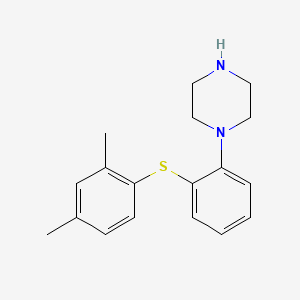
| Formula | C18H22N2S |
|---|---|
| Molecular weight | 298.46 g/mol |
| IUPAC name | 1-[2-(2,4-dimethylphenyl)sulfanylphenyl]piperazine |
| CAS | 508233-74-7 |
| PubChem CID | 9966051 |
| InChIKey | YQNWZWMKLDQSAC-UHFFFAOYSA-N |
| logP | 3.86 (XLogP 4.2) |
| Polar surface area | 15.27 Ų |
| H-bond acceptors / donors | 3 / 1 |
| Drug-likeness (QED) | 0.93 |
| Lipinski violations | 0 |
SMILES
Cc1ccc(Sc2ccccc2N2CCNCC2)c(C)c1Biology & Pharmacokinetics
Pharmacokinetics predicted
| Bioavailability | 70.0% |
|---|---|
| Half-life | 0.157 h |
| Volume of distribution | 27.196 L/kg |
| Protein binding | 87.4% |
| BBB penetrant | Yes |
Enzyme interactions
| Enzyme | Role | Detail |
|---|---|---|
| ADH | Substrate | — |
| ALDH | Substrate | — |
| CYP1A2 | Inhibitor | — |
| CYP1A2 | Substrate | — |
| CYP2A6 | Substrate | — |
| CYP2C19 | Substrate | — |
| CYP2C9 | Substrate | — |
| CYP2D6 | Substrate | — |
| CYP3A4 | Inhibitor | — |
| CYP3A4 | Substrate | — |
Receptor binding (top 7)
| Target | Action | Affinity |
|---|---|---|
| SERT (SLC6A4) | Inhibitor | pKi 8.8 |
| 5-HT3AB (HTR3A|HTR3B) | Agonist | pKi 8.4 |
| 5-HT1A receptor (HTR1A) | Agonist | pKi 7.8 |
| 5-HT1B receptor (HTR1B) | Agonist | pKi 7.5 |
| 5-HT5A receptor (HTR5A) | Antagonist | pKi 6.7 |
| 5-HT6 receptor (HTR6) | Antagonist | pKi 6.5 |
| 5-HT7 receptor (HTR7) | Antagonist | pKi 6.3 |
Transporters
BCRP (Inhibitor)BSEP (Inhibitor)MDR1 (Inhibitor)MRP1 (Inhibitor)OATP1B1 (Inhibitor)OATP1B3 (Inhibitor)P-gp (Inhibitor)MDR1 (Substrate)P-gp (Substrate)
Drug–drug interactions (100+, DDInter)
| Interacting drug | Severity | Management |
|---|---|---|
| Bupropion | major | |
| Cinacalcet | major | |
| Dacomitinib | major | |
| Dexfenfluramine | major | |
| Dextromethorphan | major | |
| Diethylpropion | major | |
| Dolasetron | major | |
| Doxepin | major | |
| Doxepin (topical) | major | |
| Fenfluramine | major | |
| Granisetron | major | |
| Iohexol | major | |
| Iopamidol | major | |
| Lorcaserin | major | |
| Mazindol | major | |
| Methylene blue | major | |
| Ondansetron | major | |
| Palonosetron | major | |
| Panobinostat | major | |
| Phentermine | major | |
| Phenylpropanolamine | major | |
| Procarbazine | major | |
| Sibutramine | major | |
| Terbinafine | major | |
| Abciximab | moderate | |
| Acalabrutinib | moderate | |
| Acetohexamide | moderate | |
| Acetylsalicylic acid | moderate | |
| Alteplase | moderate | |
| Aminoglutethimide | moderate | |
| Anagrelide | moderate | |
| Anistreplase | moderate | |
| Antithrombin III human | moderate | |
| Apalutamide | moderate | |
| Apixaban | moderate | |
| Argatroban | moderate | |
| Betrixaban | moderate | |
| Bexarotene | moderate | |
| Bivalirudin | moderate | |
| Cabozantinib | moderate |
Showing 40 of 100+.
Registered Products (18)
| Brand | Form / strength | Pack | Agent | Citizen (JOD) |
|---|---|---|---|---|
| Rovaxar | Tablet 5 mg | 30 tab | UNITED PHARM.MFG.CO.LTD(UPM)/JORDAN | 8.390 |
| Brex | Tablet 5 mg | 30 tab | joswe medical | 8.410 |
| Vorasan | Tablet 5 mg | 30 tab | SANA PHARMACEUTICAL INDUSTRY/JORDAN | 12.430 |
| Brintellix | Tablet as Hydrobromide 5 mg | 28 tab | Abu Sharef Medical Stores | 12.890 |
| Brex | Tablet 10 mg | 30 tab | joswe medical | 13.750 |
| Rovaxar | Tablet 10 mg | 30 tab | UNITED PHARM.MFG.CO.LTD(UPM)/JORDAN | 13.750 |
| Brex | Tablet 15 mg | 30 tab | joswe medical | 18.850 |
| Rovaxar 15 mg film coated Tablets | Film-Coated Tablet 15 mg | 30 tab | UNITED PHARM.MFG.CO.LTD(UPM)/JORDAN | 18.930 |
| Rovaxar 20 mg film coated Tablets | Film-Coated Tablet 20 mg | 30 tab | UNITED PHARM.MFG.CO.LTD(UPM)/JORDAN | 19.200 |
| Brex | Tablet 20 mg | 30 tab | joswe medical | 19.230 |
| Vorasan | Tablet 10 mg | 30 tab | SANA PHARMACEUTICAL INDUSTRY/JORDAN | 20.390 |
| Vurteox 10mg Film Coated Tablet | Film-Coated Tablet Vortioxetine Hydrobromide 10 mg | 30 tab | The Arab Pharmaceutical Manufactruing Co | 20.390 |
| Brintellix | Tablet as Hydrobromide 10 mg | 28 tab | Abu Sharef Medical Stores | 21.140 |
| Vorasan | Tablet 15 mg | 30 tab | SANA PHARMACEUTICAL INDUSTRY/JORDAN | 28.340 |
| Brintellix | Tablet as Hydrobromide 15 mg | 28 tab | Abu Sharef Medical Stores | 29.390 |
| Vurteox 20mg Film Coated Tablet | Film-Coated Tablet Vortioxetine Hydrobromide 20 mg | 30 tab | The Arab Pharmaceutical Manufactruing Co | 33.440 |
| Vorasan | Tablet 20 mg | 30 tab | SANA PHARMACEUTICAL INDUSTRY/JORDAN | 34.800 |
| Brintellix | Tablet as Hydrobromide 20 mg | 28 tab | Abu Sharef Medical Stores | 36.090 |