Perindopril
Active form: Perindoprilat.
🧬 Cross-allergy: ACE inhibitors
JFDA label: Hiten 8mg
- Fetal toxicity:
Mechanism of Action
Perindopril is a prodrug for perindoprilat, which acts as a competitive inhibitor of ACE; prevents conversion of angiotensin I to angiotensin II, a potent vasoconstrictor; results in lower levels of angiotensin II which, in turn, causes an increase in plasma renin activity and a reduction in aldosterone secretion.
Indications
Approved
- CAD and hypertension
- Diabetes and hypertension
- Hypertension
- Stable coronary artery disease
Off-label
- Chronic kidney disease (diabetic and nondiabetic population) to slow disease progression
- Heart failure
- Non–ST-elevation acute coronary syndrome
- ST-elevation acute coronary syndrome
Contraindications
Source: Lexicomp · Curated
- Additional contraindications (not in US labeling): Concomitant use with aliskiren in patients with moderate to severe renal impairment (GFR 2) Absolute
- History of ACE-inhibitor-associated angioedema Absolute
- Hypersensitivity (eg, angioedema) to perindopril, other ACE inhibitors, or any component of the formulation Absolute
- breastfeeding Absolute
- concomitant use or within 36 hours of switching to or from a neprilysin inhibitor (eg, sacubitril) Absolute
- concomitant use with aliskiren in patients with diabetes mellitus Absolute
- concomitant use with sacubitril/valsartan Absolute
- extracorporeal treatments leading to contact of blood with negatively charged surfaces Absolute
- hereditary problems of galactose intolerance, glucose-galactose malabsorption, or the Lapp lactase deficiency Absolute
- hereditary/idiopathic angioedema Absolute
- unilateral or bilateral renal artery stenosis Absolute
- women who are pregnant, planning to become pregnant, or women of childbearing potential not using adequate contraception Absolute
Adverse Reactions
Cardiac disorders (4)
Common chest pain · ECG abnormality · Edema · palpitations
Vascular disorders (1)
Common Hypotension (first dose)
Nervous system disorders (7)
Very Common Headache
Common depression · drowsiness · Hypertonia · nervousness · paresthesia · sleep disorder
Hepatobiliary disorders (1)
Common Increased serum ALT
Renal and urinary disorders (3)
Common proteinuria · sexual disorder · Urinary tract infection
Immune system disorders (2)
Common Seasonal allergy
Rare Angioedema
Metabolism and nutrition disorders (3)
Common Increased serum triglycerides · menstrual disease
Uncommon Hyperkalaemia
Gastrointestinal disorders (6)
Common abdominal pain · Diarrhea · dyspepsia · flatulence · nausea · vomiting
Skin and subcutaneous tissue disorders (1)
Common Skin rash
Musculoskeletal and connective tissue disorders (8)
Common arm pain · arthralgia · arthritis · back pain · leg pain · myalgia · neck pain · Weakness
Ear and labyrinth disorders (2)
Common otic infection · Tinnitus
Infections and infestations (1)
Common Viral infection
Investigations (1)
Common Elevated serum creatinine
General disorders and administration site conditions (1)
Common Fever
Respiratory, thoracic and mediastinal disorders (6)
Very Common Cough · Dry cough
Common pharyngitis · rhinitis · sinusitis · Upper respiratory tract infection
Dosing
Source: Lexicomp
Warnings & Precautions
Source: Lexicomp
Angioedema
At any time during treatment (especially following first dose), angioedema may occur rarely with ACE inhibitors; it may involve the head and neck (potentially compromising airway) or the intestine (presenting with abdominal pain). Black patients and patients with idiopathic or hereditary angioedema or previous angioedema associated with ACE inhibitor therapy may be at an increased risk. Risk may also be increased with concomitant use of mTOR inhibitor (eg, everolimus) or neprilysin inhibitor (eg, sacubitril) therapy. Prolonged frequent monitoring may be required especially if tongue, glottis, or larynx are involved as they are associated with airway obstruction. Patients with a history of airway surgery may have a higher risk of airway obstruction. Aggressive early and appropriate management is critical. Use in patients with previous angioedema associated with ACE inhibitor therapy is contraindicated.
Cholestatic jaundice
A rare toxicity associated with ACE inhibitors includes cholestatic jaundice, which may progress to fulminant hepatic necrosis (some fatal); discontinue if marked elevation of hepatic transaminases or jaundice occurs.
Cough
An ACE inhibitor cough is a dry, hacking, nonproductive one that usually occurs within the first few months of treatment and should generally resolve within 1 to 4 weeks after discontinuation of the ACE inhibitor. Other causes of cough should be considered (eg, pulmonary congestion in patients with heart failure) and excluded prior to discontinuation.
Hematologic effects
Another ACE inhibitor, captopril, has been associated with neutropenia with myeloid hypoplasia and agranulocytosis; anemia and thrombocytopenia have also occurred. Patients with renal impairment are at high risk of developing neutropenia. Patients with both renal impairment and collagen vascular disease (eg, systemic lupus erythematosus) are at an even higher risk of developing neutropenia. Periodically monitor CBC with differential in these patients.
Hyperkalemia
May occur with ACE inhibitors; risk factors include renal impairment, diabetes mellitus, concomitant use of potassium-sparing diuretics, potassium supplements and/or potassium containing salts. Use cautiously, if at all, with these agents and monitor potassium closely.
Hypersensitivity reactions
Anaphylactic/anaphylactoid reactions can occur with ACE inhibitors. Severe anaphylactoid reactions may be seen during hemodialysis (eg, CVVHD) with high-flux dialysis membranes (eg, AN69), and rarely, during low density lipoprotein apheresis with dextran sulfate cellulose. Rare cases of anaphylactoid reactions have been reported in patients undergoing sensitization treatment with hymenoptera (bee, wasp) venom while receiving ACE inhibitors.
Hypotension/syncope
Symptomatic hypotension with or without syncope can occur (usually with the first several doses); effects are most often observed in volume-depleted patients; correct volume depletion prior to initiation; close monitoring of patient is required especially with initial dosing and dosing increases; blood pressure must be lowered at a rate appropriate for the patient's clinical condition. Although dose reduction may be necessary, hypotension is not a reason for discontinuation of future ACE inhibitor use especially in patients with heart failure where a reduction in systolic blood pressure is a desirable observation.
Renal function deterioration
May be associated with deterioration of renal function and/or increases in BUN and serum creatinine, particularly in patients with low renal blood flow (eg, renal artery stenosis, heart failure) whose GFR is dependent on efferent arteriolar vasoconstriction by angiotensin II; deterioration may result in oliguria, acute renal failure, and progressive azotemia. Small increases in serum creatinine may occur following initiation; consider discontinuation only in patients with progressive and/or significant deterioration in renal function (Bakris 2000). Disease-related concerns:
Aortic stenosis
Use with caution in patients with severe aortic stenosis; may reduce coronary perfusion resulting in ischemia.
Cardiovascular disease
Initiation of therapy in patients with ischemic heart disease or cerebrovascular disease warrants close observation due to the potential consequences posed by falling blood pressure (eg, MI, stroke). Fluid replacement, if needed, may restore blood pressure; therapy may then be resumed. Discontinue therapy in patients whose hypotension recurs.
Collagen vascular disease
Use with caution in patients with collagen vascular disease especially with concomitant renal impairment; may be at increased risk for hematologic toxicity.
Hepatic impairment
Use with caution in patients with hepatic impairment.
Hypertrophic cardiomyopathy (HCM) with outflow tract obstruction
Use with caution in patients with HCM and outflow tract obstruction since reduction in afterload may worsen symptoms associated with this condition (ACCF/AHA [Gersh 2011]).
Renal artery stenosis
Use with caution in patients with unstented unilateral/bilateral renal artery stenosis. When unstented unilateral or bilateral renal artery stenosis is present, use is generally avoided due to the elevated risk of deterioration in renal function unless possible benefits outweigh risks.
Renal impairment
Use with caution in patients with renal impairment; dosage adjustment may be needed. Avoid rapid dosage escalation which may lead to further renal impairment. Concurrent drug therapy issues:
Drug-drug interactions
Potentially significant interactions may exist, requiring dose or frequency adjustment, additional monitoring, and/or selection of alternative therapy. Consult drug interactions database for more detailed information. Special populations:
Black patients
Effectiveness of ACE inhibitors is less in black patients than in non-blacks. In addition, ACE inhibitors cause a higher rate of angioedema in black than in non-black patients.
Pregnancy
Drugs that act on the renin-angiotensin system can cause injury and death to the developing fetus. Discontinue as soon as possible once pregnancy is detected.
Surgical patients
In patients on chronic ACE inhibitor therapy, intraoperative hypotension may occur with induction and maintenance of general anesthesia; use with caution before, during, or immediately after major surgery. Cardiopulmonary bypass, intraoperative blood loss, or vasodilating anesthesia increases endogenous renin release. Use of ACE inhibitors perioperatively will blunt angiotensin II formation and may result in hypotension. However, discontinuation of therapy prior to surgery is controversial. If continued preoperatively, avoidance of hypotensive agents during surgery is prudent (Hillis 2011). Based on current research and clinical guidelines in patients undergoing noncardiac surgery, continuing ACE inhibitors is reasonable in the perioperative period. If ACE inhibitors are held before surgery, it is reasonable to restart postoperatively as soon as clinically feasible (ACC/AHA [Fleisher 2014]). Dosage form specific issues:
Lactose
Some formulations may contain lactose.
Pregnancy & Lactation
Pregnancy
Avoid
Discontinue immediately on pregnancy confirmation
Lactation
It is not known if perindopril is present in breast milk. The manufacturer recommends that caution be exercised when administering perindopril to breastfeeding women.
Monitoring
| Clinical pearl | Blood pressure; BUN, serum creatinine, and potassium; if patient has collagen vascular disease and/or renal impairment, periodically monitor CBC with differential 2013 ACCF/AHA Heart Failure guideline recommendations: Within 1 to 2 weeks after initiation and periodically thereafter, reassess renal function and serum potassium especially in patients with preexisting hypotension, hyponatremia, diabetes mellitus, azotemia, or those taking potassium supplements (ACCF/AHA [Yancy 2013]). |
|---|
Chemistry & Properties
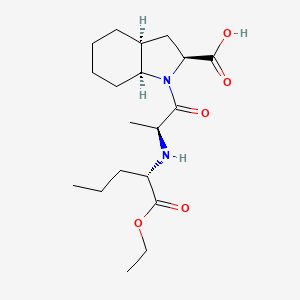
| Formula | C19H32N2O5 |
|---|---|
| Molecular weight | 368.47 g/mol |
| IUPAC name | (2S,3aS,7aS)-1-[(2S)-2-[[(2S)-1-ethoxy-1-oxopentan-2-yl]amino]propanoyl]-2,3,3a,4,5,6,7,7a-octahydroindole-2-carboxylic acid |
| CAS | 82834-16-0 |
| PubChem CID | 107807 |
| InChIKey | IPVQLZZIHOAWMC-QXKUPLGCSA-N |
| logP | 1.94 (XLogP 0.9) |
| Polar surface area | 95.94 Ų |
| H-bond acceptors / donors | 5 / 2 |
| Drug-likeness (QED) | 0.64 |
| Lipinski violations | 0 |
SMILES
CCC[C@H](N[C@@H](C)C(=O)N1[C@H](C(=O)O)C[C@@H]2CCCC[C@@H]21)C(=O)OCCBiology & Pharmacokinetics
Pharmacokinetics
| BBB penetrant | No |
|---|
Transporters
BCRP (Inhibitor)BSEP (Inhibitor)MDR1 (Inhibitor)MRP1 (Inhibitor)OATP1B1 (Inhibitor)OATP1B3 (Inhibitor)P-gp (Inhibitor)PEPT1 (Inhibitor)P-gp (Substrate)PEPT1 (Substrate)
Drug–drug interactions (100+, DDInter)
| Interacting drug | Severity | Management |
|---|---|---|
| Leflunomide | major | |
| Potassium Iodide | major | |
| Potassium acetate | major | |
| Potassium bicarbonate | major | |
| Potassium chloride | major | |
| Potassium citrate | major | |
| Potassium gluconate | major | |
| Teriflunomide | major | |
| Acetohexamide | moderate | |
| Acetylsalicylic acid | moderate | |
| Aldesleukin | moderate | |
| Alimemazine | moderate | |
| Alogliptin | moderate | |
| Alteplase | moderate | |
| Amifostine | moderate | |
| Anistreplase | moderate | |
| Asparaginase Escherichia coli | moderate | |
| Azathioprine | moderate | |
| Betamethasone | moderate | |
| Brentuximab vedotin | moderate | |
| Brimonidine (ophthalmic) | moderate | |
| Brimonidine (topical) | moderate | |
| Bromotheophylline | moderate | |
| Budesonide | moderate | |
| Bupropion | moderate | |
| Canagliflozin | moderate | |
| Celecoxib | moderate | |
| Chlorpropamide | moderate | |
| Clofarabine | moderate | |
| Codeine | moderate | |
| Corticotropin | moderate | |
| Cyclosporine | moderate | |
| Dalteparin | moderate | |
| Dapagliflozin | moderate | |
| Deflazacort | moderate | |
| Dexamethasone | moderate | |
| Diclofenac | moderate | |
| Diphenhydramine | moderate | |
| Doxepin | moderate | |
| Doxepin (topical) | moderate |
Showing 40 of 100+.
Registered Products (7)
| Brand | Form / strength | Pack | Agent | Citizen (JOD) |
|---|---|---|---|---|
| Tenoryl 10mg Film Coated Tablets | Film-Coated Tablet 10.45 mg | 30 tab | Sukhtian Group | 2.530 |
| Tenoryl 5mg Film Coated Tablets | Film-Coated Tablet 5.225 mg | 30 tab | Sukhtian Group | 2.530 |
| Coversyl | Tablet 5 mg | 30 tab | The Jordan Drugstore Co | 3.930 |
| Coversyl | Tablet 10 mg | 30 tab | The Jordan Drugstore Co | 3.930 |
| Hiten | Tablet 4 mg | 30 tab | AL Rahma Drug Store | 3.940 |
| Copryl 10mg F.C Tab | Film-Coated Tablet 10 mg | 30 tab | Dar Al Dawa Development and Investment Co Ltd/Jordan | 3.990 |
| Hiten | Tablet 8 mg | 30 tab | AL Rahma Drug Store | 4.160 |