Losartan
JFDA label: Lacine 50mg tablet
- Fetal toxicity:
Mechanism of Action
As a selective and competitive, nonpeptide angiotensin II receptor antagonist, losartan blocks the vasoconstrictor and aldosterone-secreting effects of angiotensin II; losartan interacts reversibly at the AT1 and AT2 receptors of many tissues and has slow dissociation kinetics; its affinity for the AT1 receptor is 1000 times greater than the AT2 receptor. Angiotensin II receptor antagonists may induce a more complete inhibition of the renin-angiotensin system than ACE inhibitors, they do not affect the response to bradykinin, and are less likely to be associated with nonrenin-angiotensin effects (eg, cough and angioedema). Losartan increases urinary flow rate and in addition to being natriuretic and kaliuretic, increases excretion of chloride, magnesium, uric acid, calcium, and phosphate.
Indications
Approved
- Coronary artery disease and hypertension
- Diabetes and hypertension
- Diabetic nephropathy
- Hypertension
- Hypertension with left ventricular hypertrophy
Off-label
- Acute coronary syndrome (secondary prevention of cardiovascular events)
- Heart failure, intolerant of ACE inhibitors
- Marfan syndrome
Contraindications
Source: Lexicomp · Curated
- Additional contraindications (not in U.S. labeling): Concomitant use with aliskiren in patients with moderate-to-severe renal impairment (GFR 2) Absolute
- Hypersensitivity to losartan or any component of the formulation Absolute
- Pregnancy — second and third trimester (causes fetal renal injury) Absolute
- concomitant use with aliskiren in patients with diabetes mellitus Documentation of allergenic cross-reactivity for angiotensin receptor blockers is limited. However, because of similarities in chemical structure and/or pharmacologic actions, the possibility of cross-sensitivity cannot be ruled out with certainty Absolute
Adverse Reactions
Cardiac disorders (3)
Common Chest pain · hypotension · orthostatic hypotension
Vascular disorders (1)
Uncommon Hypotension
Nervous system disorders (4)
Common Dizziness · dizziness · Myasthenia
Not Known Fatigue (type 2 diabetic nephropathy)
Renal and urinary disorders (1)
Common Urinary tract infection
Blood and lymphatic system disorders (1)
Common Anemia
Immune system disorders (1)
Very Rare Angioedema
Metabolism and nutrition disorders (3)
Common Hyperkalemia · hypoglycemia
Uncommon Hyperkalaemia
Gastrointestinal disorders (1)
Common Diarrhea
Musculoskeletal and connective tissue disorders (3)
Common Back pain · Back pain
Not Known Weakness (type 2 diabetic nephropathy)
Investigations (1)
Common Elevated serum creatinine
General disorders and administration site conditions (1)
Common Fatigue
Other (1)
Very Common Respiratory: Cough
Respiratory, thoracic and mediastinal disorders (2)
Common nasal congestion · Upper respiratory tract infection
Dosing
Source: Lexicomp
Warnings & Precautions
Source: Lexicomp
Angioedema
Angioedema has been reported rarely with some angiotensin II receptor antagonists (ARBs) and may occur at any time during treatment (especially following first dose). It may involve the head and neck (potentially compromising airway) or the intestine (presenting with abdominal pain). Patients with idiopathic or hereditary angioedema or previous angioedema associated with angiotensin-converting enzyme (ACE) inhibitor therapy may be at an increased risk. Prolonged frequent monitoring may be required, especially if tongue, glottis, or larynx are involved, as they are associated with airway obstruction. Patients with a history of airway surgery may have a higher risk of airway obstruction. Discontinue therapy immediately if angioedema occurs. Aggressive early management is critical. Intramuscular (IM) administration of epinephrine may be necessary. Do not readminister to patients who have had angioedema with ARBs.
Hyperkalemia
May occur; risk factors include renal dysfunction, diabetes mellitus, concomitant use of potassium-sparing diuretics, potassium supplements and/or potassium containing salts. Use cautiously, if at all, with these agents and monitor potassium closely.
Hypotension
Symptomatic hypotension may occur upon initiation in patients who are salt or volume depleted (eg, those treated with high-dose diuretics); correct volume depletion prior to administration. This transient hypotensive response is not a contraindication to further treatment with losartan.
Renal function deterioration
May be associated with deterioration of renal function and/or increases in serum creatinine, particularly in patients with low renal blood flow (eg, renal artery stenosis, heart failure) whose glomerular filtration rate (GFR) is dependent on efferent arteriolar vasoconstriction by angiotensin II; deterioration may result in oliguria, acute renal failure, and progressive azotemia. Small increases in serum creatinine may occur following initiation; consider discontinuation only in patients with progressive and/or significant deterioration in renal function. Disease-related concerns:
Aortic/mitral stenosis
Use with caution in patients with significant aortic/mitral stenosis.
Hepatic impairment
Use with caution in patients with hepatic impairment or a history of hepatic impairment; dose adjustment needed.
Renal artery stenosis
Use with caution in patients with unstented unilateral/bilateral renal artery stenosis. When unstented bilateral renal artery stenosis is present, use is generally avoided due to the elevated risk of deterioration in renal function unless possible benefits outweigh risks.
Renal impairment
Use with caution with preexisting renal insufficiency. Concurrent drug therapy issues:
Drug-drug interactions
Potentially significant interactions may exist, requiring dose or frequency adjustment, additional monitoring, and/or selection of alternative therapy. Consult drug interactions database for more detailed information. Special populations:
Black patients
When used to reduce the risk of stroke in patients with HTN and LVH, may not be effective in the black population.
Pregnancy
Drugs that act on the renin-angiotensin system can cause injury and death to the developing fetus. Discontinue as soon as possible once pregnancy is detected.
Surgical patients
In patients on chronic angiotensin receptor blocker (ARB) therapy, intraoperative hypotension may occur with induction and maintenance of general anesthesia; however, discontinuation of therapy prior to surgery is controversial. If continued preoperatively, avoidance of hypotensive agents during surgery is prudent (Hillis 2011). Based on current research and clinical guidelines in patients undergoing noncardiac surgery, continuing angiotensin-receptor blockers (ARB) is reasonable in the perioperative period. If ARBs are held before surgery, it is reasonable to restart postoperatively as soon as clinically feasible (ACC/AHA [Fleisher 2014]).
Pregnancy & Lactation
Pregnancy
Avoid
Discontinue on pregnancy confirmation. Switch to methyldopa or labetalol
Lactation
It is not known if losartan is excreted in breast milk. Due to the potential for serious adverse reactions in the breastfeeding infant, the manufacturer recommends a decision be made whether to discontinue breastfeeding or to discontinue the drug, taking into account the importance of treatment to the mother.
Monitoring
| Clinical pearl | Baseline and periodic blood pressure, electrolytes, renal function 2013 ACCF/AHA Heart Failure guideline recommendations: Within 1 to 2 weeks after initiation, reassess blood pressure (including postural blood pressure changes), renal function, and serum potassium; follow closely after dose changes. Patients with systolic blood pressure |
|---|
Chemistry & Properties
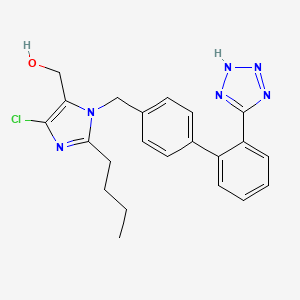
| Formula | C22H23ClN6O |
|---|---|
| Molecular weight | 422.92 g/mol |
| IUPAC name | [2-butyl-5-chloro-3-[[4-[2-(2H-tetrazol-5-yl)phenyl]phenyl]methyl]imidazol-4-yl]methanol |
| CAS | 114798-26-4 |
| PubChem CID | 3961 |
| InChIKey | PSIFNNKUMBGKDQ-UHFFFAOYSA-N |
| logP | 4.27 (XLogP 4.3) |
| Polar surface area | 92.51 Ų |
| H-bond acceptors / donors | 6 / 2 |
| Drug-likeness (QED) | 0.44 |
| Lipinski violations | 0 |
SMILES
CCCCc1nc(Cl)c(CO)n1Cc1ccc(-c2ccccc2-c2nnn[nH]2)cc1Biology & Pharmacokinetics
Pharmacokinetics predicted
| Bioavailability | 70.0% |
|---|---|
| Half-life | 0.797 h |
| Volume of distribution | 0.664 L/kg |
| Protein binding | 98.8% |
| BBB penetrant | No |
Enzyme interactions
| Enzyme | Role | Detail |
|---|---|---|
| CYP1A2 | Substrate | — |
| CYP2C19 | Inhibitor | — |
| CYP2C19 | Substrate | — |
| CYP2C8 | Inhibitor | — |
| CYP2C9 | Substrate | IC₅₀ 2.882000000000001 µM |
| CYP3A4 | Substrate | — |
| UGT | Substrate | — |
Transporters
BCRP (Inhibitor)BCRP (Inhibitor)BSEP (Inhibitor)BSEP (Inhibitor)MATE1 (Inhibitor)MDR1 (Inhibitor)MRP1 (Inhibitor)MRP2 (Inhibitor)MRP4 (Inhibitor)NTCP (Inhibitor)OAT1 (Inhibitor)OAT2 (Inhibitor)OAT4 (Inhibitor)OATP1B1 (Inhibitor)OATP1B1 (Inhibitor)OATP1B3 (Inhibitor)OATP1B3 (Inhibitor)OATP2B1 (Inhibitor)P-gp (Inhibitor)PEPT1 (Inhibitor)PEPT2 (Inhibitor)URAT1 (Inhibitor)MDR1 (Substrate)MRP1 (Substrate)MRP2 (Substrate)P-gp (Substrate)PEPT1 (Substrate)
Drug–drug interactions (100+, DDInter)
| Interacting drug | Severity | Management |
|---|---|---|
| Potassium Iodide | major | |
| Potassium acetate | major | |
| Potassium bicarbonate | major | |
| Potassium chloride | major | |
| Potassium citrate | major | |
| Potassium gluconate | major | |
| Acetylsalicylic acid | moderate | |
| Aldesleukin | moderate | |
| Alimemazine | moderate | |
| Alpelisib | moderate | |
| Amifostine | moderate | |
| Apalutamide | moderate | |
| Aprepitant | moderate | |
| Betamethasone | moderate | |
| Brimonidine (ophthalmic) | moderate | |
| Brimonidine (topical) | moderate | |
| Budesonide | moderate | |
| Bupropion | moderate | |
| Canagliflozin | moderate | |
| Celecoxib | moderate | |
| Codeine | moderate | |
| Corticotropin | moderate | |
| Cyclosporine | moderate | |
| Dabrafenib | moderate | |
| Dalteparin | moderate | |
| Dapagliflozin | moderate | |
| Deflazacort | moderate | |
| Dexamethasone | moderate | |
| Diclofenac | moderate | |
| Diphenhydramine | moderate | |
| Doxepin | moderate | |
| Doxepin (topical) | moderate | |
| Dronabinol | moderate | |
| Empagliflozin | moderate | |
| Enoxaparin | moderate | |
| Enzalutamide | moderate | |
| Epoprostenol | moderate | |
| Ertugliflozin | moderate | |
| Everolimus | moderate | |
| Exenatide | moderate |
Showing 40 of 100+.
Registered Products (16)
| Brand | Form / strength | Pack | Agent | Citizen (JOD) |
|---|---|---|---|---|
| Lacine | Tablet 50 mg | 15 tab pack varies | THE JORDANIAN PHARMACEUTICAL MANUFACTURING COMPANY/JORDAN | 1.720 |
| Azarten FC Tab | Film-Coated Tablet 50 mg | 14 tab pack varies | Hayat Pharmaceutical Industries CO.PLC/JORDAN | 2.280 |
| Lacine | Tablet 50 mg | 30 tab pack varies | THE JORDANIAN PHARMACEUTICAL MANUFACTURING COMPANY/JORDAN | 3.270 |
| Azarten FC Tab | Film-Coated Tablet 50 mg | 28 tab pack varies | Hayat Pharmaceutical Industries CO.PLC/JORDAN | 4.340 |
| Losart 50mg F.C tablets | Film-Coated Tablet 50 mg | 28 F.C Tab pack varies | AL-RAM PHARMA.INDUS.CO.LTD/JORDAN | 4.340 |
| Losart | Tablet 50 mg | 30 tab pack varies | AL-RAM PHARMA.INDUS.CO.LTD/JORDAN | 4.650 |
| Lacine Plus Tab | Tablet 12.5 mg, 50 mg | 30 tab | THE JORDANIAN PHARMACEUTICAL MANUFACTURING COMPANY/JORDAN | 5.180 |
| Lacine Plus Tab | Tablet 25 mg, 100 mg | 30 tab | THE JORDANIAN PHARMACEUTICAL MANUFACTURING COMPANY/JORDAN | 5.360 |
| Lacine Plus Tab | Tablet 12.5 mg, 100 mg | 30 tab | THE JORDANIAN PHARMACEUTICAL MANUFACTURING COMPANY/JORDAN | 5.360 |
| Hyzaar 100mg/12.5mg | Tablet 12.5 mg, 100 mg | 28 tab | Adatco Drug Store | 5.560 |
| Hyzaar 50mg/12.5mg | Tablet 12.5 mg, 50 mg | 30 tab | Adatco Drug Store | 5.750 |
| Cozaar 100mg F.C Tablet | Film-Coated Tablet 100 mg | 30 tab | Adatco Drug Store | 5.960 |
| Lacine | Tablet 50 mg | 1000 tab pack varies | THE JORDANIAN PHARMACEUTICAL MANUFACTURING COMPANY/JORDAN | 42.500 |
| Azarten FC Tab | Film-Coated Tablet 50 mg | 700 tab pack varies | Hayat Pharmaceutical Industries CO.PLC/JORDAN | 92.230 |
| Losart | Tablet 50 mg | 700 tab pack varies | AL-RAM PHARMA.INDUS.CO.LTD/JORDAN | 92.230 |
| Losart 50mg F.C Tab | Film-Coated Tablet 50 mg | 1000 F.C Tab pack varies | AL-RAM PHARMA.INDUS.CO.LTD/JORDAN | 131.750 |