Aminophylline
JFDA label: Phyllocontin forte Continus Tab
Mechanism of Action
Inhibitor of Phosphodiesterase 4 — Phosphodiesterase 4 inhibitor; Inhibitor of Phosphodiesterase 3 — Phosphodiesterase 3 inhibitor; Antagonist of Adenosine receptor — Adenosine receptor antagonist
| Target | Action | Gene / class |
|---|---|---|
| Adenosine receptor efficacy | ANTAGONIST | |
| Phosphodiesterase 3 efficacy | INHIBITOR | |
| Phosphodiesterase 4 efficacy | INHIBITOR |
Indications
Approved
- Asthma
- COPD
- Reversible airflow obstruction
Contraindications
Source: Lexicomp
- Additional contraindications (not in US labeling): Coronary artery disease where cardiac stimulation might prove harmful Absolute
- Hypersensitivity to aminophylline, theophylline, ethylenediamine, or any component of the formulation Absolute
- peptic ulcer disease Absolute
Adverse Reactions
Nervous system disorders (5)
Not Known Headache · insomnia · irritability · restlessness · seizure
Renal and urinary disorders (1)
Not Known Diuresis (transient)
Gastrointestinal disorders (3)
Not Known Diarrhea · nausea · vomiting
Skin and subcutaneous tissue disorders (2)
Not Known Allergic skin reaction · exfoliative dermatitis
Musculoskeletal and connective tissue disorders (1)
Not Known Tremor
Dosing
Source: Lexicomp
Warnings & Precautions
Source: Lexicomp
Extravasation
Vesicant; ensure proper catheter or needle position prior to and during infusion. Avoid extravasation.
Theophylline toxicity
Severe and potentially fatal theophylline toxicity may occur if reduced theophylline clearance occurs. Theophylline clearance may be decreased in patients with acute pulmonary edema, heart failure, cor pulmonale, fever (≥102°F for ≥24 hours or lesser temperature elevations for longer periods), hepatic disease, acute hepatitis, cirrhosis, hypothyroidism, sepsis with multiorgan failure, shock, neonates (term and premature), infants 60 years, and patients following cessation of smoking. Consider benefits versus risks and the need for more intensive monitoring in these patients; reduced infusion rate required. If a patient develops signs and symptoms of theophylline toxicity (eg, nausea or persistent, repetitive vomiting), a serum theophylline level should be measured immediately and subsequent doses withheld. Disease-related concerns:
Cardiovascular disease
Use with caution in patients with cardiac arrhythmias (excluding bradyarrhythmias); use may exacerbate arrhythmias.
Cystic fibrosis
Use with caution in patients with cystic fibrosis; increased theophylline clearance may occur.
Hepatic impairment
Use with caution in patients with hepatic impairment (eg, cirrhosis, acute hepatitis, cholestasis); risk of severe and potentially fatal theophylline toxicity is increased. Theophylline clearance is decreased ≥50% in these patients. Dose reduction and frequent monitoring of serum theophylline concentrations are required.
Hyperthyroidism
Use with caution in patients with hyperthyroidism; increased theophylline clearance may occur.
Peptic ulcer disease
Use with caution in patients with active peptic ulcer disease; use may exacerbate peptic ulcer.
Seizure disorder
Use with caution in patients with seizure disorders; use may exacerbate seizure disorder. Concurrent drug therapy issues:
Drug-drug interactions
Potentially significant interactions may exist, requiring dose or frequency adjustment, additional monitoring, and/or selection of alternative therapy. Consult drug interactions database for more detailed information. Special populations:
Elderly
Use extreme caution in the elderly; these patients are at greater risk of serious theophylline toxicity.
Pediatric
Select dose with caution and with frequent monitoring of concentrations (especially Other warnings/precautions:
Appropriate use
Do not increase dose in response to acute exacerbation of symptoms unless steady state serum theophylline concentration is
Pregnancy & Lactation
Pregnancy
Adverse events were observed in some animal reproduction studies. Theophylline crosses the placenta. Refer to Theophylline monograph for additional information.
Lactation
Theophylline is present in breast milk. Refer to Theophylline monograph for additional information.
LactMed: monitor the infant.
Monitoring
| Clinical pearl | Heart rate; CNS effects (insomnia, irritability); respiratory rate (COPD patients often have resting controlled respiratory rates in low 20s); arterial or capillary blood gases (if applicable) Theophylline levels: Serum theophylline levels should be monitored after initiation of therapy and prior to making dose increases; in the presence of signs or symptoms of toxicity; or when a new illness, worsening of a present illness, or change in patient’s treatment regimen that may alter theophylline clearance (eg, fever >102°F or sustained for 24 hours or more, hepatitis, or drugs that are added or discontinued); changes in fluid balance; electrolyte concentrations, acid-base balance during prolonged therapy. Loading dose: Measure serum concentrations 30 minutes after the end of an IV loading dose in patients who have not received theophylline in the previous 24 hours to determine the need for an additional loading (serum concentration 20 mcg/mL). Infusion: Measure serum concentrations one half-life (eg, ~4 hours in children 1 to 9 years of age or 8 hours in nonsmoking, otherwise healthy adults) after starting a continuous infusion, then every 12 to 24 hours for duration of infusion; measure more frequently in acutely ill patients. Monitor infusion site. |
|---|
Chemistry & Properties
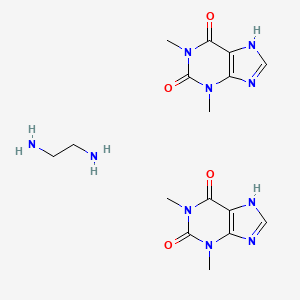
| Formula | C16H24N10O4 |
|---|---|
| Molecular weight | 420.43 g/mol |
| IUPAC name | bis(1,3-dimethyl-7H-purine-2,6-dione);ethane-1,2-diamine |
| CAS | 317-34-0 |
| PubChem CID | 9433 |
| InChIKey | FQPFAHBPWDRTLU-UHFFFAOYSA-N |
| logP | -1.04 |
| Polar surface area | 72.68 Ų |
| H-bond acceptors / donors | 5 / 1 |
| Drug-likeness (QED) | 0.56 |
| Lipinski violations | 0 |
SMILES
Cn1c(=O)c2[nH]cnc2n(C)c1=O.Cn1c(=O)c2[nH]cnc2n(C)c1=O.NCCNBiology & Pharmacokinetics
Pharmacokinetics predicted
| Bioavailability | 10.0% |
|---|---|
| Half-life | 1.31 h |
| Volume of distribution | 0.549 L/kg |
| Protein binding | 26.4% |
| BBB penetrant | Yes |
Enzyme interactions
| Enzyme | Role | Detail |
|---|---|---|
| CYP1A2 | Substrate | — |
| CYP2B6 | Substrate | — |
| CYP2C19 | Substrate | — |
| CYP2C9 | Substrate | — |
| CYP2D6 | Substrate | — |
| CYP3A4 | Substrate | — |
Transporters
BCRP (Inhibitor)BSEP (Inhibitor)BSEP (Inhibitor)MRP1 (Inhibitor)MRP2 (Inhibitor)MRP4 (Inhibitor)OATP1B1 (Inhibitor)OATP1B3 (Inhibitor)P-gp (Inhibitor)P-gp (Substrate)
Drug–drug interactions (100+, DDInter)
| Interacting drug | Severity | Management |
|---|---|---|
| Acebutolol | major | |
| Atenolol | major | |
| Betaxolol | major | |
| Betaxolol (ophthalmic) | major | |
| Bisoprolol | major | |
| Bupropion | major | |
| Carteolol | major | |
| Carteolol (ophthalmic) | major | |
| Carvedilol | major | |
| Ciprofloxacin | major | |
| Deferasirox | major | |
| Enoxacin | major | |
| Esmolol | major | |
| Fluvoxamine | major | |
| Halothane | major | |
| Iohexol | major | |
| Iopamidol | major | |
| Labetalol | major | |
| Levobetaxolol (ophthalmic) | major | |
| Levobunolol (ophthalmic) | major | |
| Metipranolol (ophthalmic) | major | |
| Metoprolol | major | |
| Mexiletine | major | |
| Nadolol | major | |
| Nebivolol | major | |
| Penbutolol | major | |
| Pindolol | major | |
| Propranolol | major | |
| Riociguat | major | |
| Sotalol | major | |
| Timolol | major | |
| Timolol (ophthalmic) | major | |
| Tramadol | major | |
| Activated charcoal | moderate | |
| Adalimumab | moderate | |
| Adenosine | moderate | |
| Alefacept | moderate | |
| Amifampridine | moderate | |
| Aminoglutethimide | moderate | |
| Amiodarone | moderate |
Showing 40 of 100+.
Registered Products (5)
| Brand | Form / strength | Pack | Agent | Citizen (JOD) |
|---|---|---|---|---|
| Phyllocontin Paediatric Cont. Tab | Tablet 100 mg | 50 tab pack varies | UNITED PHARM.MFG.CO.LTD(UPM)/JORDAN | 3.000 |
| Aminophylline Amp | Ampoule 250 mg/10 ml | 10 amp | Al Hilal Drug Store | 5.230 |
| Phyllocontin forte Continus Tab | Tablet 350 mg | 60 tab pack varies | UNITED PHARM.MFG.CO.LTD(UPM)/JORDAN | 6.420 |
| Phyllocontin Paediatric Cont. Tab | Tablet 100 mg | 1000 tab pack varies | UNITED PHARM.MFG.CO.LTD(UPM)/JORDAN | 50.400 |
| Phyllocontin forte Continus Tab | Tablet 350 mg | 1000 tab pack varies | UNITED PHARM.MFG.CO.LTD(UPM)/JORDAN | 93.100 |