Avanafil
JFDA label: Spedra 50
Mechanism of Action
Inhibitor of cGMP-specific 3',5'-cyclic phosphodiesterase — Phosphodiesterase 5A inhibitor
| Target | Action | Gene / class |
|---|---|---|
| cGMP-specific 3',5'-cyclic phosphodiesterase efficacy | INHIBITOR | PDE5A |
Indications
Approved
- Erectile dysfunction
Contraindications
Source: Lexicomp
- Hypersensitivity to avanafil or any component of the formulation Absolute
- coadministration with any form of organic nitrates (either regularly and/or intermittently) or guanylate cyclase stimulators (eg, riociguat) Absolute
Adverse Reactions
Cardiac disorders (2)
Common ECG abnormality · Flushing
Nervous system disorders (1)
Common Dizziness
Gastrointestinal disorders (1)
Common Viral gastroenteritis
Musculoskeletal and connective tissue disorders (1)
Common Back pain
Other (1)
Very Common Central nervous system: Headache
Respiratory, thoracic and mediastinal disorders (3)
Common nasal congestion · Nasopharyngitis · upper respiratory tract infection
Dosing
Source: Lexicomp
Warnings & Precautions
Source: Lexicomp
Color discrimination
May cause dose-related impairment of color discrimination. Use caution in patients with retinitis pigmentosa; a minority have genetic disorders of retinal phosphodiesterases (no safety information available).
Hearing loss
Sudden decrease or loss of hearing has been reported rarely; hearing changes may be accompanied by tinnitus and dizziness. A direct relationship between therapy and hearing loss has not been determined.
Hypotension
Decreases in blood pressure may occur due to vasodilator effects; use with caution in patients with left ventricular outflow obstruction (aortic stenosis or hypertrophic obstructive cardiomyopathy); may be more sensitive to hypotensive actions. Concurrent use with alpha-adrenergic antagonist therapy may cause symptomatic hypotension; patients should be hemodynamically stable prior to initiating therapy at the lowest possible dose. Patients should avoid or limit concurrent substantial ethanol consumption as this may increase the risk of symptomatic hypotension.
Priapism
Painful erection >6 hours in duration has been reported (rarely). Instruct patients to seek immediate medical attention if erection persists >4 hours. Use with caution in patients who have conditions which may predispose them to priapism (sickle cell anemia, multiple myeloma, leukemia).
Vision loss
Vision loss may occur rarely and be a sign of nonarteritic anterior ischemic optic neuropathy (NAION). Instruct patients to seek medical assistance for sudden loss of vision in one or both eyes. Patients who have already experienced NAION are at an increased risk of recurrence. Other risk factors for NAION include low cup-to-disc ratio (“crowded disc”), coronary artery disease, diabetes, hypertension, hyperlipidemia, smoking, and >50 years of age. Use with caution in these patients only when the benefits outweigh the risks. Safety and efficacy were not studied in patients with known degenerative retinal disorders (eg, retinitis pigmentosa); use is not recommended. Disease-related concerns:
Anatomical penis deformation
Use with caution in patients with anatomical deformation of the penis (angulation, cavernosal fibrosis, or Peyronie's disease).
Bleeding disorders
Use with caution in patients with bleeding disorders; safety and efficacy have not been established.
Cardiovascular disease
Use is not recommended in patients with hypotension (170/100 mm Hg); unstable angina or angina during intercourse; life-threatening arrhythmias, stroke, MI, or coronary revascularization within the last 6 months; cardiac failure or coronary artery disease causing unstable angina. Safety and efficacy have not been studied in these patients. Use caution in patients with left ventricular outflow obstruction (eg, aortic stenosis, hypertrophic cardiomyopathy with outflow tract obstruction). There is a degree of cardiac risk associated with sexual activity; therefore, physicians may wish to consider the cardiovascular status of their patients prior to initiating any treatment for erectile dysfunction.
Hepatic impairment
Safety and efficacy have not been studied in patients with severe hepatic impairment (Child-Pugh class C); therefore, use in these patients is not recommended.
Peptic ulcer disease
Use with caution in patients with active peptic ulcer disease; safety and efficacy have not been established.
Renal impairment
Safety and efficacy have not been studied in patients with severe renal impairment or end-stage renal disease requiring dialysis, therefore, use in these patients is not recommended. Concurrent drug therapy issues:
Drug-drug interactions
Potentially significant interactions may exist, requiring dose or frequency adjustment, additional monitoring, and/or selection of alternative therapy. Consult drug interactions database for more detailed information.
Nitrates
Use of avanafil is contraindicated in patients currently taking nitrate preparations. According to the manufacturer, when nitrate administration is deemed medically necessary in a life-threatening situation, may administer nitrates only if 12 hours has elapsed after avanafil use. Of note, the elimination half-life of avanafil is similar to that of sildenafil and vardenafil which both require 24 hours to elapse prior to administration of nitrates (ACCF/AHA [Anderson, 2013]; ACCF/AHA [O'Gara, 2013]). Other warnings/precautions:
Appropriate use
Potential underlying causes of erectile dysfunction should be evaluated prior to treatment.
Pregnancy & Lactation
Pregnancy
Based on data from animal reproduction studies, avanafil is predicted to have a low risk for major developmental abnormalities in humans. This product is not indicated for use in women.
Lactation
This product is not indicated for use in women.
Monitoring
| Clinical pearl | Monitor for response, adverse reactions, blood pressure, and heart rate. |
|---|
Chemistry & Properties
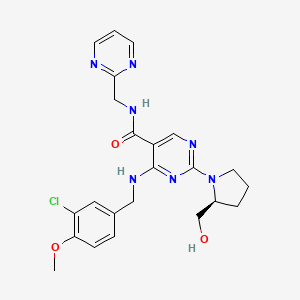
| Formula | C23H26ClN7O3 |
|---|---|
| Molecular weight | 483.96 g/mol |
| IUPAC name | 4-[(3-chloro-4-methoxyphenyl)methylamino]-2-[(2S)-2-(hydroxymethyl)pyrrolidin-1-yl]-N-(pyrimidin-2-ylmethyl)pyrimidine-5-carboxamide |
| CAS | 330784-47-9 |
| PubChem CID | 9869929 |
| InChIKey | WEAJZXNPAWBCOA-INIZCTEOSA-N |
| logP | 2.43 (XLogP 2.6) |
| Polar surface area | 125.39 Ų |
| H-bond acceptors / donors | 9 / 3 |
| Drug-likeness (QED) | 0.42 |
| Lipinski violations | 0 |
SMILES
COc1ccc(CNc2nc(N3CCC[C@H]3CO)ncc2C(=O)NCc2ncccn2)cc1ClBiology & Pharmacokinetics
Pharmacokinetics predicted
| Bioavailability | 10.0% |
|---|---|
| Half-life | 0.515 h |
| Volume of distribution | 0.741 L/kg |
| Protein binding | 96.1% |
| BBB penetrant | No |
Enzyme interactions
| Enzyme | Role | Detail |
|---|---|---|
| CYP1A2 | Inhibitor | — |
| CYP2C19 | Inhibitor | — |
| CYP2C8 | Inhibitor | — |
| CYP2C9 | Inhibitor | — |
| CYP2C9 | Substrate | — |
| CYP3A4 | Inhibitor | — |
| CYP3A4 | Substrate | — |
Transporters
BCRP (Inhibitor)BCRP (Inhibitor)BSEP (Inhibitor)MRP1 (Inhibitor)OATP1B1 (Inhibitor)OATP1B3 (Inhibitor)P-gp (Inhibitor)MDR1 (Substrate)P-gp (Substrate)
Drug–drug interactions (53, DDInter)
| Interacting drug | Severity | Management |
|---|---|---|
| Amyl Nitrite | major | |
| Aprepitant | major | |
| Ceritinib | major | |
| Clarithromycin | major | |
| Cobicistat | major | |
| Crizotinib | major | |
| Erythromycin | major | |
| Fedratinib | major | |
| Fluconazole | major | |
| Idelalisib | major | |
| Imatinib | major | |
| Ketoconazole | major | |
| Ribociclib | major | |
| Aminoglutethimide | moderate | |
| Apalutamide | moderate | |
| Bexarotene | moderate | |
| Brimonidine (ophthalmic) | moderate | |
| Brimonidine (topical) | moderate | |
| Canagliflozin | moderate | |
| Dabrafenib | moderate | |
| Dapagliflozin | moderate | |
| Deferasirox | moderate | |
| Dexamethasone | moderate | |
| Diazoxide | moderate | |
| Elagolix | moderate | |
| Empagliflozin | moderate | |
| Enzalutamide | moderate | |
| Epoprostenol | moderate | |
| Ertugliflozin | moderate | |
| Ethanol | moderate | |
| Fostamatinib | moderate | |
| Griseofulvin | moderate | |
| Iloprost | moderate | |
| Ivosidenib | moderate | |
| Larotrectinib | moderate | |
| Lorcaserin | moderate | |
| Lorlatinib | moderate | |
| Lumacaftor | moderate | |
| Minoxidil | moderate | |
| Minoxidil (topical) | moderate |
Showing 40 of 53.
Registered Products (6)
| Brand | Form / strength | Pack | Agent | Citizen (JOD) |
|---|---|---|---|---|
| Spedra 100 | Tablet 100 mg | 2 tab pack varies | Ulfa Pharma Co. | 7.200 |
| Spedra 200 | Tablet 200 mg | 2 tab pack varies | Ulfa Pharma Co. | 7.200 |
| Spedra 50 | Tablet 50 mg | 2 tab pack varies | Ulfa Pharma Co. | 7.830 |
| Spedra 100 | Tablet 100 mg | 4 tab pack varies | Ulfa Pharma Co. | 13.720 |
| Spedra 200 | Tablet 200 mg | 4 tab pack varies | Ulfa Pharma Co. | 13.720 |
| Spedra 50 | Tablet 50 mg | 4 tab pack varies | Ulfa Pharma Co. | 14.880 |