Cladribine
Active form: 2-Chlorodeoxyadenosine Triphosphate.
JFDA label: Litak
- Experienced physician:
- Bone marrow suppression:
- Neurotoxicity:
- Renal toxicity:
Mechanism of Action
Inhibitor of DNA — DNA inhibitor
| Target | Action | Gene / class |
|---|---|---|
| DNA efficacy | INHIBITOR |
Indications
Approved
- Hairy cell leukemia
- Multiple sclerosis (oral tablet [Canadian product])
Off-label
- Acute myeloid leukemia (AML) (adults)
- Acute myeloid leukemia (AML) (children/adolescents)
- Langerhans cell histiocytosis (refractory) (children)
- Mantle cell lymphoma
- T-cell large granular lymphocytic leukemia (refractory)
- Waldenström macroglobulinemia
Contraindications
Source: Lexicomp
- Hypersensitivity to cladribine or any component of the formulation Oral tablet [Canadian product]: Hypersensitivity to cladribine or any component of the formulation Absolute
- active malignancy Absolute
- bone marrow transplantation] or disease [immunodeficiency syndrome]) Absolute
- history of progressive multifocal leukoencephalopathy Absolute
- latent or active infections (including active chronic bacterial, fungal or viral infections [eg, hepatitis, tuberculosis]) Absolute
- moderate or severe renal impairment (CrCL Absolute
- patients at increased risk of opportunistic infections (including those immunocompromised due to therapy [immunosuppressive or immunomodulating, antineoplastic or myelosuppressive therapies Absolute
- total lymphoid irradiation Absolute
Adverse Reactions
Cardiac disorders (4)
Common Edema · phlebitis · tachycardia · thrombosis
Nervous system disorders (9)
Very Common Fatigue · headache
Common anxiety · chills · Dizziness · insomnia · malaise · myasthenia · pain
Blood and lymphatic system disorders (8)
Very Common anemia · bone marrow depression · febrile neutropenia · Neutropenia · thrombocytopenia
Common bruise · petechia · Purpura
Gastrointestinal disorders (7)
Very Common decreased appetite · Nausea · vomiting
Common abdominal pain · constipation · Diarrhea · flatulence
Skin and subcutaneous tissue disorders (5)
Very Common Skin rash
Common Diaphoresis · erythema · hyperhidrosis · pruritus
Musculoskeletal and connective tissue disorders (3)
Common arthralgia · myalgia · Weakness
Infections and infestations (1)
Very Common Infection
General disorders and administration site conditions (2)
Very Common Fever · Injection site reaction
Respiratory, thoracic and mediastinal disorders (5)
Very Common Abnormal breath sounds
Common Cough · dyspnea · epistaxis · rales
Dosing
Source: Lexicomp
Warnings & Precautions
Source: Lexicomp
Bone marrow suppression
Dose-dependent myelosuppression (neutropenia, anemia, and thrombocytopenia) is common and generally reversible. Use with caution in patients with preexisting hematologic or immunologic abnormalities. Monitor blood counts, especially during the first 4 to 8 weeks after treatment.
Fever
Treatment is associated with fever (≥100°F), with or without neutropenia, and is observed more commonly in the first month of treatment.
Infection
Infections (bacterial, viral, and fungal) were reported more commonly in the first month after treatment (generally mild or moderate in severity, although serious infections including sepsis have been reported); the incidence is reduced in the second month. Due to neutropenia and T-cell depletion, risk versus benefit of treatment should be evaluated in patients with active infections. If active infection is present, manage appropriately prior to administering cladribine (Grever 2017).
Neurotoxicity
Serious, dose-related neurologic toxicity (including irreversible paraparesis and quadriparesis) has been reported with continuous infusions of higher doses (4 to 9 times the approved dose); may also occur at approved doses (rare). Neurotoxicity may be delayed and may present as progressive, irreversible motor weakness of the upper and/or lower extremities; diagnostics with electromyography and nerve conduction studies were consistent with demyelinating disease. Neurotoxicity after high-dose administration was first noted 35 to 84 days after therapy initiation.
Renal toxicity
Acute nephrotoxicity (eg, acidosis, anuria, increased serum creatinine), possibly requiring dialysis, has been reported with high doses (4 to 9 times the approved dose), particularly when administered with other nephrotoxic agents. Per the manufacturer, nephrotoxicity has not occurred when used at the dose approved for hairy cell leukemia.
Tumor lysis syndrome
With high tumor burden, tumor lysis syndrome and subsequent hyperuricemia may occur (rare); consider antihyperuricemics and hydrate accordingly. Disease-related concerns:
Hepatic impairment
Use with caution in patients with hepatic impairment.
Renal impairment
Use with caution in patients with renal impairment. Concurrent drug therapy issues:
Drug-drug interactions
Potentially significant interactions may exist, requiring dose or frequency adjustment, additional monitoring, and/or selection of alternative therapy. Consult drug interactions database for more detailed information. Dosage form specific issues:
Benzyl alcohol and derivatives
Weekly (7-day) infusion preparation recommends further dilution with bacteriostatic normal saline which contains benzyl alcohol; large amounts of benzyl alcohol (≥99 mg/kg/day) have been associated with a potentially fatal toxicity (“gasping syndrome”) in neonates; the “gasping syndrome” consists of metabolic acidosis, respiratory distress, gasping respirations, CNS dysfunction (including convulsions, intracranial hemorrhage), hypotension, and cardiovascular collapse (AAP ["Inactive" 1997]; CDC 1982); some data suggests that benzoate displaces bilirubin from protein binding sites (Ahlfors 2001); avoid or use dosage forms containing benzyl alcohol with caution in neonates. See manufacturer's labeling.
Oral tablet [Canadian product]
Multiple sclerosis: Use is contraindicated in patients with active or latent tuberculosis. Complete immunizations at least 6 weeks prior to treatment initiation. Evaluate hepatitis B and C status prior to treatment. Assess varicella zoster virus (VZV) antibody status prior to treatment; if no confirmed history of chicken pox or vaccination and VZV antibody is negative, vaccination is recommended (delay cladribine for 6 weeks after vaccination). Only initiate treatment if lymphocyte counts are normal, Obtain a baseline MRI if patient has previously received MS therapy associated with progressive multifocal leukoencephalopathy (PML); do not initiate or re-initiate therapy until PML has been excluded. May be associated with an increased risk of malignancies. Other warnings/precautions:
Experienced physician
Should be administered under the supervision of an experienced cancer chemotherapy physician.
Vaccines
Administration of live vaccines is not recommended during treatment with cladribine (may increase the risk of infection due to immunosuppression).
Pregnancy & Lactation
Pregnancy
Adverse events have been observed in animal reproduction studies. May cause fetal harm if administered during pregnancy. Women of reproductive potential should use highly effective contraception during treatment. Oral tablet [Canadian product]: Use is contraindicated in pregnancy. Exclude pregnancy prior to treatment. Females of reproductive potential and males with female partners of reproductive potential should use effective contraception during treatment and for 6 months after the final cladribine dose. Women who become pregnant during therapy should discontinue treatment.
Lactation
It is not known if cladribine is present in breast milk. Due to the potential for serious adverse reactions in the breastfed infant, the decision to discontinue cladribine or to discontinue breastfeeding should take into account the importance of treatment to the mother. Oral tablet [Canadian product]: Use is contraindicated.
Monitoring
| Clinical pearl | IV: CBC with differential (particularly during the first 4 to 8 weeks post-treatment), renal and hepatic function; bone marrow biopsy (after CBC has normalized, to confirm treatment response); monitor for fever; monitor for signs/symptoms of neurotoxicity and infection Oral tablet [Canadian product]: CBC including lymphocyte count (within 6 months prior to treatment initiation or after discontinuation of prior therapy; assess lymphocyte count prior to initiation in year 1 and year 2 and periodically in between and after treatment); evaluate hepatitis B (HBV) and hepatitis C (HCV) status (prior to treatment); evaluate varicella zoster virus VZV antibody status (prior to treatment); pregnancy test (prior to treatment in females of reproductive potential); MRI (at baseline if received prior MS therapy associated with PML). |
|---|
Chemistry & Properties
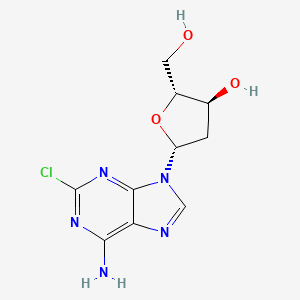
| Formula | C10H12ClN5O3 |
|---|---|
| Molecular weight | 285.69 g/mol |
| IUPAC name | (2R,3S,5R)-5-(6-amino-2-chloropurin-9-yl)-2-(hydroxymethyl)oxolan-3-ol |
| CAS | 4291-63-8 |
| PubChem CID | 20279 |
| InChIKey | PTOAARAWEBMLNO-KVQBGUIXSA-N |
| logP | -0.3 (XLogP 0.8) |
| Polar surface area | 119.31 Ų |
| H-bond acceptors / donors | 8 / 3 |
| Drug-likeness (QED) | 0.65 |
| Lipinski violations | 0 |
SMILES
Nc1nc(Cl)nc2c1ncn2[C@H]1C[C@H](O)[C@@H](CO)O1Biology & Pharmacokinetics
Pharmacokinetics predicted
| Bioavailability | 10.0% |
|---|---|
| Half-life | 1.721 h |
| Volume of distribution | 9.203 L/kg |
| Protein binding | 19.3% |
| BBB penetrant | No |
Enzyme interactions
| Enzyme | Role | Detail |
|---|---|---|
| CYP2B6 | Inhibitor | — |
Transporters
BCRP (Inhibitor)BSEP (Inhibitor)BSEP (Inhibitor)CNT2 (Inhibitor)CNT3 (Inhibitor)ENT2 (Inhibitor)MATE1 (Inhibitor)MRP1 (Inhibitor)MRP2 (Inhibitor)MRP3 (Inhibitor)MRP4 (Inhibitor)OAT1 (Inhibitor)OATP1B1 (Inhibitor)OATP1B3 (Inhibitor)OATP1B3 (Inhibitor)OCT1 (Inhibitor)P-gp (Inhibitor)Transporter(unspecified) (Inhibitor)BCRP (Substrate)CNT3 (Substrate)ENT1 (Substrate)MDR1 (Substrate)MRP4 (Substrate)MRP5 (Substrate)OCT1 (Substrate)P-gp (Substrate)Transporter(unspecified) (Substrate)
Drug–drug interactions (100+, DDInter)
| Interacting drug | Severity | Management |
|---|---|---|
| Abatacept | major | |
| Abemaciclib | major | |
| Acalabrutinib | major | |
| Acetohydroxamic acid | major | |
| Adalimumab | major | |
| Aflibercept | major | |
| Albendazole | major | |
| Aldesleukin | major | |
| Alefacept | major | |
| Alemtuzumab | major | |
| Altretamine | major | |
| Anakinra | major | |
| Antilymphocyte immunoglobulin (horse) | major | |
| Antithymocyte immunoglobulin (rabbit) | major | |
| Asparaginase Escherichia coli | major | |
| Atezolizumab | major | |
| Auranofin | major | |
| Aurothioglucose | major | |
| Avapritinib | major | |
| Axicabtagene ciloleucel | major | |
| Azacitidine | major | |
| Azathioprine | major | |
| Bacillus calmette-guerin substrain tice live antigen | major | |
| Baricitinib | major | |
| Basiliximab | major | |
| Belantamab mafodotin | major | |
| Belatacept | major | |
| Belimumab | major | |
| Belinostat | major | |
| Bendamustine | major | |
| Betamethasone | major | |
| Bexarotene | major | |
| Bleomycin | major | |
| Blinatumomab | major | |
| Bortezomib | major | |
| Bosutinib | major | |
| Brentuximab vedotin | major | |
| Brexucabtagene autoleucel | major | |
| Brigatinib | major | |
| Brodalumab | major |
Showing 40 of 100+.
Registered Products (6)
| Brand | Form / strength | Pack | Agent | Citizen (JOD) |
|---|---|---|---|---|
| Drebiclen | Tablet 10 mg | 4 tab pack varies | Hikma Pharmaceuticals | — |
| Drebiclen | Tablet 10 mg | 1 tab pack varies | Hikma Pharmaceuticals | — |
| Drebiclen | Tablet 10 mg | 6 tab pack varies | Hikma Pharmaceuticals | — |
| Litak | Vial 10 mg/5 ml | 1 vial pack varies | Al Wafi Drug Store | — |
| Litak | Vial 10 mg/5 ml | 5 vial pack varies | Al Wafi Drug Store | — |
| Mavenclad Tablet | Tablet 10 mg | 1 tab | THE ARAB DRUG STORE P.S.C | — |