Colchicine
JFDA label: Colcine 0.5 Tablets
Mechanism of Action
Inhibitor of Tubulin — Tubulin inhibitor
| Target | Action | Gene / class |
|---|---|---|
| Tubulin efficacy | INHIBITOR |
Indications
Approved
- Familial Mediterranean fever (tablet [eg, Colcrys] only)
- Gout flares
Off-label
- Behçet syndrome
- Pericarditis, acute (adults)
- Pericarditis, recurrent (adults)
- Postpericardiotomy syndrome (prevention)
Contraindications
Source: Lexicomp
- Additional contraindications (not in US labeling): Hypersensitivity to colchicine Absolute
- Concomitant use of a P-glycoprotein (P-gp) or strong CYP3A4 inhibitor in presence of renal or hepatic impairment Mitigare: Patients with both renal and hepatic impairment Absolute
- serious gastrointestinal, hepatic, renal, and cardiac disease Absolute
Adverse Reactions
Nervous system disorders (2)
Common Fatigue · headache
Blood and lymphatic system disorders (1)
Rare Myelosuppression (overdose)
Metabolism and nutrition disorders (1)
Common Gout
Gastrointestinal disorders (5)
Very Common Diarrhoea
Common Abdominal cramps · Abdominal pain · abdominal pain · Nausea / vomiting
Musculoskeletal and connective tissue disorders (1)
Uncommon Myopathy (long-term / renal impairment)
General disorders and administration site conditions (1)
Rare Multi-organ failure (overdose)
Other (4)
Very Common diarrhea · Gastrointestinal: Gastrointestinal disease · nausea · vomiting
Respiratory, thoracic and mediastinal disorders (1)
Common Pharyngolaryngeal pain
Dosing
Source: Lexicomp
Warnings & Precautions
Source: Lexicomp
Blood dyscrasias
Myelosuppression (eg, thrombocytopenia, leukopenia, granulocytopenia, pancytopenia) and aplastic anemia have been reported in patients receiving therapeutic doses.
Gastrointestinal symptoms
Dosage reduction is recommended in patients who develop gastrointestinal symptoms (anorexia, diarrhea, nausea, vomiting) related to drug therapy.
Neuromuscular toxicity
Myotoxicity (including rhabdomyolysis) has been reported in patients receiving therapeutic doses; patients with renal dysfunction and elderly patients are at increased risk. Concomitant use of cyclosporine, diltiazem, verapamil, fibrates, and statins may increase the risk of myopathy. Symptoms typically resolve within 1 week to several months of colchicine discontinuation. Disease-related concerns:
Hepatic impairment
Clearance is decreased in hepatic impairment; monitor closely for adverse effects/toxicity. Dosage adjustments may be considered depending on degree of impairment or indication, and may be affected by the use of concurrent medication (CYP3A4 or P-gp inhibitors). Concurrent use of P-gp or strong CYP3A4 inhibitors is contraindicated in hepatic impairment. Fatal toxicity has been reported.
Renal impairment
Clearance is decreased in renal impairment; monitor closely for adverse effects/toxicity. Dosage adjustments may be required depending on degree of impairment or indication, and may be affected by the use of concurrent medication (CYP3A4 or P-gp inhibitors). Concurrent use of P-gp or strong CYP3A4 inhibitors is contraindicated in renal impairment. Fatal toxicity has been reported. Concurrent drug therapy issues:
Drug-drug interactions
Potentially significant interactions may exist, requiring dose or frequency adjustment, additional monitoring, and/or selection of alternative therapy. Consult drug interactions database for more detailed information. Special populations:
Elderly
Use with caution in the elderly; literature suggests dosage adjustments should be considered. Other warnings/precautions:
Appropriate use
Colchicine is not an analgesic and should not be used to treat pain from other causes.
Fatal overdose
Accidental and intentional fatal overdoses have been reported. Dosage associated with fatal toxicity is variable (eg, wide dosage range).
Pregnancy & Lactation
Pregnancy
Adverse events were observed in animal reproduction studies. Colchicine crosses the human placenta. Use during pregnancy in the treatment of familial Mediterranean fever has not shown an increase in miscarriage, stillbirth, or teratogenic effects (limited data).
Lactation
Colchicine enters breast milk; exclusively breast-fed infants are expected to receive
Monitoring
| Clinical pearl | CBC, renal and hepatic function tests |
|---|
Chemistry & Properties
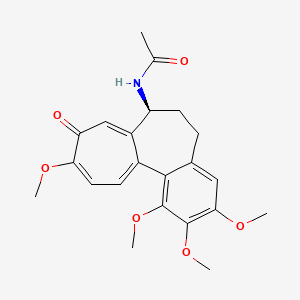
| Formula | C22H25NO6 |
|---|---|
| Molecular weight | 399.44 g/mol |
| IUPAC name | N-[(7S)-1,2,3,10-tetramethoxy-9-oxo-6,7-dihydro-5H-benzo[a]heptalen-7-yl]acetamide |
| CAS | 64-86-8 |
| PubChem CID | 6167 |
| InChIKey | IAKHMKGGTNLKSZ-INIZCTEOSA-N |
| logP | 2.87 (XLogP 1.0) |
| Polar surface area | 83.09 Ų |
| H-bond acceptors / donors | 6 / 1 |
| Drug-likeness (QED) | 0.83 |
| Lipinski violations | 0 |
SMILES
COc1cc2c(c(OC)c1OC)-c1ccc(OC)c(=O)cc1[C@@H](NC(C)=O)CC2Biology & Pharmacokinetics
Pharmacokinetics
| BBB penetrant | No |
|---|
Enzyme interactions
| Enzyme | Role | Detail |
|---|---|---|
| CYP1A2 | Substrate | — |
| CYP2B6 | Inhibitor | — |
| CYP2C19 | Substrate | — |
| CYP3A4 | Substrate | — |
Receptor binding (top 1)
| Target | Action | Affinity |
|---|---|---|
| tubulin beta class I (TUBB) | Inhibitor | pIC50 8.0 |
Transporters
BCRP (Inhibitor)BCRP (Inhibitor)BSEP (Inhibitor)BSEP (Inhibitor)MDR1 (Inhibitor)MRP (Inhibitor)MRP1 (Inhibitor)MRP2 (Inhibitor)MRP3 (Inhibitor)MRP4 (Inhibitor)OATP1B1 (Inhibitor)OATP1B1 (Inhibitor)OATP1B3 (Inhibitor)OATP1B3 (Inhibitor)OATP2B1 (Inhibitor)OCT1 (Inhibitor)OCT3 (Inhibitor)P-gp (Inhibitor)PEPT1 (Inhibitor)BCRP (Substrate)MDR1 (Substrate)MRP2 (Substrate)P-gp (Substrate)
Drug–drug interactions (100+, DDInter)
| Interacting drug | Severity | Management |
|---|---|---|
| Aprepitant | major | |
| Cabozantinib | major | |
| Ceritinib | major | |
| Cladribine | major | |
| Clarithromycin | major | |
| Cobicistat | major | |
| Crizotinib | major | |
| Cyclosporine | major | |
| Deferiprone | major | |
| Eliglustat | major | |
| Erythromycin | major | |
| Fedratinib | major | |
| Fluconazole | major | |
| Gilteritinib | major | |
| Idelalisib | major | |
| Imatinib | major | |
| Ivacaftor | major | |
| Ketoconazole | major | |
| Lapatinib | major | |
| Midostaurin | major | |
| Neratinib | major | |
| Nilotinib | major | |
| Ponatinib | major | |
| Quinine | major | |
| Ribociclib | major | |
| Rolapitant | major | |
| Rosuvastatin | major | |
| Simvastatin | major | |
| Sorafenib | major | |
| Tacrolimus | major | |
| Tamoxifen | major | |
| Vemurafenib | major | |
| Venetoclax | major | |
| Adalimumab | moderate | |
| Alemtuzumab | moderate | |
| Alpelisib | moderate | |
| Apalutamide | moderate | |
| Azathioprine | moderate | |
| Benznidazole | moderate | |
| Blinatumomab | moderate |
Showing 40 of 100+.
Registered Products (4)
| Brand | Form / strength | Pack | Agent | Citizen (JOD) |
|---|---|---|---|---|
| Colcine 0.5 Tablets | Tablet 0.5 mg | 20 tab | Hikma Pharmaceuticals Co.Ltd/Jordan | 0.950 |
| Colchiqan | Tablet 0.50 mg | 20 tab | Itqan Pharmaceutical Industries | 1.000 |
| Colchiqan | Tablet 1 mg | 20 tab | Itqan Pharmaceutical Industries | 1.890 |
| COLCHICINE OPOCALCIUM 1 mg, scored tablet | Tablet 1 mg mg | 20 tab | Ulfa Pharma Co. | 2.570 |