Crizotinib
JFDA label: Xalkori 250
Mechanism of Action
Inhibitor of Hepatocyte growth factor receptor — Hepatocyte growth factor receptor inhibitor; Inhibitor of ALK tyrosine kinase receptor — ALK tyrosine kinase receptor inhibitor; Inhibitor of EML4-ALK — EML4-ALK inhibitor; Inhibitor of NPM/ALK (Nucleophosmin/ALK tyrosine kinase receptor) — NPM/ALK (Nucleophosmin/ALK tyrosine kinase receptor) inhibitor; Inhibitor of Proto-oncogene tyrosine-protein kinase ROS — Proto-oncogene tyrosine-protein kinase ROS inhibitor; Inhibitor of Macrophage-stimulating protein receptor — Macrophage-stimulating protein receptor inhibitor
| Target | Action | Gene / class |
|---|---|---|
| ALK tyrosine kinase receptor efficacy | INHIBITOR | ALK |
| EML4-ALK efficacy | INHIBITOR | |
| Hepatocyte growth factor receptor efficacy | INHIBITOR | MET |
| Macrophage-stimulating protein receptor efficacy | INHIBITOR | MST1R |
| NPM/ALK (Nucleophosmin/ALK tyrosine kinase receptor) efficacy | INHIBITOR | |
| Proto-oncogene tyrosine-protein kinase ROS efficacy | INHIBITOR | ROS1 |
Indications
Approved
- Non-small cell lung cancer, metastatic
Contraindications
Source: Lexicomp
- Known hypersensitivity to crizotinib or any component of the formulation Absolute
- There are no contraindications listed in the manufacturer’s US labeling Absolute
- congenital long QT syndrome or with persistent Fridericia-corrected QT interval (QTcF) ≥500 msec Absolute
Adverse Reactions
Cardiac disorders (7)
Very Common bradycardia · Edema
Common prolonged Q-T interval on ECG · Pulmonary embolism · syncope
Not Known Cardiac arrhythmia · septic shock
Nervous system disorders (4)
Very Common dizziness · Fatigue · headache · neuropathy
Hepatobiliary disorders (3)
Very Common Increased serum ALT · increased serum AST
Common Hepatic failure
Renal and urinary disorders (2)
Very Common Decreased estimated GFR (eGFR)
Common Renal cyst
Blood and lymphatic system disorders (2)
Very Common lymphocytopenia · Neutropenia
Metabolism and nutrition disorders (6)
Very Common hypokalemia · Hypophosphatemia
Common decreased plasma testosterone · diabetic ketoacidosis · weight gain · Weight loss
Gastrointestinal disorders (10)
Very Common abdominal pain · constipation · decreased appetite · Diarrhea · dysgeusia · dyspepsia · nausea · vomiting
Common Dysphagia · esophagitis
Skin and subcutaneous tissue disorders (1)
Very Common Skin rash
Musculoskeletal and connective tissue disorders (2)
Very Common Limb pain
Common Muscle spasm
Eye disorders (1)
Very Common Visual disturbance
Infections and infestations (1)
Common Sepsis
General disorders and administration site conditions (1)
Very Common Fever
Respiratory, thoracic and mediastinal disorders (5)
Common Adult respiratory distress syndrome · dyspnea · interstitial pulmonary disease · pneumonia · respiratory failure
Dosing
Source: Lexicomp
Warnings & Precautions
Source: Lexicomp
Bradycardia
Symptomatic bradycardia may occur; heart rate • GI toxicity: Crizotinib is associated with a moderate emetic potential (Hesketh 2017); antiemetics may be needed to prevent nausea and vomiting.
Hepatotoxicity
Fatalities due to crizotinib-induced hepatotoxicity have occurred. Grade 3 or 4 ALT increases (usually asymptomatic and reversible) have been observed in clinical trials. May require dosage interruption and/or reduction; permanent discontinuation was necessary in some cases. Elevations in ALT or AST >5 × ULN were observed; concurrent ALT or AST elevations ≥3 × ULN and total bilirubin elevations ≥2 × ULN (without alkaline phosphatase elevations) occurred rarely. Transaminase elevation onset generally was within 2 months of treatment initiation. Monitor liver function tests, including ALT, AST, and total bilirubin, every 2 weeks during the first 2 months of therapy, then monthly and as clinically necessary.
Ocular toxicities
Ocular toxicities (eg, blurred vision, diplopia, photophobia, photopsia, visual acuity decreased, visual brightness, visual field defect, visual impairment, and/or vitreous floaters) commonly occur. Onset is generally within 1 week of treatment initiation. Grade 4 visual field defect with vision loss had been reported (rare); optic atrophy and optic nerve disorder have been reported as potential causes of vision loss. Discontinue with new onset of severe visual loss (best corrected vision less than 20/200 in one or both eyes). Obtain ophthalmic evaluation (including best corrected visual acuity, retinal photographs, visual fields, optical coherence tomography, and other evaluations as appropriate). The risks of restarting crizotinib after severe vision loss have not been evaluated; the decision to resume therapy should consider the potential benefits of treatment.
Pulmonary toxicity
Severe, life-threatening, and potentially fatal interstitial lung disease (ILD)/pneumonitis has been associated with crizotinib. Onset was generally within 3 months of treatment initiation. Monitor for pulmonary symptoms which may indicate ILD/pneumonitis; exclude other potential causes (eg, disease progression, infection, other pulmonary disease, or radiation therapy). Permanently discontinue if treatment-related ILD/pneumonitis is confirmed.
QT prolongation
QTc prolongation has been observed. Monitor ECG and electrolytes in patients with heart failure, bradyarrhythmias, electrolyte abnormalities, or who are taking medications known to prolong the QT interval. May require treatment interruption, dosage reduction, or discontinuation. Avoid use in patients with congenital long QT syndrome. Disease-related concerns:
Hepatic impairment
Use with caution in patients with hepatic impairment; has not been studied; patients with ALT or AST >2.5 times ULN (>5 times ULN if due to liver metastases) and total bilirubin >1.5 times ULN were excluded from studies. Crizotinib is extensively metabolized in the liver and liver impairment is likely to increase crizotinib levels.
Renal impairment
Reduce initial dose in patients with severe renal impairment not requiring dialysis. Concurrent drug therapy issues:
Drug-drug/drug-food interactions
Potentially significant interactions may exist, requiring dose or frequency adjustment, additional monitoring, and/or selection of alternative therapy. Consult drug interactions database for more detailed information. Avoid concomitant use with strong CYP3A4 inhibitors and inducers and with CYP3A4 substrates. Other warnings/precautions:
ALK or ROS1 positivity
Approved for use only in patients with metastatic non-small cell lung cancer (NSCLC) who test positive for the abnormal anaplastic lymphoma kinase (ALK) gene or ROS1 rearrangements. The Vysis ALK break-apart FISH probe kit is approved to test for the ALK gene abnormality. An approved test is not currently available for detection of ROS1 rearrangements; in clinical trials, ROS1 positivity was determined by laboratory-developed break-apart FISH or RT-PCR.
Pregnancy & Lactation
Pregnancy
Adverse events have been observed in animal reproduction studies. Based on the mechanism of action, crizotinib may cause fetal harm if administered during pregnancy. Women of childbearing potential should use adequate contraception during treatment and for at least 45 days after the last crizotinib dose; males with female partners of reproductive potential should use condoms during treatment and for at least 90 days after the final dose. The Canadian labeling recommends adequate contraception during treatment and for at least 90 days after the last dose for both males and females.
Lactation
It is not known if crizotinib is present in breast milk. Due to the potential for serious adverse reactions in the breastfeeding infant, the manufacturer recommends against breastfeeding during treatment and for 45 days after the final dose.
Monitoring
| Clinical pearl | ALK or ROS1 positivity; CBC with differential monthly and as clinically appropriate (monitor more frequently if grades 3 or 4 abnormalities observed or with fever or infection), liver function tests every 2 weeks for the first 2 months, then monthly and as clinically appropriate (monitor more frequently if grades 2, 3, or 4 abnormalities observed); renal function (baseline and periodic). Monitor pulmonary symptoms (for interstitial lung disease [ILD]/pneumonitis). Monitor heart rate and blood pressure; monitoring ECG and electrolytes in patients with heart failure, bradycardia, bradyarrhythmias, electrolyte abnormalities, or who are taking medications known to prolong the QT interval. Obtain ophthalmic evaluation (including best corrected visual acuity, retinal photographs, visual fields, optical coherence tomography, and other evaluations as appropriate) if severe visual loss occurs. Monitor adherence. |
|---|
Chemistry & Properties
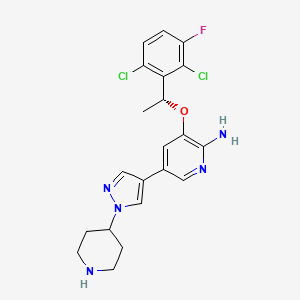
| Formula | C21H22Cl2FN5O |
|---|---|
| Molecular weight | 450.35 g/mol |
| IUPAC name | 3-[(1R)-1-(2,6-dichloro-3-fluorophenyl)ethoxy]-5-(1-piperidin-4-ylpyrazol-4-yl)pyridin-2-amine |
| CAS | 877399-52-5 |
| PubChem CID | 11626560 |
| InChIKey | KTEIFNKAUNYNJU-GFCCVEGCSA-N |
| logP | 5.04 (XLogP 3.7) |
| Polar surface area | 77.99 Ų |
| H-bond acceptors / donors | 6 / 2 |
| Drug-likeness (QED) | 0.53 |
| Lipinski violations | 1 |
SMILES
C[C@@H](Oc1cc(-c2cnn(C3CCNCC3)c2)cnc1N)c1c(Cl)ccc(F)c1ClBiology & Pharmacokinetics
Pharmacokinetics predicted
| Bioavailability | 10.0% |
|---|---|
| Half-life | 0.707 h |
| Volume of distribution | 21.797 L/kg |
| Protein binding | 90.5% |
| BBB penetrant | No |
Enzyme interactions
| Enzyme | Role | Detail |
|---|---|---|
| CYP1A2 | Inhibitor | — |
| CYP2B6 | Inhibitor | — |
| CYP2C19 | Inhibitor | — |
| CYP2C8 | Inhibitor | — |
| CYP3A4 | Substrate | — |
Receptor binding (top 3)
| Target | Action | Affinity |
|---|---|---|
| MET proto-oncogene, receptor tyrosine kinase (MET) | Inhibitor | pIC50 9.1 |
| ALK receptor tyrosine kinase (ALK) | Inhibitor | pIC50 9.0 |
| MET proto-oncogene, receptor tyrosine kinase (MET) | Inhibitor | pKi 8.7 |
Transporters
BCRP (Inhibitor)BCRP (Inhibitor)BSEP (Inhibitor)BSEP (Inhibitor)MDR1 (Inhibitor)MRP1 (Inhibitor)OAT3 (Inhibitor)OATP1B1 (Inhibitor)OATP1B1 (Inhibitor)OATP1B3 (Inhibitor)OATP1B3 (Inhibitor)OATP2B1 (Inhibitor)OCT1 (Inhibitor)OCT2 (Inhibitor)P-gp (Inhibitor)BCRP (Substrate)Hepatic uptake transporters(unspecified) (Substrate)MDR1 (Substrate)P-gp (Substrate)
Drug–drug interactions (100+, DDInter)
| Interacting drug | Severity | Management |
|---|---|---|
| Abarelix | major | |
| Abiraterone | major | |
| Acalabrutinib | major | |
| Adenosine | major | |
| Alfentanil | major | |
| Alfuzosin | major | |
| Alimemazine | major | |
| Amiodarone | major | |
| Amisulpride | major | |
| Amitriptyline | major | |
| Amoxapine | major | |
| Amprenavir | major | |
| Anagrelide | major | |
| Apalutamide | major | |
| Apomorphine | major | |
| Arsenic trioxide | major | |
| Asenapine | major | |
| Astemizole | major | |
| Atazanavir | major | |
| Atomoxetine | major | |
| Avanafil | major | |
| Avapritinib | major | |
| Azithromycin | major | |
| Bedaquiline | major | |
| Benzhydrocodone | major | |
| Bepridil | major | |
| Berotralstat | major | |
| Bicalutamide | major | |
| Boceprevir | major | |
| Bosutinib | major | |
| Brexpiprazole | major | |
| Brigatinib | major | |
| Buprenorphine | major | |
| Butorphanol | major | |
| Cabozantinib | major | |
| Carbamazepine | major | |
| Ceritinib | major | |
| Chloroquine | major | |
| Chlorpromazine | major | |
| Cilostazol | major |
Showing 40 of 100+.
Registered Products (2)
| Brand | Form / strength | Pack | Agent | Citizen (JOD) |
|---|---|---|---|---|
| Xalkori 200 | Tablet 200 mg | 60 tab | Petra Drug Store | — |
| Xalkori 250 | Tablet 250 mg | 60 tab | Petra Drug Store | — |