Digoxin
JFDA label: Lanoxin Tablets
Mechanism of Action
Inhibitor of Sodium/potassium-transporting ATPase — Sodium/potassium-transporting ATPase inhibitor
| Target | Action | Gene / class |
|---|---|---|
| Sodium/potassium-transporting ATPase efficacy | INHIBITOR |
Indications
Approved
- Atrial fibrillation
- Heart failure
Off-label
- Fetal tachycardia
- Supraventricular tachycardia
Contraindications
Source: Lexicomp
- Hypersensitivity to digoxin, other forms of digitalis, or any component of the formulation Absolute
- ventricular fibrillation Absolute
Adverse Reactions
Cardiac disorders (12)
Not Known Accelerated junctional rhythm · asystole · atrial tachycardia with or without block · AV dissociation · facial edema · first- · or third-degree heart block · PR prolongation · PVCs (especially bigeminy or trigeminy) · second- (Wenckebach) · ST segment depression · ventricular tachycardia or ventricular fibrillation
Nervous system disorders (10)
Not Known anxiety · apathy · confusion · delirium · depression · Dizziness · fever · hallucinations · headache · mental disturbances
Gastrointestinal disorders (5)
Not Known abdominal pain · anorexia · diarrhea · Nausea · vomiting
Skin and subcutaneous tissue disorders (4)
Not Known angioneurotic edema · pruritus · Rash (erythematous, maculopapular [most common], papular, scarlatiniform, vesicular or bullous) · urticaria
Musculoskeletal and connective tissue disorders (1)
Not Known Weakness
Other (1)
Not Known Visual disturbances (blurred or yellow vision)
Respiratory, thoracic and mediastinal disorders (1)
Not Known Laryngeal edema
Dosing
Source: Lexicomp
Warnings & Precautions
Source: Lexicomp
Digoxin toxicity
Signs and symptoms of digoxin toxicity include anorexia, nausea, vomiting, visual changes, and cardiac arrhythmias; toxicity is usually associated with digoxin levels >2 ng/mL, although symptoms may occur at lower levels. Patients at increased risk for digoxin toxicity include those with low body weight, advanced age, renal impairment, hypokalemia, hypercalcemia, or hypomagnesemia.
Extravasation
IV administration: Vesicant; ensure proper needle or catheter placement prior to and during administration; avoid extravasation.
Proarrhythmic effects
Monitor for proarrhythmic effects (especially with digoxin toxicity) Disease-related concerns:
Accessory bypass tract (eg, Wolff-Parkinson-White [WPW] syndrome)
During an episode of atrial fibrillation or flutter in patients with an accessory bypass tract or pre-excitation syndrome, use has been associated with increased anterograde conduction down the accessory pathway leading to ventricular fibrillation; avoid use in such patients (ACLS [Neumar 2010]; AHA/ACC/HRS [January 2014]).
Acute coronary syndrome
Use with caution in patients with an acute MI; may increase myocardial oxygen demand and lead to ischemia. During an acute coronary syndrome, digoxin administered IV may be used to slow a rapid ventricular response and improve left ventricular (LV) function in the acute treatment of atrial fibrillation associated with severe LV function and heart failure or hemodynamic instability (AHA/ACC/HRS [January 2014]).
Atrial fibrillation
When used for rate control in patients with atrial fibrillation, monitor serum concentrations closely; may be associated with an increased risk of mortality especially when serum concentrations are not properly controlled (Vamos 2015).
Beri beri heart disease
Patients with beri beri heart disease may fail to adequately respond to digoxin therapy; treat underlying thiamine deficiency concomitantly.
Electrolyte imbalance
Correct electrolyte disturbances, especially hypokalemia or hypomagnesemia, prior to use and throughout therapy; toxicity may occur despite therapeutic digoxin concentrations (eg, • Heart failure: Digoxin should be considered for use only in heart failure (HF) with reduced ejection fraction (HFrEF) when symptoms remain despite guideline-directed medical therapy. It may also be considered in patients with both HF and atrial fibrillation; however, beta blockers may offer better ventricular rate control than digoxin (ACCF/AHA [Yancy 2013]). Withdrawal of digoxin in clinically stable patients with HF may lead to recurrence of HF symptoms (Packer 1993). Monitor serum concentrations closely; may be associated with an increased risk of mortality especially when serum concentrations are not properly controlled (Vamos 2015).
Hypermetabolic states
Atrial arrhythmias associated with hypermetabolic (eg, hyperthyroidism) or hyperdynamic (hypoxia, arteriovenous shunt) states are very difficult to treat; treat underlying condition first. If digoxin is used, ensure digoxin toxicity does not occur.
Hypertrophic cardiomyopathy (HCM) with outflow tract obstruction
Outflow obstruction may worsen due to the positive inotropic effects of digoxin; avoid use unless used to control ventricular response with atrial fibrillation. Digoxin is potentially harmful in the treatment of dyspnea in patients with HCM in the absence of atrial fibrillation (Gersh 2011).
Myocarditis
In a murine model of viral myocarditis, digoxin in high doses was shown to be detrimental (Matsumori 1999). If used in humans, therefore, digoxin should be used with caution and only at low doses (Frishman 2007). The manufacturer recommends avoiding the use of digoxin in patients with myocarditis.
Preserved left ventricular function
Decreased cardiac output may occur in patients with preserved left ventricular systolic function, including restrictive or hypertrophic cardiomyopathy, constrictive pericarditis, amyloid heart disease, and acute cor pulmonale; in general, the manufacturer recommends to avoid use unless used to control ventricular response with atrial fibrillation.
Renal impairment
Use with caution in patients with renal impairment; dosage adjustment needed.
Sinus node disease and atrioventricular (AV) block
Because digoxin slows sinoatrial and AV conduction, the drug commonly prolongs the PR interval. Digoxin may cause severe sinus bradycardia or sinoatrial block particularly in patients with preexisting sinus node disease. Avoid use in patients with second- or third-degree heart block (except in patients with a functioning artificial pacemaker) (Yancy 2013); incomplete AV block (eg, Stokes-Adams attacks) may progress to complete block with digoxin administration. In such patients, if treatment with digoxin is necessary, consider the insertion of a pacemaker before treatment.
Thyroid disease
Use with caution in patients with hypothyroidism, higher digoxin concentrations may result due to significant reduction in digoxin clearance (Burk 2010). In patients with hyperthyroidism, lower digoxin concentrations may result due to an increase in renal clearance of digoxin. No significant differences in absorption were seen in either thyroid condition compared with those with normal thyroid function (Burk 2010). Note: New-onset atrial fibrillation or exacerbation of ventricular arrhythmias should prompt evaluation of thyroid status. Concurrent drug therapy issues:
Drug-drug interactions
Potentially significant interactions may exist, requiring dose or frequency adjustment, additional monitoring, and/or selection of alternative therapy. Consult drug interactions database for more detailed information. Special populations:
Infants
Newborn infants display considerable variability to their tolerance to digoxin; premature and immature infants are particularly sensitive to the effects of digoxin.
Low body weight
Patients with decreased body weight are at an increased risk of drug-related toxicity. Dosage form specific issues:
Propylene glycol
Some dosage forms may contain propylene glycol; large amounts are potentially toxic and have been associated hyperosmolality, lactic acidosis, seizures, and respiratory depression; use caution (AAP 1997; Zar 2007). Other warnings/precautions:
Elective electrical cardioversion
It is not necessary to routinely reduce or hold digoxin therapy prior to elective electrical cardioversion for atrial fibrillation; however, exclusion of digoxin toxicity (eg, clinical and ECG signs) is necessary prior to cardioversion. If signs of digoxin excess exist, withhold digoxin and delay cardioversion until toxicity subsides (AHA/ACC/HRS [January 2014]).
Pregnancy & Lactation
Pregnancy
Caution
Acceptable for arrhythmia control. Drug levels change due to expanded Vd and altered renal clearance — monitor closely. Used intentionally to treat fetal SVT via transplacental transfer
Lactation
Digoxin is excreted into breast milk and similar concentrations are found within mother's serum and milk (milk/plasma ratio ~0.6 to 0.9). However, this exposure is expected to be less than the usual therapeutic infant dose and adverse events to a nursing infant are not expected.
Monitoring
| Efficacy | Serum digoxin level 0.5–0.9 ng/mL (HF) or 1.0–2.0 ng/mL (AF); renal function (CrCl); ECG |
|---|---|
| Toxicity | Serum digoxin > 2.0 ng/mL → toxicity; electrolytes (K⁺, Mg²⁺); signs of toxicity: nausea, visual disturbances, arrhythmias |
| Clinical pearl | Sample at least 6–8 h post-dose (distribution equilibrium). Hypokalaemia and hypomagnesaemia dramatically increase toxicity risk at any level. |
| Counseling | Report yellow-green halos around lights, nausea, or irregular heartbeat immediately. Avoid excessive potassium loss (diarrhoea, diuretics without supplementation). |
Chemistry & Properties
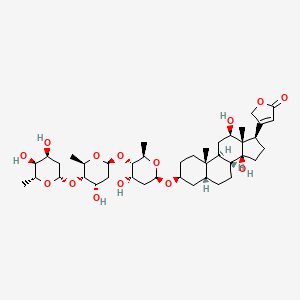
| Formula | C41H64O14 |
|---|---|
| Molecular weight | 780.95 g/mol |
| IUPAC name | 3-[(3S,5R,8R,9S,10S,12R,13S,14S,17R)-3-[(2R,4S,5S,6R)-5-[(2S,4S,5S,6R)-5-[(2S,4S,5S,6R)-4,5-dihydroxy-6-methyloxan-2-yl]oxy-4-hydroxy-6-methyloxan-2-yl]oxy-4-hydroxy-6-methyloxan-2-yl]oxy-12,14-dihydroxy-10,13-dimethyl-1,2,3,4,5,6,7,8,9,11,12,15,16,17-tetradecahydrocyclopenta[a]phenanthren-17-yl]-2H-furan-5-one |
| CAS | 20830-75-5 |
| PubChem CID | 2724385 |
| InChIKey | LTMHDMANZUZIPE-PUGKRICDSA-N |
| logP | 2.22 (XLogP 1.3) |
| Polar surface area | 203.06 Ų |
| H-bond acceptors / donors | 14 / 6 |
| Drug-likeness (QED) | 0.16 |
| Lipinski violations | 3 |
SMILES
C[C@H]1O[C@@H](O[C@H]2[C@@H](O)C[C@H](O[C@H]3[C@@H](O)C[C@H](O[C@H]4CC[C@@]5(C)[C@H](CC[C@@H]6[C@@H]5C[C@@H](O)[C@]5(C)[C@@H](C7=CC(=O)OC7)CC[C@]65O)C4)O[C@@H]3C)O[C@@H]2C)C[C@H](O)[C@@H]1OBiology & Pharmacokinetics
Pharmacokinetics
| BBB penetrant | No |
|---|
Enzyme interactions
| Enzyme | Role | Detail |
|---|---|---|
| CYP2B6 | Inhibitor | — |
| CYP3A4 | Substrate | — |
Transporters
BCRP (Inhibitor)BCRP (Inhibitor)BSEP (Inhibitor)MDR1 (Inhibitor)MRP1 (Inhibitor)MRP2 (Inhibitor)OAT1 (Inhibitor)OAT3 (Inhibitor)OATP1A2 (Inhibitor)OATP1B1 (Inhibitor)OATP1B1 (Inhibitor)OATP1B3 (Inhibitor)OATP1B3 (Inhibitor)OATP2B1 (Inhibitor)OATP4C1 (Inhibitor)OCT1 (Inhibitor)OCTN2 (Inhibitor)P-gp (Inhibitor)BCRP (Substrate)MDR1 (Substrate)MRP1 (Substrate)MRP2 (Substrate)OAT (Substrate)OATP (Substrate)OATP1A2 (Substrate)OATP1B1 (Substrate)OATP1B3 (Substrate)OATP1C1 (Substrate)OATP2B1 (Substrate)OATP3A1 (Substrate)OATP4C1 (Substrate)OCT(unspecified) (Substrate)OCT1 (Substrate)P-gp (Substrate)Transporter(unspecified) (Substrate)
Drug–drug interactions (100+, DDInter)
| Interacting drug | Severity | Management |
|---|---|---|
| Calcium chloride | major | |
| Calcium glucoheptonate | major | |
| Calcium gluconate | major | |
| Ceritinib | major | |
| Clarithromycin | major | |
| Dolasetron | major | |
| Fingolimod | major | |
| Lapatinib | major | |
| Parathyroid hormone | major | |
| Siponimod | major | |
| Acarbose | moderate | |
| Acetylsalicylic acid | moderate | |
| Activated charcoal | moderate | |
| Alectinib | moderate | |
| Alpelisib | moderate | |
| Amphotericin B | moderate | |
| Amphotericin B (cholesteryl sulfate) | moderate | |
| Amphotericin B (lipid complex) | moderate | |
| Amphotericin B (liposomal) | moderate | |
| Apalutamide | moderate | |
| Betamethasone | moderate | |
| Bleomycin | moderate | |
| Brigatinib | moderate | |
| Brimonidine (ophthalmic) | moderate | |
| Brimonidine (topical) | moderate | |
| Bupropion | moderate | |
| Cabozantinib | moderate | |
| Calcifediol | moderate | |
| Calcitriol | moderate | |
| Calcium Phosphate | moderate | |
| Calcium acetate | moderate | |
| Calcium carbonate | moderate | |
| Calcium citrate | moderate | |
| Calcium glubionate anhydrous | moderate | |
| Calcium lactate | moderate | |
| Canagliflozin | moderate | |
| Carfilzomib | moderate | |
| Carmustine | moderate | |
| Chloroquine | moderate | |
| Cholecalciferol | moderate |
Showing 40 of 100+.
Registered Products (11)
| Brand | Form / strength | Pack | Agent | Citizen (JOD) |
|---|---|---|---|---|
| Digoxin Tablet BP | Tablet 62.5 mcg | 28 tab | Burqan Drug Store | 0.400 |
| Digoxin Tablet BP | Tablet 250 mcg | 28 tab | Burqan Drug Store | 0.480 |
| Digoxin Tablet BP | Tablet 125 mcg | 28 tab | Burqan Drug Store | 0.480 |
| Lanoxin Tablets | Tablet 0.25 mg | 100 tab | Suleiman Tannous & Sons Co. Ltd | 3.850 |
| Lanoxin PG Elixir | Injection 0.05 mg/ml | 60 ml | Suleiman Tannous & Sons Co. Ltd | 4.320 |
| Digoxin Injectable Sol. | Injection 0.5 mg/2 ml | 2 ml | Nairoukh Drug Store | 4.440 |
| Lanoxin Tablets | Tablet 0.125 mg | 500 tab | Suleiman Tannous & Sons Co. Ltd | 8.920 |
| Cardixin | Ampoule 0.5 mg/ml | 5 amp pack varies | AL-Faiasel Drug Store | — |
| Cardixin | Ampoule 0.5 mg/ml | 100 amp pack varies | AL-Faiasel Drug Store | — |
| Digoxin Kern Pharma 0.25 mg/ml solution for injection | Powder for Injection Digoxin 0.5 mg | 5 amp | InterPharma | — |
| Lanoxin Injection | Injection 0.25 mg/ml | 5 amp | Suleiman Tannous & Sons Co. Ltd | — |