Eslicarbazepine
JFDA label: Zebinix
Mechanism of Action
Blocker of Sodium channel alpha subunit — Sodium channel alpha subunit blocker
| Target | Action | Gene / class |
|---|---|---|
| Sodium channel alpha subunit efficacy | BLOCKER |
Indications
Approved
- Partial-onset seizures (epilepsy)
Contraindications
Source: Lexicomp
- Additional contraindications (not in US labeling): Hypersensitivity to carbamazepine Absolute
- Hypersensitivity to eslicarbazepine, oxcarbazepine, or any component of the formulation Absolute
- history of, or presence of, second- or third-degree atrioventricular block Absolute
Adverse Reactions
Cardiac disorders (2)
Common Hypertension · peripheral edema
Nervous system disorders (14)
Very Common Dizziness · drowsiness · headache
Common abnormal gait · ataxia · cognitive dysfunction · depression · dysarthria · equilibrium disturbance · falling · Fatigue · insomnia · memory impairment · vertigo
Renal and urinary disorders (1)
Common Urinary tract infection
Blood and lymphatic system disorders (2)
Not Known Decreased hematocrit · decreased hemoglobin
Metabolism and nutrition disorders (5)
Common Hyponatremia, diarrhea, abdominal pain, constipation, gastritis
Not Known Hypercholesterolemia · hypochloremia (concurrent with hyponatremia) · increased LDL cholesterol · increased serum triglycerides
Gastrointestinal disorders (1)
Very Common Nausea
Skin and subcutaneous tissue disorders (1)
Common Skin rash
Musculoskeletal and connective tissue disorders (3)
Common Tremor · weakness
Not Known Increased creatine phosphokinase
Eye disorders (4)
Very Common Diplopia
Common Blurred vision · decreased visual acuity · nystagmus
Respiratory, thoracic and mediastinal disorders (1)
Common Cough
Dosing
Source: Lexicomp
Warnings & Precautions
Source: Lexicomp
CNS effects
Use has been associated with dose-dependent CNS-related adverse events, most significant of these were cognitive symptoms (eg, memory impairment, disturbance in attention, amnesia, confusional state, aphasia, speech disorder, slowness of thought, disorientation, psychomotor retardation), somnolence or fatigue, dizziness and coordination abnormalities (eg, ataxia, vertigo, balance disorder, gait disturbance, nystagmus, abnormal coordination), and visual changes (eg, diplopia, blurred vision, impaired vision). There was an increased risk of visual changes and dizziness and coordination abnormalities during the titration period, in patients >60 years of age, and with concomitant carbamazepine use; consider dosage modifications in patients using eslicarbazepine and carbamazepine concomitantly. Caution patients about performing tasks which require mental alertness (eg, operating machinery or driving).
Dermatologic reactions
Potentially serious, sometimes fatal, dermatologic reactions including Stevens-Johnson syndrome (SJS) have been reported; monitor for signs and symptoms of skin reactions; discontinuation and conversion to alternate therapy may be required. Avoid use in patients with prior dermatologic reaction with carbamazepine, oxcarbazepine, or eslicarbazepine.
Hematologic effects
Cases of pancytopenia, agranulocytosis, and leukopenia have been reported; consider discontinuing eslicarbazepine if these hematologic abnormalities develop.
Hepatic effects
Hepatic effects ranging from mild to moderate elevations in transaminases (>3 times the upper limit of normal) to rare cases of concomitant elevations of total bilirubin (>2 times the upper limit of normal) have been reported. Perform baseline liver laboratory tests. Discontinue in patients with jaundice or other evidence of significant liver injury.
Hypersensitivity reactions
Rare cases of anaphylaxis and angioedema have been reported. Permanently discontinue should symptoms occur. Avoid use in patients with a prior anaphylactic-type reaction with either oxcarbazepine or eslicarbazepine.
Hyponatremia
Clinically significant hyponatremia (serum sodium • Multiorgan hypersensitivity reactions: Potentially serious, sometimes fatal drug reaction with eosinophilia and systemic symptoms (DRESS), also known as multiorgan hypersensitivity reactions, have been reported. Monitor for signs and symptoms (eg, fever, rash, lymphadenopathy, eosinophilia) in association with other organ system involvement (eg, hepatitis, nephritis, hematological abnormalities, myocarditis, myositis). Evaluate immediately if signs or symptoms are present. Discontinuation and conversion to alternate therapy may be required. Avoid use in patients with a prior DRESS reaction with carbamazepine, oxcarbazepine, or eslicarbazepine.
Suicidal ideation
Pooled analysis of trials involving various antiepileptics (regardless of indication) showed an increased risk of suicidal thoughts/behavior (incidence rate: 0.43% treated patients compared to 0.24% of patients receiving placebo); risk observed as early as 1 week after initiation and continued through duration of trials (most trials ≤24 weeks). Monitor all patients for notable changes in behavior that might indicate suicidal thoughts or depression; patients should be instructed to notify healthcare provider immediately if symptoms occur.
Thyroid function
Dose-dependent decreases in serum T3 and T4 (free and total) values have been observed; changes were not associated with other abnormal thyroid function tests suggesting hypothyroidism. Disease-related concerns:
Renal impairment
Clearance is decreased in patients with impaired renal function; dosage adjustment is necessary in patients with CrCl • Hepatic impairment: Avoid use in patients with severe hepatic impairment. Concurrent drug therapy issues:
Drug-drug interactions
Potentially significant interactions may exist, requiring dose or frequency adjustment, additional monitoring, and/or selection of alternative therapy. Consult drug interactions database for more detailed information. Other warnings/precautions:
Withdrawal
Anticonvulsants should not be discontinued abruptly because of the possibility of increasing seizure frequency; therapy should be withdrawn gradually to minimize the potential of increased seizure frequency, unless safety concerns require a more rapid withdrawal.
Pregnancy & Lactation
Pregnancy
Adverse events have been observed in animal reproduction studies. Eslicarbazepine may decrease plasma concentrations of hormonal contraceptives; additional or alternative nonhormonal contraceptives are recommended in women of reproductive potential. Patients exposed to eslicarbazepine during pregnancy are encouraged to enroll themselves into the AED Pregnancy Registry by calling 1-888-233-2334. Additional information is available at http://www.aedpregnancyregistry.org.
Lactation
Eslicarbazepine is present in breast milk. According to the manufacturer, the decision to breastfeed during therapy should consider the risk of infant exposure, the benefits of breastfeeding to the infant, and benefits of treatment to the mother.
Monitoring
| Clinical pearl | Seizure frequency; liver enzymes (baseline); serum sodium and chloride as deemed necessary during maintenance treatment, particularly in patients receiving other medications known to decrease sodium levels or if symptoms of hyponatremia develop; symptoms of CNS depression (dizziness, disturbance in gait and coordination, somnolence); visual changes; hypersensitivity reactions. Monitor for suicidality (eg, suicidal thoughts, depression, behavioral changes). For adjunctive therapy, serum levels of concomitant antiepileptic drugs during titration as necessary. |
|---|
Chemistry & Properties
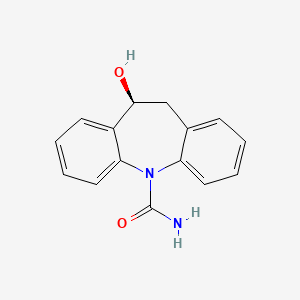
| Formula | C15H14N2O2 |
|---|---|
| Molecular weight | 254.29 g/mol |
| IUPAC name | (5S)-5-hydroxy-5,6-dihydrobenzo[b][1]benzazepine-11-carboxamide |
| CAS | 104746-04-5 |
| PubChem CID | 9881504 |
| InChIKey | BMPDWHIDQYTSHX-AWEZNQCLSA-N |
| logP | 2.49 (XLogP 1.4) |
| Polar surface area | 66.56 Ų |
| H-bond acceptors / donors | 2 / 2 |
| Drug-likeness (QED) | 0.76 |
| Lipinski violations | 0 |
SMILES
NC(=O)N1c2ccccc2C[C@H](O)c2ccccc21Biology & Pharmacokinetics
Pharmacokinetics predicted
| Bioavailability | 10.0% |
|---|---|
| Half-life | 2.117 h |
| Volume of distribution | 0.729 L/kg |
| Protein binding | 35.9% |
| BBB penetrant | Yes |
Enzyme interactions
| Enzyme | Role | Detail |
|---|---|---|
| CYP2B6 | Inhibitor | — |
| CYP3A4 | Substrate | — |
Transporters
BCRP (Inhibitor)BSEP (Inhibitor)MDR1 (Inhibitor)MRP1 (Inhibitor)OATP1B1 (Inhibitor)OATP1B3 (Inhibitor)P-gp (Inhibitor)MDR1 (Substrate)P-gp (Substrate)Transporter(unspecified) (Substrate)
Drug–drug interactions (100+, DDInter)
| Interacting drug | Severity | Management |
|---|---|---|
| Brigatinib | major | |
| Cobimetinib | major | |
| Ethinylestradiol | major | |
| Glasdegib | major | |
| Hydrocodone | major | |
| Lorlatinib | major | |
| Siponimod | major | |
| Venetoclax | major | |
| Abemaciclib | moderate | |
| Acalabrutinib | moderate | |
| Alimemazine | moderate | |
| Apixaban | moderate | |
| Apremilast | moderate | |
| Aprepitant | moderate | |
| Artemether | moderate | |
| Axitinib | moderate | |
| Azatadine | moderate | |
| Azelastine (nasal) | moderate | |
| Binimetinib | moderate | |
| Bosutinib | moderate | |
| Brompheniramine | moderate | |
| Cabazitaxel | moderate | |
| Cabozantinib | moderate | |
| Carbinoxamine | moderate | |
| Ceritinib | moderate | |
| Chlorcyclizine | moderate | |
| Chloroquine | moderate | |
| Chlorphenesin | moderate | |
| Chlorpheniramine | moderate | |
| Cilostazol | moderate | |
| Clemastine | moderate | |
| Clofedanol | moderate | |
| Clopidogrel | moderate | |
| Cobicistat | moderate | |
| Codeine | moderate | |
| Copanlisib | moderate | |
| Crizotinib | moderate | |
| Cyclizine | moderate | |
| Cyproheptadine | moderate | |
| Darolutamide | moderate |
Showing 40 of 100+.
Registered Products (1)
| Brand | Form / strength | Pack | Agent | Citizen (JOD) |
|---|---|---|---|---|
| Zebinix | Tablet 800 mg | 30 tab | Nabulsi Drug Store | 116.430 |