Felodipine
JFDA label: PLENDIL TAB
Mechanism of Action
Antagonist of Mineralocorticoid receptor — Mineralocorticoid receptor antagonist; Blocker of Voltage-gated L-type calcium channel — Voltage-gated L-type calcium channel blocker
| Target | Action | Gene / class |
|---|---|---|
| Mineralocorticoid receptor efficacy | ANTAGONIST | NR3C2 |
| Voltage-gated L-type calcium channel efficacy | BLOCKER |
Indications
Approved
- Chronic kidney disease (CKD) and hypertension
- Diabetes and hypertension
- Hypertension
Off-label
- Pediatric hypertension
Contraindications
Source: Lexicomp
- Additional contraindications (not in U.S. labeling): Hypersensitivity to other dihydropyridines Absolute
- Hypersensitivity to felodipine or any component of the formulation Absolute
- women of childbearing potential, in pregnancy, and during lactation Absolute
Adverse Reactions
Cardiac disorders (1)
Very Common Peripheral edema
Nervous system disorders (1)
Very Common Headache
Other (2)
Common Cardiovascular: Flushing · tachycardia
Dosing
Source: Lexicomp
Warnings & Precautions
Source: Lexicomp
Angina/MI
Increased angina and/or MI has occurred with initiation or dosage titration of dihydropyridine calcium channel blockers; reflex tachycardia may occur resulting in angina and/or MI in patients with obstructive coronary disease especially in the absence of concurrent beta-blockade.
Hypotension/syncope
Symptomatic hypotension with or without syncope can rarely occur; blood pressure must be lowered at a rate appropriate for the patient's clinical condition.
Peripheral edema
The most common side effect is peripheral edema (dose dependent); occurs within 2 to 3 weeks of starting therapy. Disease-related concerns:
Aortic stenosis
Use with extreme caution in patients with severe aortic stenosis; may reduce coronary perfusion resulting in ischemia.
Heart failure
The ACCF/AHA heart failure guidelines recommend to avoid use in patients with heart failure (HF) due to lack of benefit and/or worse outcomes with calcium channel blockers in general (Yancy, 2013).
Hepatic impairment
Use with caution in patients with hepatic impairment; may require lower starting dose.
Hypertrophic cardiomyopathy (HCM) with outflow tract obstruction
Use with caution in patients with HCM and outflow tract obstruction since reduction in afterload may worsen symptoms associated with this condition. Special populations:
Elderly
Initiate at a lower dose in the elderly. Dosage forms specific issues:
Lactose
May contain lactose; if necessary, consider alternative agents in patients intolerant of lactose. Concurrent drug therapy issues:
Drug-drug interactions
Potentially significant interactions may exist, requiring dose or frequency adjustment, additional monitoring, and/or selection of alternative therapy. Consult drug interactions database for more detailed information.
Pregnancy & Lactation
Pregnancy
Adverse events were observed in animal reproduction studies. Untreated chronic maternal hypertension is associated with adverse events in the fetus, infant, and mother. If treatment for hypertension during pregnancy is needed, other agents are preferred (ACOG, 2013). The Canadian labeling contraindicates use in women of childbearing potential and during pregnancy.
Lactation
It is not known if felodipine is excreted in breast milk. Due to the potential for serious adverse reactions in the nursing infant, the U.S. labeling recommends a decision be made whether to discontinue nursing or to discontinue the drug, taking into account the importance of treatment to the mother. The Canadian labeling contraindicates use in nursing women.
Chemistry & Properties
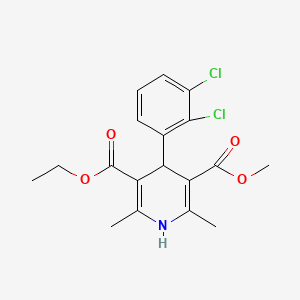
| Formula | C18H19Cl2NO4 |
|---|---|
| Molecular weight | 384.26 g/mol |
| IUPAC name | 5-O-ethyl 3-O-methyl 4-(2,3-dichlorophenyl)-2,6-dimethyl-1,4-dihydropyridine-3,5-dicarboxylate |
| CAS | 72509-76-3 |
| PubChem CID | 3333 |
| InChIKey | RZTAMFZIAATZDJ-UHFFFAOYSA-N |
| logP | 3.96 (XLogP 3.9) |
| Polar surface area | 64.63 Ų |
| H-bond acceptors / donors | 5 / 1 |
| Drug-likeness (QED) | 0.80 |
| Lipinski violations | 0 |
SMILES
CCOC(=O)C1=C(C)NC(C)=C(C(=O)OC)C1c1cccc(Cl)c1ClBiology & Pharmacokinetics
Pharmacokinetics
| BBB penetrant | No |
|---|
Enzyme interactions
| Enzyme | Role | Detail |
|---|---|---|
| CYP1A2 | Inhibitor | — |
| CYP1A2 | Substrate | — |
| CYP2B6 | Inhibitor | — |
| CYP2C19 | Inhibitor | — |
| CYP2C19 | Substrate | — |
| CYP2C8 | Inhibitor | — |
| CYP2C9 | Inhibitor | IC₅₀ 4.5794999999999995 µM |
| CYP3A4 | Inhibitor | — |
| CYP3A4 | Substrate | — |
Receptor binding (top 2)
| Target | Action | Affinity |
|---|---|---|
| CFTR (CFTR) | Activator | pKi 8.4 |
| CFTR (CFTR) | Activator | pEC50 5.7 |
Transporters
ASBT (Inhibitor)BCRP (Inhibitor)BCRP (Inhibitor)BSEP (Inhibitor)BSEP (Inhibitor)ENT1 (Inhibitor)MDR1 (Inhibitor)MRP1 (Inhibitor)MRP2 (Inhibitor)MRP3 (Inhibitor)MRP4 (Inhibitor)OATP1B1 (Inhibitor)OATP1B1 (Inhibitor)OATP1B3 (Inhibitor)OATP2B1 (Inhibitor)OCT1 (Inhibitor)P-gp (Inhibitor)P-gp (Substrate)Transporter(unspecified) (Substrate)
Drug–drug interactions (100+, DDInter)
| Interacting drug | Severity | Management |
|---|---|---|
| Apalutamide | major | |
| Betrixaban | major | |
| Ceritinib | major | |
| Dolasetron | major | |
| Edoxaban | major | |
| Enzalutamide | major | |
| Ketoconazole | major | |
| Lumacaftor | major | |
| Mitotane | major | |
| Siponimod | major | |
| Venetoclax | major | |
| Acetylsalicylic acid | moderate | |
| Adalimumab | moderate | |
| Afatinib | moderate | |
| Aldesleukin | moderate | |
| Alefacept | moderate | |
| Alimemazine | moderate | |
| Amifostine | moderate | |
| Anakinra | moderate | |
| Apixaban | moderate | |
| Aprepitant | moderate | |
| Betamethasone | moderate | |
| Bexarotene | moderate | |
| Binimetinib | moderate | |
| Brigatinib | moderate | |
| Brimonidine (ophthalmic) | moderate | |
| Brimonidine (topical) | moderate | |
| Budesonide | moderate | |
| Bupropion | moderate | |
| Calcium Phosphate | moderate | |
| Calcium acetate | moderate | |
| Calcium carbonate | moderate | |
| Calcium chloride | moderate | |
| Calcium citrate | moderate | |
| Calcium glubionate anhydrous | moderate | |
| Calcium glucoheptonate | moderate | |
| Calcium gluconate | moderate | |
| Calcium lactate | moderate | |
| Canagliflozin | moderate | |
| Canakinumab | moderate |
Showing 40 of 100+.
Registered Products (2)
| Brand | Form / strength | Pack | Agent | Citizen (JOD) |
|---|---|---|---|---|
| PLENDIL TAB | Tablet 5 mg | 30 tab | Shawi & Rushedat Drug Store | 4.150 |
| PLENDIL TAB | Tablet 10 mg | 30 tab | Shawi & Rushedat Drug Store | 7.490 |