Ketorolac Tromethamine
🧬 Cross-allergy: NSAIDs
JFDA label: Acular LS Eye Drops
- immune system toxicity — ChEMBL drug_warning (Black Box Warning) | United States
- gastrointestinal toxicity — ChEMBL drug_warning (Black Box Warning) | United States
- cardiotoxicity — ChEMBL drug_warning (Black Box Warning) | United States
- neurotoxicity — ChEMBL drug_warning (Black Box Warning) | United States
- vascular toxicity — ChEMBL drug_warning (Black Box Warning) | United States
- respiratory toxicity — ChEMBL drug_warning (Black Box Warning) | United States
- Black Box Warning — ChEMBL drug_warning (Black Box Warning) | United States
- Ketorolac tromethamine, a nonsteroidal anti-inflammatory drug (NSAID), is indicated for the short-term (up to 5 days in adults) management of moderately severe acute pain that requires analgesia at th
Mechanism of Action
Inhibitor of Cyclooxygenase — Cyclooxygenase inhibitor
| Target | Action | Gene / class |
|---|---|---|
| Cyclooxygenase efficacy | INHIBITOR |
Indications
Approved
- Acute Pain — pain
- Cataract — cataract
- Eye Pain — Ocular pain
- Inflammation — inflammation
- Pain — pain
Off-label
- Back Pain
- Heart Diseases
- Kidney Calculi
- Macular Edema
- Migraine Disorders
- Pulpitis
- Renal Colic
- Shoulder Impingement Syndrome
Contraindications
Source: openFDA
- (See also Boxed WARNING .) Ketorolac tromethamine is contraindicated in patients with previously demonstrated hypersensitivity to ketorolac tromethamine. Ketorolac tromethamine is contraindicated in patients with active peptic ulcer disease, in patients with recent gastrointestinal bleeding or perforation and in patients with a history of peptic ulcer disease or gastrointestinal bleeding. Ketorolac tromethamine should not be given to patients who have experienced asthma, urticaria, or allergic-type reactions after taking aspirin or other NSAIDs. Severe, rarely fatal, anaphylactic-like reactions to NSAIDs have been reported in such patients (see WARNINGS – Anaphylactoid Reactions , and PRECAUTIONS – Pre-existing Asthma ). Ketorolac tromethamine is contraindicated as prophylactic analgesic before any major surgery. Ketorolac tromethamine is contraindicated in the setting of coronary artery bypass graft (CABG) surgery (see WARNINGS ). Ketorolac tromethamine is contraindicated in patients with advanced renal impairment or in patients at risk for renal failure due to volume depletion (see WARNINGS for correction of volume depletion). Ketorolac tromethamine is contraindicated in labor and delivery because, through its prostaglandin synthesis inhibitory effect, it may adversely affect fetal circulation and inhibit uterine musculature, thus increasing the risk of uterine hemorrhage. Ketorolac tromethamine inhibits platelet function and is, therefore, contraindicated in patients with suspected or confirmed cerebrovascular bleeding, hemorrhagic diathesis, incomplete hemostasis and those at high risk of bleeding (see WARNINGS and PRECAUTIONS ). Ketorolac tromethamine is contraindicated in patients currently receiving aspirin or NSAIDs because of the cumulative risks of inducing se Absolute
Adverse Reactions
Cardiac disorders (4)
Rare Bradycardia · Cardiac disorder · Cardiac failure · Palpitations
Vascular disorders (6)
Common Retinal haemorrhage
Rare Bleeding time prolonged · Flushing · Haematoma · Hypertension · Hypotension
Nervous system disorders (6)
Very Common Headache
Common Dizziness · Somnolence
Rare Convulsion · Meningitis aseptic · Paraesthesia
Hepatobiliary disorders (5)
Rare Hepatic failure · Hepatitis · Hepatobiliary disease · Jaundice cholestatic · Liver function test abnormal
Renal and urinary disorders (7)
Rare Blood creatinine increased · Haematuria · Nephrotic syndrome · Pollakiuria · Renal failure acute · Urinary retention · Urinary tract disorder
Blood and lymphatic system disorders (3)
Rare Haemolytic uraemic syndrome · Leukopenia · Thrombocytopenia
Immune system disorders (3)
Rare Anaphylactic shock · Hypersensitivity · Immune system disorder
Metabolism and nutrition disorders (2)
Rare Hyperkalaemia · Hyponatraemia
Gastrointestinal disorders (23)
Very Common Dyspepsia · Gastrointestinal pain · Nausea
Common Diarrhoea
Uncommon Vomiting
Rare Abdominal pain · Colitis · Constipation · Decreased appetite · Dry mouth · Flatulence · Gastrointestinal disorder · Gastrointestinal haemorrhage · Gastrointestinal perforation · Haematemesis · Melaena · Oesophagitis · Pancreatitis · Pancreatitis acute · Peptic ulcer · Rectal haemorrhage · Stomatitis · Thirst
Skin and subcutaneous tissue disorders (15)
Rare Angioedema · Dermatitis · Dermatitis exfoliative · Erythema multiforme · Hyperhidrosis · Pruritus · Purpura · Rash · Rash maculo-papular · Skin disorder · Stevens-Johnson syndrome · Toxic epidermal necrolysis · Urticaria · Vascular purpura · Wound haemorrhage
Musculoskeletal and connective tissue disorders (3)
Rare Connective tissue disorder · Musculoskeletal discomfort · Myalgia
Psychiatric disorders (7)
Rare Abnormal dreams · Agitation · Anxiety · Euphoric mood · Hallucination · Insomnia · Mental disorder
Eye disorders (5)
Common Eye burns · Eye pain
Uncommon Eye oedema
Rare Eye disorder · Visual impairment
Ear and labyrinth disorders (5)
Rare Deafness · Ear disorder · Hearing impaired · Tinnitus · Vertigo
Reproductive system and breast disorders (2)
Rare Breast disorder · Infertility female
Infections and infestations (1)
Rare Infection
Investigations (4)
Rare Blood urea increased · Body temperature increased · Thinking abnormal · Weight increased
General disorders and administration site conditions (34)
Common Corneal deposits · Cystoid macular oedema · Oedema
Uncommon Conjunctival hyperaemia · Corneal infiltrates
Rare Anaphylactoid reaction · Angiopathy · Asthenia · Azotaemia · Chest pain · Crohn's disease · Discomfort · Disturbance in attention · Dysgeusia · Eructation · Extrapyramidal disorder · Flank pain · Gastritis · Hyperkinesia · Injection site reaction · Malnutrition · Mediastinal disorder · Mental disability · Mouth ulceration · Nephritis · Nervous system disorder · Nervousness · Oliguria · Pallor · Psychotic disorder · Tension · Tongue disorder · Tongue oedema · Urethral disorder
Respiratory, thoracic and mediastinal disorders (7)
Rare Asthma · Bronchospasm · Dyspnoea · Epistaxis · Laryngeal oedema · Pulmonary oedema · Tubulointerstitial nephritis
Injury, poisoning and procedural complications (1)
Common Injury
Dosing
Source: openFDA
Warnings & Precautions
Source: openFDA
Boxed Warning
Ketorolac tromethamine, a nonsteroidal anti-inflammatory drug (NSAID), is indicated for the short-term (up to 5 days in adults) management of moderately severe acute pain that requires analgesia at the opioid level. Oral ketorolac tromethamine is indicated only as continuation treatment following intravenous or intramuscular dosing of ketorolac tromethamine, if necessary. The total combined duration of use of oral ketorolac tromethamine and ketorolac tromethamine injection should not exceed 5 days. Ketorolac tromethamine is not indicated for use in pediatric patients and it is NOT indicated for minor or chronic painful conditions. Increasing the dose of ketorolac tromethamine beyond the label recommendations will not provide better efficacy but will increase the risk of developing serious adverse events. GASTROINTESTINAL RISK • Ketorolac tromethamine can cause peptic ulcers, gastrointestinal bleeding and/or perforation of the stomach or intestines, which can be fatal. These events can occur at any time during use and without warning symptoms. Therefore, ketorolac tromethamine is CONTRAINDICATED in patients with active peptic ulcer disease, in patients with recent gastrointestinal bleeding or perforation, and in patients with a history of peptic ulcer disease or gastrointestinal bleeding. Elderly patients are at greater risk for serious gastrointestinal events (see WARNING S ). CARDIOVASCULAR THROMBOTIC EVENTS • Nonsteroidal anti-inflammatory drugs (NSAIDs) cause an increased risk of serious cardiovascular thrombotic events, including myocardial infarction and stroke, which can be fatal. This risk may occur early in treatment and may increase with duration of use (see WARNINGS and PRECAUTIONS ). • Ketorolac tromethamine is CONTRAINDICATED in the setting of coronary artery bypass graft (CABG) surgery (see CONTRAINDICATIONS and WARNINGS ). RENAL RISK • Ketorolac tromethamine is CONTRAINDICATED in patients with advanced renal impairment and in patients at risk for renal failure due to volume depletion (see WARNINGS ). RISK OF BLEEDING • Ketorolac tromethamine inhibits platelet function and is, therefore, CONTRAINDICATED in patients with suspected or confirmed cerebrovascular bleeding, patients with hemorrhagic diathesis, incomplete hemostasis and those at high risk of bleeding (see WARNINGS and PRECAUTIONS ). Ketorolac tromethamine is CONTRAINDICATED as prophylactic analgesic before any major surgery. HYPERSENSITIVITY • Hypersensitivity reactions, ranging from
Warnings & Precautions
(See also Boxed WARNING .) The total combined duration of use of oral ketorolac tromethamine and intravenous or intramuscular dosing of ketorolac tromethamine is not to exceed 5 days in adults. Ketorolac tromethamine is not indicated for use in pediatric patients. The most serious risks associated with ketorolac tromethamine are: Gastrointestinal Effects – Risk of Ulceration, Bleeding and Perforation: Ketorolac tromethamine is contraindicated in patients with previously documented peptic ulcers and/or gastrointestinal (GI) bleeding. Ketorolac tromethamine can cause serious GI adverse events including bleeding, ulceration and perforation, of the stomach, small intestine, or large intestine, which can be fatal. These serious adverse events can occur at any time, with or without warning symptoms, in patients treated with ketorolac tromethamine. Only one in five patients who develop a serious upper GI adverse event on NSAID therapy is symptomatic. Minor upper gastrointestinal problems, such as dyspepsia, are common and may also occur at any time during NSAID therapy. The incidence and severity of gastrointestinal complications increases with increasing dose of, and duration of treatment with ketorolac tromethamine. Do not use ketorolac tromethamine for more than five days. However, even short-term therapy is not without risk. In addition to past history of ulcer disease, other factors that increase the risk for GI bleeding in patients treated with NSAIDs include concomitant use of oral corticosteroids, or anticoagulants, longer duration of NSAID therapy, smoking, use of alcohol, older age, and poor general health status. Most spontaneous reports of fatal GI events are in elderly or debilitated patients and therefore, special care should be taken in treating this population. To minimize the potential risk for an adverse GI event, the lowest effective dose should be used for the shortest possible duration. Patients and physicians should remain alert for signs and symptoms of GI ulceration and bleeding during NSAID therapy and promptly initiate additional evaluation and treatment if a serious GI adverse event is suspected. This should include discontinuation of ketorolac tromethamine until a serious GI adverse event is ruled out. For high risk patients, alternate therapies that do not involve NSAIDs should be considered. NSAIDs should be given with care to patients with a history of inflammatory bowel disease (ulcerative colitis, Crohn’s disease) as their conditi
Pregnancy & Lactation
Pregnancy
Lactation
Maternal
Chemistry & Properties
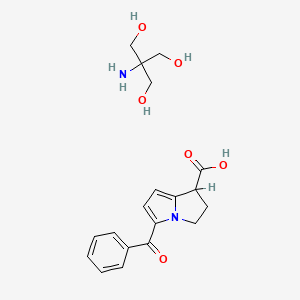
| Formula | C19H24N2O6 |
|---|---|
| Molecular weight | 376.41 g/mol |
| IUPAC name | 2-amino-2-(hydroxymethyl)propane-1,3-diol;5-benzoyl-2,3-dihydro-1H-pyrrolizine-1-carboxylic acid |
| CAS | 74103-07-4 |
| PubChem CID | 84003 |
| InChIKey | BWHLPLXXIDYSNW-UHFFFAOYSA-N |
| logP | 2.29 |
| Polar surface area | 59.3 Ų |
| H-bond acceptors / donors | 3 / 1 |
| Drug-likeness (QED) | 0.86 |
| Lipinski violations | 0 |
SMILES
NC(CO)(CO)CO.O=C(c1ccccc1)c1ccc2n1CCC2C(=O)OBiology & Pharmacokinetics
Pharmacokinetics predicted
| Bioavailability | 10.0% |
|---|---|
| Half-life | 2.122 h |
| Volume of distribution | 0.097 L/kg |
| Protein binding | 96.7% |
| BBB penetrant | No |
Enzyme interactions
| Enzyme | Role | Detail |
|---|---|---|
| CYP2C9 | Substrate | — |
Receptor binding (top 2)
| Target | Action | Affinity |
|---|---|---|
| COX-1 | Binding | pKi 8.1 |
| COX-2 | Binding | pKi 7.0 |
Transporters
BCRP (Inhibitor)BSEP (Inhibitor)BSEP (Inhibitor)MRP1 (Inhibitor)MRP2 (Inhibitor)MRP3 (Inhibitor)MRP4 (Inhibitor)NTCP (Inhibitor)OAT1 (Inhibitor)OATP1B1 (Inhibitor)OATP1B3 (Inhibitor)OCTN2 (Inhibitor)P-gp (Inhibitor)OAT1 (Substrate)OAT3 (Substrate)P-gp (Substrate)
Drug–drug interactions (100+, DDInter)
| Interacting drug | Severity | Management |
|---|---|---|
| Acalabrutinib | major | |
| Acetylsalicylic acid | major | |
| Apixaban | major | |
| Betrixaban | major | |
| Cabozantinib | major | |
| Celecoxib | major | |
| Dalteparin | major | |
| Danaparoid | major | |
| Dasatinib | major | |
| Deferasirox | major | |
| Desirudin | major | |
| Diatrizoate | major | |
| Diclofenac | major | |
| Dicoumarol | major | |
| Drotrecogin alfa | major | |
| Edoxaban | major | |
| Enoxaparin | major | |
| Everolimus | major | |
| Flurbiprofen | major | |
| Fondaparinux | major | |
| Ibritumomab tiuxetan | major | |
| Ibrutinib | major | |
| Ibuprofen | major | |
| Iodipamide | major | |
| Iodixanol | major | |
| Iohexol | major | |
| Iopamidol | major | |
| Iopromide | major | |
| Iothalamic acid | major | |
| Ioversol | major | |
| Ioxilan | major | |
| Leflunomide | major | |
| Methotrexate | major | |
| Omacetaxine mepesuccinate | major | |
| Panobinostat | major | |
| Pentoxifylline | major | |
| Ponatinib | major | |
| Prasugrel | major | |
| Ramucirumab | major | |
| Regorafenib | major |
Showing 40 of 100+.
Registered Products (3)
| Brand | Form / strength | Pack | Agent | Citizen (JOD) |
|---|---|---|---|---|
| Acular LS Eye Drops | Ophthalmic Solution 0.4 % | 5 ml | Arab Company for Medical & Agricultural Products | 4.100 |
| Ketomax | Ampoule 30 mg/1 ml | 10 amp | Amman Pharmaceutical Industries Co | 6.250 |
| Acuvail | Vial 4.5 mg/ml | 0.4 ml | Arab Company for Medical & Agricultural Products | 7.570 |