Linezolid
JFDA label: Zyvox
Mechanism of Action
Inhibitor of Bacterial 70S ribosome — Bacterial 70S ribosome inhibitor
| Target | Action | Gene / class |
|---|---|---|
| Bacterial 70S ribosome efficacy | INHIBITOR |
Indications
Approved
- Community-acquired
- Complicated
- Enterococcal infections (vancomycin-resistant)
- Hospital-acquired or healthcare-associated
- Pneumonia
- Skin and skin structure infections
- Uncomplicated
Off-label
- CNS infection due to methicillin-resistant S. aureus
- Infective endocarditis, treatment (adults)
- Intravascular catheter-associated bloodstream infection
- Osteomyelitis (S. aureus [methicillin-resistant])
- Osteomyelitis, native vertebral
- Prosthetic joint infection
- Septic arthritis (S. aureus [methicillin-resistant])
- Tuberculosis, extensively drug-resistant
Antimicrobial Spectrum
Expected / intrinsic spectrum (EUCAST breakpoints & labels) — not local resistance. Source: EUCAST v16 · curated · openfda-label.
Bacteria
| Organism | Activity | MIC |
|---|---|---|
| Anaerobes | Susceptible | 2.0 mg/L |
| Bacillus spp. | Susceptible | 2.0 mg/L |
| Coagulase-negative staphylococci | Susceptible | 4.0 mg/L |
| Corynebacterium spp. | Susceptible | 2.0 mg/L |
| Enterococcus faecalis | Susceptible | 4.0 mg/L |
| Enterococcus faecium | Susceptible | 4.0 mg/L |
| Enterococcus spp. | Susceptible | 4.0 mg/L |
| Pasteurella multocida | Active | — |
| Staphylococcus aureus | Susceptible | 4.0 mg/L |
| Staphylococcus epidermidis | Active | — |
| Staphylococcus haemolyticus | Active | — |
| Staphylococcus spp. | Susceptible | 4.0 mg/L |
| Streptococcus A/B/C/G | Susceptible | 2.0 mg/L |
| Streptococcus agalactiae | Active | — |
| Streptococcus pneumoniae | Susceptible | 2.0 mg/L |
| Streptococcus pneumoniae | Susceptible | 2.0 mg/L |
| Streptococcus pyogenes | Active | — |
| Staphylococcus aureus | Resistant | 4.0 mg/L |
Class profile
| gramStatus | Gram+ |
|---|---|
| spectrumBreadth | Narrow |
| atypicalCoverage | No |
| isBactericidal | 0 |
| moaCategory | Protein synthesis inhibitor (50S ribosomal, 23S rRNA, unique binding site) |
| pdIndex | Time-dependent |
| postAntibioticEffect | None |
| mrsaCoverage | 1 |
| resistanceMechanisms | 23S rRNA mutation (G2576T),cfr gene methylation,Efflux pumps (optrA,poxtA) |
Contraindications
Source: Lexicomp
- Additional contraindications (not in US labeling): Unless monitored for potential increases in blood pressure, linezolid should not be administered to patients with uncontrolled hypertension, pheochromocytoma, thyrotoxicosis and/or patients taking any of the following: sympathomimetic agents (eg, pseudoephedrine, phenylpropanolamine), vasopressive agents (eg, epinephrine, norepinephrine), dopaminergic agents (eg, dopamine, dobutamine). Unless carefully observed for signs and/or symptoms of serot Absolute
- Hypersensitivity to linezolid or any component of the formulation Absolute
- concurrent use or within 2 weeks of MAO inhibitors Absolute
Adverse Reactions
Nervous system disorders (1)
Common Headache, pruritus
Hepatobiliary disorders (2)
Common Increased serum ALT · increased serum bilirubin
Renal and urinary disorders (2)
Common Increased blood urea nitrogen · increased serum creatinine
Blood and lymphatic system disorders (6)
Very Common decreased platelet count · Decreased white blood cells
Common Anemia · decreased neutrophils · eosinophilia · thrombocytopenia
Metabolism and nutrition disorders (2)
Common Increased amylase · increased lactate dehydrogenase
Gastrointestinal disorders (4)
Very Common Diarrhea
Common increased serum lipase · nausea · Vomiting
Dosing
Source: Lexicomp
Warnings & Precautions
Source: Lexicomp
Lactic acidosis
Has been reported with use. Patients who develop recurrent nausea and vomiting, unexplained acidosis, or low bicarbonate levels need immediate evaluation.
Myelosuppression
Has been reported and may be dependent on duration of therapy (generally >2 weeks of treatment); use with caution in patients with preexisting myelosuppression, in patients receiving other drugs which may cause bone marrow suppression, or in chronic infection (previous or concurrent antibiotic therapy). Weekly CBC monitoring is recommended; consider discontinuation in patients developing myelosuppression (or in whom myelosuppression worsens during treatment). Thrombocytopenia is the most frequently observed blood dyscrasia.
Peripheral and optic neuropathy (with vision loss)
Has been reported in adults and children and may occur primarily with extended courses of therapy >28 days; any symptoms of visual change or impairment warrant immediate ophthalmic evaluation and possible discontinuation of therapy.
Serotonin syndrome
Symptoms of agitation, confusion, hallucinations, hyper-reflexia, myoclonus, shivering, and tachycardia may occur with concomitant proserotonergic drugs, agents which reduce linezolid's metabolism, or in patients with carcinoid syndrome. Avoid use in such patients unless clinically appropriate and under close monitoring for signs/symptoms of serotonin syndrome or neuroleptic malignant syndrome-like reactions.
Superinfection
Prolonged use may result in fungal or bacterial superinfection, including C. difficile-associated diarrhea (CDAD) and pseudomembranous colitis; CDAD has been observed >2 months postantibiotic treatment. Disease-related concerns:
Carcinoid syndrome
Use with caution and closely monitor for serotonin syndrome in patients with carcinoid syndrome; linezolid has not been studied in patients with this condition. Do not use in the absence of close monitoring.
Diabetes mellitus
Hypoglycemic episodes have been reported; use with caution and closely monitor glucose in diabetic patients. Dose reductions/discontinuation of concurrent hypoglycemic agents or discontinuation of linezolid may be required.
Hypertension
Use with caution and closely monitor blood pressure in patients with uncontrolled hypertension; linezolid has not been studied in patients with this condition. Do not use in the absence of close monitoring.
Hyperthyroidism
Use with caution and closely monitor blood pressure in patients with untreated hyperthyroidism; linezolid has not been studied in patients with this condition. Do not use in the absence of close monitoring.
Pheochromocytoma
Use with caution and closely monitor blood pressure in patients with pheochromocytoma; linezolid has not been studied in patients with this condition. Do not use in the absence of close monitoring.
Seizure disorder
Seizures have been reported; use with caution in patients with a history of seizures. Concurrent drug therapy issues:
Drug-drug interactions
Potentially significant interactions may exist, requiring dose or frequency adjustment, additional monitoring, and/or selection of alternative therapy. Consult drug interactions database for more detailed information. Special populations:
Pediatric
The manufacturer does not recommend the use of linezolid for empiric treatment of pediatric CNS infections since therapeutic linezolid concentrations are not consistently achieved or maintained in the CSF of patients with ventriculoperitoneal shunts. However, limited data in the form of case reports in pediatric and adult patients suggest that linezolid may be useful in treating gram-positive CNS infections that have failed to respond to other treatment options describing successful treatment of documented VRE and Staphylococcus aureus CNS and shunt infections in the literature (Cook 2005; da Silva 2007; Milstone 2007; Shaikh 2001; Villani 2002). Dosage form specific issues:
Benzyl alcohol and derivatives
Some dosage forms may contain sodium benzoate/benzoic acid; benzoic acid (benzoate) is a metabolite of benzyl alcohol; large amounts of benzyl alcohol (≥99 mg/kg/day) have been associated with a potentially fatal toxicity (“gasping syndrome”) in neonates; the “gasping syndrome” consists of metabolic acidosis, respiratory distress, gasping respirations, CNS dysfunction (including convulsions, intracranial hemorrhage), hypotension, and cardiovascular collapse (AAP ["Inactive" 1997]; CDC, 1982); some data suggests that benzoate displaces bilirubin from protein binding sites (Ahlfors 2001); avoid or use dosage forms containing benzyl alcohol derivative with caution in neonates. See manufacturer’s labeling.
Phenylalanine
Some products may contain phenylalanine. Other warnings/precautions:
Appropriate use
Unnecessary use may lead to the development of resistance to linezolid; consider alternatives before initiating outpatient treatment.
Catheter-related bloodstream infections (CRBSI)
Linezolid should not be used in the empiric treatment of CRBSI, but may be appropriate for targeted therapy (Mermel 2009).
Pregnancy & Lactation
Pregnancy
Adverse effects were observed in some animal reproduction studies at doses that were also maternally toxic. Information related to linezolid use during pregnancy is limited.
Lactation
Linezolid is excreted into breast milk. The manufacturer advises caution if administering linezolid to a breast-feeding woman. Nondose-related effects could include modification of bowel flora.
LactMed: monitor the infant.
Monitoring
| Efficacy | Culture and susceptibility testing; clinical resolution (temperature, WBC, CRP, procalcitonin) |
|---|---|
| Toxicity | Renal function (dose adjustment in renal impairment); hepatic function for hepatically cleared agents; signs of C. difficile infection (diarrhoea) |
| Clinical pearl | Culture results guide de-escalation to narrower-spectrum therapy. Review antibiotic appropriateness at 48–72 h (antimicrobial stewardship). |
| Counseling | Complete the full course. Report persistent diarrhoea, rash, or lack of improvement after 48–72 h. |
Chemistry & Properties
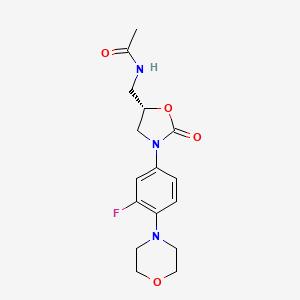
| Formula | C16H20FN3O4 |
|---|---|
| Molecular weight | 337.35 g/mol |
| IUPAC name | N-[[(5S)-3-(3-fluoro-4-morpholin-4-ylphenyl)-2-oxo-1,3-oxazolidin-5-yl]methyl]acetamide |
| CAS | 165800-03-3 |
| PubChem CID | 441401 |
| InChIKey | TYZROVQLWOKYKF-ZDUSSCGKSA-N |
| logP | 1.12 (XLogP 0.7) |
| Polar surface area | 71.11 Ų |
| H-bond acceptors / donors | 5 / 1 |
| Drug-likeness (QED) | 0.89 |
| Lipinski violations | 0 |
SMILES
CC(=O)NC[C@H]1CN(c2ccc(N3CCOCC3)c(F)c2)C(=O)O1Biology & Pharmacokinetics
Pharmacokinetics predicted
| Bioavailability | 10.0% |
|---|---|
| Half-life | 1.06 h |
| Volume of distribution | 0.596 L/kg |
| Protein binding | 25.7% |
| BBB penetrant | No |
Enzyme interactions
| Enzyme | Role | Detail |
|---|---|---|
| CYP2C19 | Substrate | — |
Receptor binding (top 1)
| Target | Action | Affinity |
|---|---|---|
| Monoamine oxidase B (MAOB) | Inhibitor | pIC50 5.7 |
Transporters
BCRP (Inhibitor)BSEP (Inhibitor)BSEP (Inhibitor)MRP1 (Inhibitor)MRP2 (Inhibitor)MRP3 (Inhibitor)MRP4 (Inhibitor)OAT1 (Inhibitor)OAT3 (Inhibitor)OATP1B1 (Inhibitor)OATP1B3 (Inhibitor)P-gp (Inhibitor)P-gp (Substrate)
Drug–drug interactions (100+, DDInter)
| Interacting drug | Severity | Management |
|---|---|---|
| Adalimumab | major | |
| Baricitinib | major | |
| Bupropion | major | |
| Certolizumab pegol | major | |
| Cladribine | major | |
| Cocaine (nasal) | major | |
| Cocaine (topical) | major | |
| Codeine | major | |
| Deferiprone | major | |
| Dexfenfluramine | major | |
| Dextromethorphan | major | |
| Diethylpropion | major | |
| Dolasetron | major | |
| Doxapram | major | |
| Doxepin | major | |
| Doxepin (topical) | major | |
| Doxylamine | major | |
| Ephedrine | major | |
| Epinephrine | major | |
| Etanercept | major | |
| Fenfluramine | major | |
| Fingolimod | major | |
| Golimumab | major | |
| Granisetron | major | |
| Hydrocodone | major | |
| Infliximab | major | |
| Iobenguane (I-131) | major | |
| Isometheptene | major | |
| Leflunomide | major | |
| Lorcaserin | major | |
| Mazindol | major | |
| Methylene blue | major | |
| Morphine | major | |
| Natalizumab | major | |
| Ondansetron | major | |
| Opium | major | |
| Ozanimod | major | |
| Palonosetron | major | |
| Phentermine | major | |
| Phenylephrine | major |
Showing 40 of 100+.
Registered Products (10)
| Brand | Form / strength | Pack | Agent | Citizen (JOD) |
|---|---|---|---|---|
| Joswe Deteria | Tablet 600 mg | 30 tab pack varies | Jordan Sweden Medical & Sterilization Co. | — |
| Joswe Deteria | Tablet 600 mg | 20 tab pack varies | Jordan Sweden Medical & Sterilization Co. | — |
| Lozned | Tablet 600 mg | 30 tab | United Pharmaceutical | — |
| Lozned 600mg/300ml Solution for IV Infusion | Infusion Linezolid 2 mg/1 ml | (1 BAG) | MS Pharma Jordan | — |
| Zersa | Suspension 100 mg/5 ml | 150 ml | Hikma Pharmaceuticals Co.Ltd/Jordan | — |
| Zersa | Tablet 600 mg | 10 tab | Hikma Pharmaceuticals Co.Ltd/Jordan | — |
| Zersa | Infusion 600 mg/300 ml | 1 BAG/1 BOX | Hikma Pharmaceuticals Co.Ltd/Jordan | — |
| Zextro® | Tablet 600 mg | 20 tab | Pharma International Company/ Jordan | — |
| Zyvox | Infusion 2 mg/ml | 300 ml | Khoury Drug Store | — |
| Zyvox | Tablet 600 mg | 20 tab | Khoury Drug Store | — |