Neratinib
JFDA label: Speranta
Mechanism of Action
Inhibitor of Epidermal growth factor receptor — Epidermal growth factor receptor erbB1 inhibitor; Inhibitor of Receptor tyrosine-protein kinase erbB-2 — Receptor protein-tyrosine kinase erbB-2 inhibitor; Inhibitor of Receptor tyrosine-protein kinase erbB-4 — Receptor protein-tyrosine kinase erbB-4 inhibitor
| Target | Action | Gene / class |
|---|---|---|
| Epidermal growth factor receptor efficacy | INHIBITOR | EGFR |
| Receptor tyrosine-protein kinase erbB-2 efficacy | INHIBITOR | ERBB2 |
| Receptor tyrosine-protein kinase erbB-4 efficacy | INHIBITOR | ERBB4 |
Indications
Approved
- Breast cancer
Contraindications
Source: Lexicomp
- There are no contraindications listed in the manufacturer's labeling Absolute
Adverse Reactions
Nervous system disorders (1)
Very Common Fatigue
Hepatobiliary disorders (2)
Common Increased serum ALT · increased serum AST
Renal and urinary disorders (1)
Common Urinary tract infection
Metabolism and nutrition disorders (2)
Common dehydration · Weight loss
Gastrointestinal disorders (9)
Very Common abdominal pain · decreased appetite · Diarrhea · nausea · stomatitis · vomiting
Common abdominal distension · Dyspepsia · xerostomia
Skin and subcutaneous tissue disorders (4)
Very Common Skin rash
Common Nail disease · skin fissure · xeroderma
Musculoskeletal and connective tissue disorders (1)
Very Common Muscle spasm
Respiratory, thoracic and mediastinal disorders (1)
Common Epistaxis
Dosing
Source: Lexicomp
Warnings & Precautions
Source: Lexicomp
GI toxicity
Severe diarrhea, which may result in dehydration, hypotension, and renal failure has been observed commonly with neratinib treatment. Almost all patients receiving neratinib in a clinical trial experienced diarrhea; the majority developed diarrhea during the first month of treatment. The median time to onset of grade 3 or higher diarrhea was 8 days (range: 1 day to 350 days); the median cumulative duration of toxicity was 5 days (range: 1 day to 139 days). Antidiarrheal prophylaxis with loperamide has been shown to lower the incidence and severity of diarrhea and is recommended during the first 2 cycles of therapy (begin with the first dose of neratinib). Monitor closely for diarrhea and subsequent complications; additional antidiarrheals may be necessary. Administer fluid and electrolytes as needed; stool cultures may be needed to exclude infectious etiologies for diarrhea. Diarrhea may require therapy interruption and dosage reductions and/or discontinuation. Nausea, vomiting, abdominal pain, and stomatitis have also been reported. ·
Hepatoxicity
Hepatotoxicity characterized by elevated liver enzymes has been reported with neratinib therapy. ALT and AST elevations have been observed, and have led to treatment discontinuation in some patients. Monitor liver function tests (ALT, AST, total bilirubin, and alkaline phosphatase) prior to treatment initiation, monthly for the first 3 months, then every 3 months thereafter and as clinically indicated. Assess liver function tests in patients with grade 3 or higher diarrhea requiring IV fluids or in those with signs/symptoms of hepatotoxicity (worsening fatigue, nausea, vomiting, right upper quadrant pain or tenderness, fever, rash, or eosinophilia). May require therapy interruption, dose reduction, or permanent discontinuation. Disease related concerns:
Hepatic impairment
Use with caution in patients with hepatic impairment; neratinib clearance may be reduced in patients with severe hepatic dysfunction. Dose reduction is required in patients with preexisting severe (Child-Pugh class C) hepatic impairment. Concurrent drug therapy issues:
Drug-drug interactions
Potentially significant interactions may exist, requiring dose or frequency adjustment, additional monitoring, and/or selection of alternative therapy. Consult drug interactions database for more detailed information.
Drugs that affect gastric pH
Concomitant use of neratinib with drugs that affect gastric pH may result in decreased neratinib exposure and reduced efficacy; avoid concomitant use with proton pump inhibitors and H2-receptor antagonists. If antacid administration is necessary, administer neratinib 3 hours after the antacid. Special populations:
Elderly
The incidence of serious adverse reactions and treatment discontinuation was higher in patients 65 years and older (compared to patients younger than 65 years) in a clinical trial. The most commonly reported serious adverse reactions in elderly patients included vomiting, diarrhea, renal failure, and dehydration.
Pregnancy & Lactation
Pregnancy
Based on the mechanism of action and data from animal reproduction studies, use of neratinib in pregnancy may cause fetal harm. Women of reproductive potential should have a pregnancy test prior to treatment; effective contraception should be used during therapy and for at least 1 month after the last dose. Male patients with female partners of reproductive potential should also use effective contraception during therapy and for at least 3 months after the last dose.
Lactation
It is not known if neratinib is present in breast milk. According to the manufacturer, breastfeeding is not recommended during therapy or for at least 1 month after the last dose.
Monitoring
| Clinical pearl | Liver function tests (ALT, AST, bilirubin, and alkaline phosphatase) prior to treatment initiation, monthly for the first 3 months, then every 3 months thereafter or as clinically indicated; fractionated bilirubin and prothrombin time if clinically necessary; pregnancy test prior to therapy initiation in women of reproductive potential; monitor for diarrhea and signs/symptoms of dehydration and hepatotoxicity (eg, worsening fatigue, nausea, vomiting, right upper quadrant tenderness or pain, fever, rash, or eosinophilia). Monitor adherence. |
|---|
Chemistry & Properties
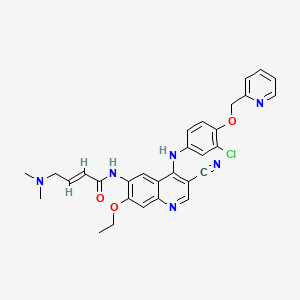
| Formula | C30H29ClN6O3 |
|---|---|
| Molecular weight | 557.05 g/mol |
| IUPAC name | (E)-N-[4-[3-chloro-4-(pyridin-2-ylmethoxy)anilino]-3-cyano-7-ethoxyquinolin-6-yl]-4-(dimethylamino)but-2-enamide |
| CAS | 698387-09-6 |
| PubChem CID | 9915743 |
| InChIKey | JWNPDZNEKVCWMY-VQHVLOKHSA-N |
| logP | 5.93 (XLogP 4.9) |
| Polar surface area | 112.4 Ų |
| H-bond acceptors / donors | 8 / 2 |
| Drug-likeness (QED) | 0.22 |
| Lipinski violations | 2 |
SMILES
CCOc1cc2ncc(C#N)c(Nc3ccc(OCc4ccccn4)c(Cl)c3)c2cc1NC(=O)/C=C/CN(C)CBiology & Pharmacokinetics
Pharmacokinetics predicted
| Bioavailability | 70.0% |
|---|---|
| Half-life | 0.567 h |
| Volume of distribution | 7.339 L/kg |
| Protein binding | 99.1% |
| BBB penetrant | No |
Enzyme interactions
| Enzyme | Role | Detail |
|---|---|---|
| CYP1A2 | Inhibitor | — |
| CYP1A2 | Substrate | — |
| CYP2B6 | Inhibitor | — |
| CYP2C19 | Inhibitor | — |
| CYP2C8 | Inhibitor | — |
| CYP2C9 | Inhibitor | — |
| CYP2C9 | Substrate | — |
| CYP2D6 | Substrate | — |
| CYP3A4 | Inhibitor | — |
| CYP3A4 | Substrate | — |
Receptor binding (top 3)
| Target | Action | Affinity |
|---|---|---|
| erb-b2 receptor tyrosine kinase 2 (ERBB2) | Inhibitor | pKd 8.2 |
| erb-b2 receptor tyrosine kinase 2 (ERBB2) | Inhibitor | pIC50 7.2 |
| epidermal growth factor receptor (EGFR) | Inhibitor | pIC50 7.0 |
Transporters
BCRP (Inhibitor)BCRP (Inhibitor)BSEP (Inhibitor)BSEP (Inhibitor)MDR1 (Inhibitor)MRP1 (Inhibitor)MRP2 (Inhibitor)OAT1 (Inhibitor)OAT3 (Inhibitor)OATP1A2 (Inhibitor)OATP1B1 (Inhibitor)OATP1B1 (Inhibitor)OATP1B3 (Inhibitor)OATP1B3 (Inhibitor)OCT1 (Inhibitor)OCT2 (Inhibitor)OCTN2 (Inhibitor)P-gp (Inhibitor)MDR1 (Substrate)OATP1B1 (Substrate)OATP1B3 (Substrate)P-gp (Substrate)Transporter(unspecified) (Substrate)
Drug–drug interactions (100+, DDInter)
| Interacting drug | Severity | Management |
|---|---|---|
| Amprenavir | major | |
| Apalutamide | major | |
| Aprepitant | major | |
| Atazanavir | major | |
| Berotralstat | major | |
| Boceprevir | major | |
| Bosentan | major | |
| Carbamazepine | major | |
| Cenobamate | major | |
| Chloramphenicol | major | |
| Cimetidine | major | |
| Ciprofloxacin | major | |
| Clarithromycin | major | |
| Clotrimazole | major | |
| Cobicistat | major | |
| Colchicine | major | |
| Conivaptan | major | |
| Crizotinib | major | |
| Cyclosporine | major | |
| Dabrafenib | major | |
| Dalfopristin | major | |
| Darunavir | major | |
| Delavirdine | major | |
| Dexamethasone | major | |
| Dexlansoprazole | major | |
| Diltiazem | major | |
| Dronedarone | major | |
| Duvelisib | major | |
| Edoxaban | major | |
| Efavirenz | major | |
| Enzalutamide | major | |
| Erythromycin | major | |
| Esomeprazole | major | |
| Etravirine | major | |
| Famotidine | major | |
| Fedratinib | major | |
| Fluconazole | major | |
| Fluvoxamine | major | |
| Fosamprenavir | major | |
| Fosaprepitant | major |
Showing 40 of 100+.
Registered Products (1)
| Brand | Form / strength | Pack | Agent | Citizen (JOD) |
|---|---|---|---|---|
| Speranta | Tablet 40 mg | 180 tab | HIKMA PHARMACEUTICALS - JORDAN / HIKMA PHARMACEUTICALS - JORDAN / Genera | — |