Osimertinib
JFDA label: Tagrisso 40mg F.C.T
Mechanism of Action
Inhibitor of Epidermal growth factor receptor — Epidermal growth factor receptor erbB1 inhibitor
| Target | Action | Gene / class |
|---|---|---|
| Epidermal growth factor receptor efficacy | INHIBITOR | EGFR |
Indications
Approved
- Non-small cell lung cancer, metastatic
Class profile
| mechanismClass | Tyrosine kinase inhibitor (EGFR TKI, 3rd gen) |
|---|---|
| targetMolecule | EGFR (T790M + exon19del/L858R) |
| targetPathway | EGFR signaling |
| generation | 3rd generation EGFR TKI (T790M-specific) |
| primaryTumors | NSCLC (T790M+ or 1st line EGFR-mutant) |
| resistanceMechanisms | EGFR C797S tertiary mutation,MET amplification,KRAS/NRAS mutation,HER2 amplification,RET/BRAF/PIK3CA alterations |
| source | NCCN/OncoKB/Goodman&Gilman13ed |
Contraindications
Source: Lexicomp
- Additional contraindications (not in US labeling): Hypersensitivity to osimertinib or any component of the formulation Absolute
- There are no contraindications listed in the manufacturer's US labeling Absolute
Adverse Reactions
Cardiac disorders (3)
Common cardiomyopathy · Decreased left ventricular ejection fraction · prolonged Q-T interval on ECG
Nervous system disorders (1)
Very Common Fatigue
Blood and lymphatic system disorders (3)
Very Common leukopenia · Lymphocytopenia · thrombocytopenia
Gastrointestinal disorders (6)
Very Common constipation · decreased appetite · Diarrhea · nausea · stomatitis · vomiting
Skin and subcutaneous tissue disorders (4)
Very Common nail disease · pruritus · Skin rash · xeroderma
Musculoskeletal and connective tissue disorders (1)
Common Back pain
Respiratory, thoracic and mediastinal disorders (1)
Common Interstitial pneumonitis
Dosing
Source: Lexicomp
Warnings & Precautions
Source: Lexicomp
Bone marrow suppression
Lymphopenia, thrombocytopenia, neutropenia, and anemia may occur (usually grades 1 and 2) with osimertinib.
Cardiovascular toxicity
Cardiomyopathy (cardiac failure, congestive heart failure, pulmonary edema, decreased ejection fraction, or stress cardiomyopathy) has been observed; some events were fatal. In patients who had baseline and at least one follow up assessment, a left ventricular ejection fraction (LVEF) decline of ≥10% and a drop to below 50% was noted. Assess LVEF prior to treatment, while on treatment in patients with cardiac risk factors, and in patients who develop cardiac signs/symptoms during treatment. Permanently discontinue for symptomatic heart failure or persistent, asymptomatic left ventricular dysfunction that does not resolve within 4 weeks. Prolongation of the QTc interval may occur; QTc >500 msec and an increase from baseline of >60 msec have been reported, although no QTc-related arrhythmias have been reported. Patients with a baseline QTc of ≥470 were excluded from clinical trials. Monitor ECG and electrolytes periodically in patients with a history of congenital long QTc syndrome, heart failure, electrolyte abnormalities, and/or those taking concurrent medications known to prolong the QTc interval. Permanently discontinue in patients who develop QTc interval prolongation with signs/symptoms of life-threatening arrhythmia.
Dermatologic toxicity
Skin reactions, including rash, dry skin, and itching may occur. Nail toxicity may also occur.
Fertility effects
Osimertinib may impair fertility; effects may be reversible in females.
Gastrointestinal toxicity
Diarrhea (usually grades 1 and 2) was observed in almost half the patients receiving osimertinib.
Ocular toxicity
Keratitis has been reported (rarely) in clinical trials. Promptly refer patients for ophthalmologic evaluation if signs/symptoms of keratitis (eye inflammation, lacrimation, light sensitivity, blurred vision, eye pain and/or red eye) develop.
Pulmonary toxicity
Interstitial lung disease (ILD) and pneumonitis was observed in clinical studies; some events were fatal. Withhold treatment with worsening respiratory symptoms (dyspnea, cough, fever) which may be indicative of ILD; permanently discontinue if ILD is confirmed. Concurrent drug therapy issues:
Drug-drug interactions
Potentially significant interactions may exist, requiring dose or frequency adjustment, additional monitoring, and/or selection of alternative therapy. Consult drug interactions database for more detailed information. Other warnings/precautions:
Appropriate use
Confirm the presence of a T790M epidermal growth factor receptor (EGFR) mutation in tumor sample or plasma specimen prior to treatment initiation. Mutation status should be determined from tumor sample; if tumor was not biopsied, a plasma sample may be used. Circulating tumor cells from plasma sample may be used as a surrogate marker for detection of T790M in tumor tissue (Remon 2017). If mutation is not detected in plasma sample, re-evaluate the feasibility of tumor biopsy for tissue testing. Information on diagnostic tests approved for detection of T790M mutations may be found at www.fda.gov/companiondiagnostics.
Pregnancy & Lactation
Pregnancy
Based on data from animal reproduction studies and the mechanism of action, use during pregnancy is expected to cause fetal harm. Women of reproductive potential should use effective contraception during therapy and for 6 weeks after the last dose. Males with female partners of reproductive potential should also use effective contraception during therapy and for 4 months after the last dose.
Lactation
It is not known if osimertinib is present in breast milk. Because of the potential for serious adverse reactions in the breastfed infant, breastfeeding is not recommended by the manufacturer during therapy and for 2 weeks after the last dose.
Monitoring
| Efficacy | Tumour response (RECIST criteria, tumour markers, imaging); progression-free survival; performance status (ECOG/Karnofsky) |
|---|---|
| Toxicity | CBC with differential (nadir timing depends on agent); LFTs; renal function; ECG (QT for relevant agents); echocardiogram for cardiotoxic agents (anthracyclines, trastuzumab); cumulative dose tracking for dose-limited toxicities |
| Clinical pearl | Treatment response is assessed after 2–3 cycles. Grade 3–4 toxicities typically require dose reduction or interruption per protocol-defined criteria. |
| Counseling | Attend all scheduled blood tests and imaging appointments. Report fever > 38°C (risk of neutropaenic sepsis — medical emergency), unusual bleeding, or new pain immediately. |
Chemistry & Properties
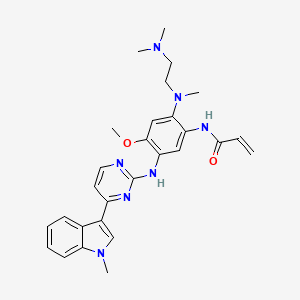
| Formula | C28H33N7O2 |
|---|---|
| Molecular weight | 499.62 g/mol |
| IUPAC name | N-[2-[2-(dimethylamino)ethyl-methylamino]-4-methoxy-5-[[4-(1-methylindol-3-yl)pyrimidin-2-yl]amino]phenyl]prop-2-enamide |
| CAS | 1421373-65-0 |
| PubChem CID | 71496458 |
| InChIKey | DUYJMQONPNNFPI-UHFFFAOYSA-N |
| logP | 4.51 (XLogP 3.7) |
| Polar surface area | 87.55 Ų |
| H-bond acceptors / donors | 8 / 2 |
| Drug-likeness (QED) | 0.31 |
| Lipinski violations | 0 |
SMILES
C=CC(=O)Nc1cc(Nc2nccc(-c3cn(C)c4ccccc34)n2)c(OC)cc1N(C)CCN(C)CBiology & Pharmacokinetics
Pharmacokinetics predicted
| Bioavailability | 70.0% |
|---|---|
| Half-life | 0.51 h |
| Volume of distribution | 17.723 L/kg |
| Protein binding | 97.2% |
| BBB penetrant | No |
Enzyme interactions
| Enzyme | Role | Detail |
|---|---|---|
| CYP1A2 | Inhibitor | — |
| CYP1A2 | Substrate | — |
| CYP2D6 | Substrate | — |
| CYP3A4 | Inhibitor | — |
| CYP3A4 | Substrate | — |
Receptor binding (top 1)
| Target | Action | Affinity |
|---|---|---|
| epidermal growth factor receptor (EGFR) | Inhibitor | pIC50 6.3 |
Transporters
BCRP (Inhibitor)BCRP (Inhibitor)BSEP (Inhibitor)MDR1 (Inhibitor)MRP1 (Inhibitor)OATP1B1 (Inhibitor)OATP1B3 (Inhibitor)P-gp (Inhibitor)BCRP (Substrate)MDR1 (Substrate)P-gp (Substrate)
Drug–drug interactions (100+, DDInter)
| Interacting drug | Severity | Management |
|---|---|---|
| Abarelix | major | |
| Abiraterone | major | |
| Adalimumab | major | |
| Adenosine | major | |
| Alfuzosin | major | |
| Alimemazine | major | |
| Amiodarone | major | |
| Amisulpride | major | |
| Amitriptyline | major | |
| Amoxapine | major | |
| Amprenavir | major | |
| Anagrelide | major | |
| Apalutamide | major | |
| Apomorphine | major | |
| Arsenic trioxide | major | |
| Asenapine | major | |
| Atazanavir | major | |
| Atomoxetine | major | |
| Azithromycin | major | |
| Bacillus calmette-guerin substrain tice live antigen | major | |
| Baricitinib | major | |
| Bedaquiline | major | |
| Bepridil | major | |
| Berotralstat | major | |
| Bicalutamide | major | |
| Boceprevir | major | |
| Bosutinib | major | |
| Buprenorphine | major | |
| Cabozantinib | major | |
| Carbamazepine | major | |
| Ceritinib | major | |
| Certolizumab pegol | major | |
| Chloroquine | major | |
| Chlorpromazine | major | |
| Cilostazol | major | |
| Cisapride | major | |
| Citalopram | major | |
| Cladribine | major | |
| Clarithromycin | major | |
| Clofazimine | major |
Showing 40 of 100+.
Registered Products (2)
| Brand | Form / strength | Pack | Agent | Citizen (JOD) |
|---|---|---|---|---|
| Tagrisso 40mg F.C.T | Tablet 47.7 mg | 1 tab | Shawi & Rushedat Drug Store | — |
| Tagrisso 80mg F.C.T | Tablet 95.4 mg | 30 tab | Shawi & Rushedat Drug Store | — |