Valaciclovir
Active form: Acyclovir Triphosphate.
JFDA label: Valtrex Tablets
Mechanism of Action
Valacyclovir is rapidly and nearly completely converted to acyclovir by intestinal and hepatic metabolism. Acyclovir is converted to acyclovir monophosphate by virus-specific thymidine kinase then further converted to acyclovir triphosphate by other cellular enzymes. Acyclovir triphosphate inhibits DNA synthesis and viral replication by competing with deoxyguanosine triphosphate for viral DNA polymerase and being incorporated into viral DNA.
Indications
Off-label
- B virus, postexposure prophylaxis
- CMV reactivation (prevention in allogeneic HSCT recipients)
- HSV keratitis
- HSV reactivation (prevention in seropositive HSCT recipients)
- HSV, orolabial (cold sores) infection in HIV-infected patients (adolescents and adults)
- Herpes simplex virus (HSV), genital infection in HIV-infected patients (adolescents and adults)
- Herpes zoster (shingles) in HIV-infected patients (adolescents and adults)
- VZV reactivation (prevention in HSCT recipients)
- VZV, postexposure prophylaxis (HSCT recipients)
- Varicella infection (chickenpox) in HIV-infected patients (adolescents and adults)
- Varicella zoster virus (VZV) acute retinal necrosis (ARN) in HIV-infected patients (adolescent and adults)
Contraindications
Source: Lexicomp
- Hypersensitivity to valacyclovir, acyclovir, or any component of the formulation Absolute
Adverse Reactions
Nervous system disorders (6)
Very Common Headache
Common depression · dizziness · Fatigue · Headache
Uncommon CNS effects (high-dose — confusion, hallucinations)
Hepatobiliary disorders (3)
Very Common increased serum ALT · Increased serum AST
Common Increased serum alkaline phosphatase
Blood and lymphatic system disorders (3)
Common leukopenia · Thrombocytopenia
Very Rare Thrombotic thrombocytopaenic purpura / haemolytic uraemic syndrome (high-dose, immunocompromised)
Metabolism and nutrition disorders (1)
Common Dehydration
Gastrointestinal disorders (5)
Very Common abdominal pain · Nausea
Common diarrhea · Nausea · Vomiting
Skin and subcutaneous tissue disorders (1)
Common Skin rash
Musculoskeletal and connective tissue disorders (1)
Common Arthralgia
Infections and infestations (1)
Common Herpes simplex infection
General disorders and administration site conditions (1)
Common Fever
Respiratory, thoracic and mediastinal disorders (2)
Very Common Nasopharyngitis
Common Rhinorrhea
Dosing
Source: Lexicomp
Warnings & Precautions
Source: Lexicomp
CNS effects
CNS adverse effects (including agitation, hallucinations, confusion, delirium, seizures, and encephalopathy) have been reported in both adult and pediatric patients with or without renal dysfunction. Elderly patients are more likely to experience CNS adverse effects.
Thrombotic microangiopathy
Has occurred in immunocompromised patients (at doses of 8 g/day). Disease-related concerns:
Renal impairment
Use caution in patients with renal impairment, the elderly, and/or those receiving nephrotoxic agents. Acute renal failure and CNS effects have been observed in patients with renal dysfunction; dose adjustment may be required. Precipitation in renal tubules may occur; maintain adequate hydration. Special populations:
Elderly
Use with caution in the elderly; CNS effects have been reported.
Immunocompromised patients
Advanced HIV (CD4 3): Safety and efficacy have not been established for treatment/suppression of recurrent genital herpes or disseminated herpes in patients with profound immunosuppression. Other warnings/precautions:
Appropriate use
For cold sores, treatment should begin with earliest symptom (tingling, itching, burning). For genital herpes, treatment should begin as soon as possible after the first signs and symptoms (within 72 hours of onset of first diagnosis or within 24 hours of onset of recurrent episodes). For herpes zoster, treatment should begin within 72 hours of onset of rash. For chickenpox, treatment should begin with earliest sign or symptom.
Pregnancy & Lactation
Pregnancy
Safe
500 mg twice daily from 36 weeks for recurrent genital herpes to prevent neonatal herpes
Lactation
Valacyclovir is rapidly metabolized to acyclovir. Following administration of valacyclovir, acyclovir is present in breast milk; unchanged valacyclovir has not been detected in breast milk. Following administration of valacyclovir, the relative infant dose (RID) of acyclovir is 5.1% when calculated using the highest average breast milk concentration located and compared to an infant therapeutic dose of intravenous acyclovir of 30 mg/kg/day. In general, breastfeeding is considered acceptable wh
Monitoring
| Clinical pearl | Urinalysis, BUN, serum creatinine, liver enzymes, and CBC |
|---|
Chemistry & Properties
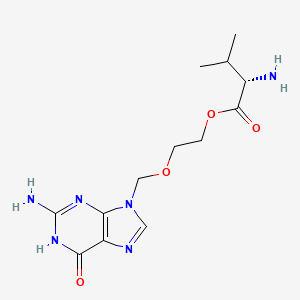
| Formula | C13H20N6O4 |
|---|---|
| Molecular weight | 324.34 g/mol |
| IUPAC name | 2-[(2-amino-6-oxo-1H-purin-9-yl)methoxy]ethyl (2S)-2-amino-3-methylbutanoate |
| CAS | 124832-26-4 |
| PubChem CID | 135398742 |
| InChIKey | HDOVUKNUBWVHOX-QMMMGPOBSA-N |
| logP | -0.8 (XLogP -0.9) |
| Polar surface area | 151.14 Ų |
| H-bond acceptors / donors | 9 / 3 |
| Drug-likeness (QED) | 0.44 |
| Lipinski violations | 0 |
SMILES
CC(C)[C@H](N)C(=O)OCCOCn1cnc2c(=O)nc(N)[nH]c21Biology & Pharmacokinetics
Pharmacokinetics predicted
| Bioavailability | 70.0% |
|---|---|
| Half-life | 0.983 h |
| Volume of distribution | 1.349 L/kg |
| Protein binding | 17.6% |
| BBB penetrant | Yes |
Transporters
BCRP (Inhibitor)BSEP (Inhibitor)MRP1 (Inhibitor)OATP1B1 (Inhibitor)OATP1B1 (Inhibitor)OATP1B3 (Inhibitor)OATP1B3 (Inhibitor)OATP2B1 (Inhibitor)P-gp (Inhibitor)PEPT2 (Inhibitor)P-gp (Substrate)PEPT1 (Substrate)PEPT2 (Substrate)
Drug–drug interactions (37, DDInter)
| Interacting drug | Severity | Management |
|---|---|---|
| Diatrizoate | major | |
| Everolimus | major | |
| Iodipamide | major | |
| Iodixanol | major | |
| Iohexol | major | |
| Iopamidol | major | |
| Iopromide | major | |
| Iothalamic acid | major | |
| Ioversol | major | |
| Ioxilan | major | |
| Sirolimus | major | |
| Tacrolimus | major | |
| Temsirolimus | major | |
| Amikacin | moderate | |
| Amikacin (liposome) | moderate | |
| Balsalazide | moderate | |
| Carboplatin | moderate | |
| Cisplatin | moderate | |
| Cladribine | moderate | |
| Clofarabine | moderate | |
| Cyclosporine | moderate | |
| Gentamicin | moderate | |
| Iopodic acid | moderate | |
| Mesalazine | moderate | |
| Methotrexate | moderate | |
| Neomycin | moderate | |
| Olsalazine | moderate | |
| Oxaliplatin | moderate | |
| Paromomycin | moderate | |
| Pemetrexed | moderate | |
| Pentamidine | moderate | |
| Streptomycin | moderate | |
| Sulfasalazine | moderate | |
| Talimogene laherparepvec | moderate | |
| Trospium | moderate | |
| Cimetidine | minor | |
| Mycophenolic acid | minor |
Registered Products (2)
| Brand | Form / strength | Pack | Agent | Citizen (JOD) |
|---|---|---|---|---|
| Valtrex Tablets | Tablet 500 mg | 10 tab pack varies | Suleiman Tannous & Sons Co. Ltd | 9.410 |
| Valtrex Tablets | Tablet 500 mg | 42 tab pack varies | Suleiman Tannous & Sons Co. Ltd | 36.770 |