Vemurafenib
JFDA label: Zelboraf 240mg F.C Tab
Mechanism of Action
Inhibitor of Serine/threonine-protein kinase B-raf — Serine/threonine-protein kinase B-raf inhibitor
| Target | Action | Gene / class |
|---|---|---|
| Serine/threonine-protein kinase B-raf efficacy | INHIBITOR | BRAF |
Indications
Approved
- Erdheim-Chester disease
- Melanoma, unresectable or metastatic
Off-label
- Melanoma, metastatic (with BRAFV600K mutation)
- Non-small cell lung cancer, refractory (with BRAF V600 mutation)
Class profile
| mechanismClass | BRAF kinase inhibitor (TKI) |
|---|---|
| targetMolecule | BRAF V600E |
| targetPathway | MAPK/ERK signaling |
| generation | 1st generation BRAF inhibitor |
| primaryTumors | Melanoma (BRAF V600E+),NSCLC (BRAF V600E+) |
| resistanceMechanisms | NRAS mutation,MAP2K1/MEK1 mutation,BRAF splice variants,BRAF amplification,COT1 kinase activation |
| source | NCCN/OncoKB/Goodman&Gilman13ed |
Contraindications
Source: Lexicomp
- Hypersensitivity to vemurafenib or any component of the formulation Absolute
- There are no contraindications listed in the manufacturer's US labeling Absolute
Adverse Reactions
Cardiac disorders (7)
Very Common Atrial fibrillation · hypertension · hypotension · peripheral edema · Prolonged Q-T interval on ECG · retinal vein occlusion · vasculitis
Nervous system disorders (6)
Very Common Cranial nerve palsy (facial) · dizziness · Fatigue · headache · peripheral neuropathy · peripheral sensory neuropathy
Hepatobiliary disorders (4)
Very Common Increased gamma-glutamyl transferase · increased serum alkaline phosphatase · Increased serum ALT · increased serum bilirubin
Renal and urinary disorders (1)
Very Common Increased serum creatinine
Blood and lymphatic system disorders (6)
Very Common Basal cell carcinoma · Cutaneous papilloma · keratoacanthoma · malignant melanoma (new primary) · squamous cell carcinoma (oropharyngeal) · squamous cell carcinoma of skin
Immune system disorders (2)
Very Common Anaphylaxis · hypersensitivity reaction
Metabolism and nutrition disorders (1)
Very Common Weight loss
Gastrointestinal disorders (6)
Very Common constipation · decreased appetite · Diarrhea · dysgeusia · nausea · vomiting
Skin and subcutaneous tissue disorders (16)
Very Common alopecia · erythema · Erythema nodosum · folliculitis · hyperkeratosis · Maculopapular rash · nevus · palmar-plantar erythrodysesthesia · papular rash · pruritus · skin photosensitivity · skin rash · Stevens-Johnson syndrome · sunburn · toxic epidermal necrolysis · xeroderma
Musculoskeletal and connective tissue disorders (8)
Very Common Arthralgia · Arthritis · back pain · limb pain · musculoskeletal pain · myalgia · panniculitis · weakness
Eye disorders (4)
Very Common Blurred vision · iritis · photophobia · uveitis
General disorders and administration site conditions (1)
Very Common Fibrosis (Dupuytren contracture) (1% to 10%:
Respiratory, thoracic and mediastinal disorders (1)
Very Common Cough
Other (1)
Not Known Hematologic & oncologic: Secondary acute myelocytic leukemia
Dosing
Source: Lexicomp
Warnings & Precautions
Source: Lexicomp
Dermatologic toxicity
Dermatologic reactions have been observed, including case reports of Stevens-Johnson syndrome and toxic epidermal necrolysis. Discontinue (permanently) for severe dermatologic toxicity.
Fibroproliferative disease
Cases of Dupuytren contracture and plantar fascial fibromatosis have been reported with vemurafenib use (Chan 2015; Perez 2017; Vandersleyen 2016). In June of 2017, the vemurafenib manufacturer issued a “Dear Healthcare Provider” letter stating that the majority of cases reported were mild to moderate, although disabling Dupuytren contracture cases have been observed. The median time to onset was 224 days from therapy initiation; the majority of patients experienced symptom resolution or improvement with interruption or discontinuation of vemurafenib (Perez 2017). Per the manufacturer, fibromatoses may require therapy interruption or treatment discontinuation.
Hepatotoxicity
Liver injury has been reported with use, and may cause functional impairment such as coagulopathy or other organ dysfunction. Monitor transaminases, alkaline phosphatase, and bilirubin at baseline and monthly during therapy, or as clinically necessary. May require dosage reduction, therapy interruption, or discontinuation.
Hypersensitivity
Anaphylaxis and severe hypersensitivity may occur during treatment or upon reinitiation. Serious reactions have included generalized rash, erythema, hypotension, and drug rash with eosinophilia and systemic symptoms (DRESS syndrome). Discontinue (permanently) with severe hypersensitivity reaction.
Malignancies
Cutaneous squamous cell carcinomas (cuSCC), keratoacanthomas, and melanoma have been reported (at a higher rate in patients receiving vemurafenib compared to control). Cutaneous SCC generally occurs early in the treatment course (median onset: 7 to 8 weeks in melanoma patients and ~12 weeks in Erdheim Chester disease [ECD] patients) and is managed with excision (while continuing vemurafenib treatment). Approximately one-third of melanoma patients experienced >1 cuSCC occurrence and the median time between occurrences was 6 weeks. Potential risk factors for cuSCC include age ≥65 years, history of skin cancer, or chronic sun exposure. Monitor for skin lesions (with dermatology evaluation) at baseline and every 2 months during treatment; consider continued monitoring for 6 months after treatment. In patients receiving vemurafenib for the treatment of melanoma, new primary malignant melanomas have been reported (rare). Noncutaneous squamous cell carcinomas (non-cuSCC) of the head and neck have also been observed; monitor closely for signs/symptoms. Vemurafenib may promote malignancies correlated with RAS activation; monitor for signs/symptoms of other malignancies. Myeloid malignancies in patients with ECD have been reported, including patients receiving vemurafenib; monitor CBC in patients with ECD and co-existing myeloid malignancies.
Nephrotoxicity
Acute kidney injury, including interstitial nephritis, acute tubular necrosis, and serum creatinine elevations (grades 1 to 4) have been reported. Monitor serum creatinine.
Ocular toxicity
Uveitis (including iritis), blurred vision, and photophobia may occur; monitor for signs and symptoms. Uveitis may be managed with corticosteroid and mydriatic eye drops. Retinal vein occlusion has been reported in clinical trials.
Pancreatitis
Pancreatitis has been reported (rare). Onset occurs within 2 weeks after initiation, with exacerbation occurring upon rechallenge at a reduced dose (Muluneh 2013). Consider evaluating unexplained abdominal pain for pancreatitis (eg, serum lipase and amylase; abdominal CT) as clinically indicated.
Photosensitivity
Photosensitivity ranging from mild to severe has been reported. Advise patients to avoid sun exposure and wear protective clothing and use effective UVA/UVB sunscreen and lip balm (SPF ≥30) when outdoors. Dosage modifications are recommended for intolerable photosensitivity consisting of erythema ≥10% to 30% of body surface area.
QT prolongation
QT prolongation (dose-dependent) has been observed; may lead to increased risk for ventricular arrhythmia, including torsade de pointes. Monitor electrolytes (calcium, magnesium and potassium) at baseline and with dosage adjustments. Monitor ECG at baseline, 15 days after initiation, then monthly for 3 months, then every 3 months thereafter (more frequently if clinically appropriate); also monitor with dosage adjustments. Do not initiate treatment if baseline QTc >500 msec. During treatment, if QTc >500 msec, temporarily interrupt treatment; correct electrolytes and control other risk factors for QT prolongation. May reinitiate with a dose reduction once QTc falls to 500 msec and there is >60 msec change above baseline. Do not initiate treatment in patients with electrolyte abnormalities which are not correctable, long QT syndrome, or taking concomitant medication known to prolong the QT interval.
Radiation sensitization/recall
Radiation sensitization and recall (some cases may be severe or involve cutaneous and visceral organs) have been reported in patients treated with radiation prior to, during, or after treatment with vemurafenib; fatal cases have been reported in patients with visceral organ involvement. Monitor closely when vemurafenib is administered concomitantly or sequentially with radiation treatment. Concurrent drug therapy issues:
Drug-drug interactions
Potentially significant interactions may exist, requiring dose or frequency adjustment, additional monitoring, and/or selection of alternative therapy. Consult drug interactions database for more detailed information. Special populations:
Elderly
May be at increased risk for adverse effects; in clinical trials, there was an increased incidence of cuSCC and keratoacanthoma, atrial fibrillation, peripheral edema, and nausea/decreased appetite in patients ≥65 years. Other warnings/precautions:
BRAF genomics
Only patients with a BRAF V600 mutation-positive melanoma (including BRAF V600E) will benefit from treatment; mutation must be detected and confirmed by an approved test prior to treatment. The cobas 4800 BRAF V600 Mutation Test was used in clinical trials and is FDA-approved to detect BRAF V600E mutation.
Pregnancy & Lactation
Pregnancy
Adverse effects were not demonstrated in animal reproduction studies. However, based on the mechanism of action, vemurafenib may cause fetal harm if administered during pregnancy or in patients who become pregnant during treatment. Women of reproductive potential should use effective contraception methods during treatment and for at least 2 weeks after the last dose.
Lactation
It is not known if vemurafenib is present in breast milk. Due to the potential for serious adverse reactions in the breastfed infant, breastfeeding is not recommended by the manufacturer during treatment and for 2 weeks after the last dose.
Monitoring
| Efficacy | Tumour response (RECIST criteria, tumour markers, imaging); progression-free survival; performance status (ECOG/Karnofsky) |
|---|---|
| Toxicity | CBC with differential (nadir timing depends on agent); LFTs; renal function; ECG (QT for relevant agents); echocardiogram for cardiotoxic agents (anthracyclines, trastuzumab); cumulative dose tracking for dose-limited toxicities |
| Clinical pearl | Treatment response is assessed after 2–3 cycles. Grade 3–4 toxicities typically require dose reduction or interruption per protocol-defined criteria. |
| Counseling | Attend all scheduled blood tests and imaging appointments. Report fever > 38°C (risk of neutropaenic sepsis — medical emergency), unusual bleeding, or new pain immediately. |
Chemistry & Properties
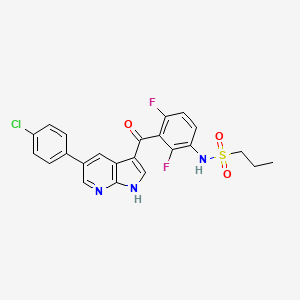
| Formula | C23H18ClF2N3O3S |
|---|---|
| Molecular weight | 489.93 g/mol |
| IUPAC name | N-[3-[5-(4-chlorophenyl)-1H-pyrrolo[2,3-b]pyridine-3-carbonyl]-2,4-difluorophenyl]propane-1-sulfonamide |
| CAS | 918504-65-1 |
| PubChem CID | 42611257 |
| InChIKey | GPXBXXGIAQBQNI-UHFFFAOYSA-N |
| logP | 5.54 (XLogP 5.0) |
| Polar surface area | 91.92 Ų |
| H-bond acceptors / donors | 4 / 2 |
| Drug-likeness (QED) | 0.33 |
| Lipinski violations | 1 |
SMILES
CCCS(=O)(=O)Nc1ccc(F)c(C(=O)c2c[nH]c3ncc(-c4ccc(Cl)cc4)cc23)c1FBiology & Pharmacokinetics
Pharmacokinetics
| BBB penetrant | No |
|---|
Enzyme interactions
| Enzyme | Role | Detail |
|---|---|---|
| CYP1A2 | Inhibitor | — |
| CYP2C19 | Inhibitor | — |
| CYP2C8 | Inhibitor | — |
| CYP2C9 | Substrate | — |
| CYP2D6 | Substrate | — |
| CYP3A4 | Inhibitor | — |
| CYP3A4 | Substrate | — |
Receptor binding (top 1)
| Target | Action | Affinity |
|---|---|---|
| B-Raf proto-oncogene, serine/threonine kinase (BRAF) | Inhibitor | pIC50 7.0 |
Transporters
BCRP (Inhibitor)BCRP (Inhibitor)BSEP (Inhibitor)MDR1 (Inhibitor)MRP1 (Inhibitor)MRP1 (Inhibitor)OATP1B1 (Inhibitor)OATP1B3 (Inhibitor)OATP2B1 (Inhibitor)P-gp (Inhibitor)BCRP (Substrate)MDR1 (Substrate)P-gp (Substrate)
Drug–drug interactions (100+, DDInter)
| Interacting drug | Severity | Management |
|---|---|---|
| Abarelix | major | |
| Abiraterone | major | |
| Adenosine | major | |
| Alfuzosin | major | |
| Alimemazine | major | |
| Aminolevulinic acid | major | |
| Amiodarone | major | |
| Amisulpride | major | |
| Amitriptyline | major | |
| Amoxapine | major | |
| Anagrelide | major | |
| Apalutamide | major | |
| Apomorphine | major | |
| Arsenic trioxide | major | |
| Asenapine | major | |
| Astemizole | major | |
| Atomoxetine | major | |
| Azithromycin | major | |
| Bedaquiline | major | |
| Bepridil | major | |
| Berotralstat | major | |
| Betrixaban | major | |
| Bicalutamide | major | |
| Bosutinib | major | |
| Buprenorphine | major | |
| Cabozantinib | major | |
| Carbamazepine | major | |
| Ceritinib | major | |
| Chloroquine | major | |
| Chlorpromazine | major | |
| Cilostazol | major | |
| Ciprofloxacin | major | |
| Cisapride | major | |
| Citalopram | major | |
| Clarithromycin | major | |
| Clofazimine | major | |
| Clomipramine | major | |
| Clozapine | major | |
| Colchicine | major | |
| Crizotinib | major |
Showing 40 of 100+.
Registered Products (1)
| Brand | Form / strength | Pack | Agent | Citizen (JOD) |
|---|---|---|---|---|
| Zelboraf 240mg F.C Tab | Film-Coated Tablet 240 mg | 56 tab | Shawi & Rushedat Drug Store | — |