Vigabatrin
JFDA label: Sabril Tabs
- Permanent vision loss:
Mechanism of Action
Inhibitor of 4-aminobutyrate aminotransferase, mitochondrial — Gamma-amino-N-butyrate transaminase inhibitor
| Target | Action | Gene / class |
|---|---|---|
| 4-aminobutyrate aminotransferase, mitochondrial efficacy | INHIBITOR | ABAT |
Indications
Approved
- Infantile spasms
- Refractory complex partial seizures
Contraindications
Source: Lexicomp
- Hypersensitivity to vigabatrin or any component of the formulation Absolute
- There are no contraindications listed in the manufacturer’s labeling Absolute
- breast-feeding Absolute
Adverse Reactions
Cardiac disorders (2)
Common edema · Peripheral edema
Nervous system disorders (28)
Very Common dizziness · Drowsiness · fatigue · headache · insomnia · irritability · sedation
Common abnormal behavior · abnormality in thinking · aggressive behavior · anxiety · ataxia · confusion · depression · disturbance in attention · dysarthria · hyperreflexia · hypoesthesia · hyporeflexia · hypotonia · impaired consciousness · lethargy · Memory impairment · paresthesia · seizure · sensory disturbance · status epilepticus · vertigo
Renal and urinary disorders (2)
Common Dysmenorrhea · urinary tract infection
Blood and lymphatic system disorders (1)
Common Bruise
Metabolism and nutrition disorders (3)
Common fluid retention · increased thirst · Weight gain
Gastrointestinal disorders (11)
Very Common constipation · diarrhea · Vomiting
Common abdominal distention · abdominal pain · decreased appetite · dyspepsia · hemorrhoids · increased appetite · Nausea · viral gastroenteritis
Skin and subcutaneous tissue disorders (1)
Very Common Skin rash
Musculoskeletal and connective tissue disorders (9)
Very Common Tremor
Common Arthralgia · back pain · joint swelling · limb pain · muscle spasm · myalgia · shoulder pain · weakness
Eye disorders (7)
Very Common blurred vision · nystagmus · Visual field loss
Common asthenopia · conjunctivitis · Diplopia · strabismus
Ear and labyrinth disorders (2)
Very Common Otitis media
Common Tinnitus
Infections and infestations (3)
Very Common Viral infection
Common Candidiasis · influenza
General disorders and administration site conditions (1)
Very Common Fever
Respiratory, thoracic and mediastinal disorders (11)
Very Common bronchitis · nasal congestion · pharyngitis · pneumonia · Upper respiratory tract infection
Common cough · croup · dyspnea · Pharyngolaryngeal pain · sinus headache · sinusitis
Dosing
Source: Lexicomp
Warnings & Precautions
Source: Lexicomp
Anemia
Use has been associated with decreased hemoglobin and hematocrit; cases of significantly reduced hemoglobin (• CNS depression: May cause CNS depression, which may impair physical or mental abilities; patients must be cautioned about performing tasks which require mental alertness (eg, operating machinery or driving).
Edema
Peripheral edema and edema independent of hypertension, heart failure, weight gain, renal or hepatic dysfunction has been reported.
Neurotoxicity
Patients must be closely monitored for potential neurotoxicity (observed in animal models but not established in adults).
Peripheral neuropathy
Peripheral neuropathy manifesting as numbness or tingling in the toes or feet, reduced distal lower limb vibration or position sensation, or progressive loss of reflexes, starting at the ankles, has been reported in adult patients.
Suicidal ideation
Pooled analysis of trials involving various antiepileptics (regardless of indication) showed an increased risk of suicidal thoughts/behavior (incidence rate: 0.43% treated patients compared to 0.24% of patients receiving placebo); risk observed as early as 1 week after initiation and continued through duration of trials (most trials ≤24 weeks). Monitor all patients for notable changes in behavior that might indicate suicidal thoughts or depression; notify healthcare provider immediately if symptoms occur.
Vision loss
Vigabatrin causes permanent vision loss in infants, children, and adults. Due to the risk of vision loss and because vigabatrin, provides an observable symptomatic benefit when it is effective, the patient who fails to show substantial clinical benefit within a short period of time after initiation of treatment (2 to 4 weeks for infantile spasms; 30% of patients ranging in severity from mild to severe, including tunnel vision to within 10 degrees of visual fixation, and can result in disability. In some cases, vigabatrin can damage the central retina and may decrease visual acuity. Symptoms of vision loss are unlikely to be recognized by the patient or caregiver before loss is severe. Vision loss of milder severity, although potentially unrecognized by the patient or caregiver, may still adversely affect function. Vision should be assessed to the extent possible at baseline (no later than 4 weeks after initiation), at least every 3 months during therapy and at 3 to 6 months after discontinuation. Once detected, vision loss is not reversible; even with frequent monitoring, it is expected that some patients will develop severe vision loss. In patients who cannot be tested, treatment may continue according to clinical judgement, with appropriate patient counseling. Vigabatrin should not be used in patients with, or at high risk of, other types of irreversible vision loss unless the benefits of treatment clearly outweigh the risks. The interaction of other types of irreversible v
Weight gain
Use has been associated with an average weight gain of 3.5 kg in adults and ≥7% of baseline body weight in pediatric patients. Disease-related concerns:
Psychiatric behavior
Use with caution in patients with a history of psychosis (psychotic/agitated reactions may occur more frequently), depression, or behavioral problems.
Renal impairment
Use with caution in patients with renal impairment; modify dose in children (≥10 years) and adults with renal impairment (CrCl • Seizures: May cause an increase in seizure frequency in some patients; use with particular caution in patients with myoclonic seizures, which may be more prone to this effect. Concurrent drug therapy issues:
Drug-drug interactions
Potentially significant interactions may exist, requiring dose or frequency adjustment, additional monitoring, and/or selection of alternative therapy. Consult drug interactions database for more detailed information. Special populations:
Elderly
Use with caution in the elderly as moderate to severe sedation and confusion have been reported; consider dose and/or frequency adjustments as renal clearance may be decreased. Other warnings/precautions:
Appropriate use
Vigabatrin is not indicated as a first-line agent for complex partial seizures.
MRI abnormalities
Abnormal MRI changes have been reported in some infants. Resolution of MRI changes usually occurs with discontinuation of therapy. MRI changes were not seen in older children and adult patients.
REMS program
Because of the risk of permanent vision loss, vigabatrin is only available through a restricted distribution program under a Risk Evaluation and Mitigation Strategy (REMS) program. Under the Vigabatrin REMS program, only prescribers and pharmacies registered with the program are able to prescribe and distribute vigabatrin. Vigabatrin may only be dispensed to patients who are enrolled in and meet all conditions of the Vigabatrin REMS program. Call 866-244-8175 or visit http://www.vigabatrinREMS.com for further information.
Withdrawal
Anticonvulsants should not be discontinued abruptly because of the possibility of increasing seizure frequency; therapy should be withdrawn gradually to minimize the potential of increased seizure frequency, unless safety concerns require a more rapid withdrawal.
Pregnancy & Lactation
Pregnancy
Adverse events were observed in animal reproduction studies. Vigabatrin crosses the placenta in humans (Tran 1998). Birth defects have been reported following use in pregnancy and include: cardiac defects, limb defects, male genital malformations, fetal anticonvulsant syndrome, renal and ear abnormalities. Time of exposure or maternal dosage was not reported and information is not available relating to the incidence or types of these outcomes in comparison to the general epilepsy population. Visual field examinations have been conducted following in utero exposure in a limited number of children tested at ≥6 years of age; no visual field loss was observed in 4 children and results were inconclusive in 2 others (Lawthorn 2009; Sorri 2005). Data collection to monitor pregnancy and infant outcomes following exposure to vigabatrin is ongoing. Healthcare providers are encouraged to enroll women exposed to vigabatrin during pregnancy in the North American Antiepileptic Drug (NAAED) Pregnan
Lactation
Vigabatrin is present in small amounts of breast milk (≤4% of the weight-adjusted maternal dose based on 2 cases) (Tran 1998). Due to the potential for serious adverse reactions in the breastfed infant, the manufacturer recommends a decision be made whether to discontinue breastfeeding or to discontinue the drug, taking into account the importance of treatment to the mother.
Monitoring
| Clinical pearl | Ophthalmologic examination by an ophthalmic professional with expertise in visual field interpretation and the ability to perform dilated indirect ophthalmoscopy of the retina at baseline (no later than 4 weeks after therapy initiation), periodically during therapy (every 3 months), and 3 to 6 months after discontinuation of therapy; assessment should include visual acuity and visual field whenever possible including mydriatic peripheral fundus examination and visual field perimetry, preferably by automated threshold visual field testing. Observe patient for excessive sedation, especially when instituting or increasing therapy; hemoglobin and hematocrit; suicidality (eg, suicidal thoughts, depression, behavioral changes); weight gain/edema |
|---|
Chemistry & Properties
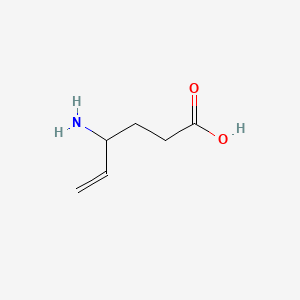
| Formula | C6H11NO2 |
|---|---|
| Molecular weight | 129.16 g/mol |
| IUPAC name | 4-aminohex-5-enoic acid |
| CAS | 60643-86-9 |
| PubChem CID | 5665 |
| InChIKey | PJDFLNIOAUIZSL-UHFFFAOYSA-N |
| logP | 0.36 (XLogP -2.2) |
| Polar surface area | 63.32 Ų |
| H-bond acceptors / donors | 2 / 2 |
| Drug-likeness (QED) | 0.54 |
| Lipinski violations | 0 |
SMILES
C=CC(N)CCC(=O)OBiology & Pharmacokinetics
Pharmacokinetics
| BBB penetrant | Yes |
|---|
Enzyme interactions
| Enzyme | Role | Detail |
|---|---|---|
| CYP2C9 | Substrate | — |
| CYP2D6 | Substrate | — |
Transporters
BCRP (Inhibitor)BSEP (Inhibitor)MDR1 (Inhibitor)MRP1 (Inhibitor)MRP2 (Inhibitor)MRP3 (Inhibitor)MRP4 (Inhibitor)OATP1B1 (Inhibitor)OATP1B3 (Inhibitor)OCTN2 (Inhibitor)P-gp (Inhibitor)MDR1 (Substrate)P-gp (Substrate)
Drug–drug interactions (63, DDInter)
| Interacting drug | Severity | Management |
|---|---|---|
| Betamethasone | major | |
| Budesonide | major | |
| Chloroquine | major | |
| Clioquinol (topical) | major | |
| Deferoxamine | major | |
| Deflazacort | major | |
| Dexamethasone | major | |
| Hydrocortisone | major | |
| Hydroxychloroquine | major | |
| Methylprednisolone | major | |
| Oxyquinoline (topical) | major | |
| Prednisolone | major | |
| Prednisone | major | |
| Quinine | major | |
| Tamoxifen | major | |
| Triamcinolone | major | |
| Triamcinolone (ophthalmic) | major | |
| Alimemazine | moderate | |
| Azatadine | moderate | |
| Azelastine (nasal) | moderate | |
| Brimonidine (ophthalmic) | moderate | |
| Brimonidine (topical) | moderate | |
| Brompheniramine | moderate | |
| Carbinoxamine | moderate | |
| Cetirizine | moderate | |
| Chlorphenesin | moderate | |
| Chlorpheniramine | moderate | |
| Clemastine | moderate | |
| Clofedanol | moderate | |
| Codeine | moderate | |
| Cyclizine | moderate | |
| Cyproheptadine | moderate | |
| Dexbrompheniramine | moderate | |
| Dextromethorphan | moderate | |
| Difenoxin | moderate | |
| Diphenhydramine | moderate | |
| Diphenoxylate | moderate | |
| Doxepin | moderate | |
| Doxepin (topical) | moderate | |
| Doxylamine | moderate |
Showing 40 of 63.
Registered Products (1)
| Brand | Form / strength | Pack | Agent | Citizen (JOD) |
|---|---|---|---|---|
| Sabril Tabs | Tablet 500 mg | 100 tab | Ulfa Pharma Co. | 43.240 |