Zaleplon
JFDA label: Sonata Cap
Mechanism of Action
Positive Allosteric Modulator of GABA A receptor alpha-1/beta-1/gamma-2 — GABA A receptor alpha-1/beta-1/gamma-2 positive allosteric modulator
| Target | Action | Gene / class |
|---|---|---|
| GABA A receptor alpha-1/beta-1/gamma-2 efficacy | POSITIVE ALLOSTERIC MODULATOR |
Indications
Approved
- Insomnia
Contraindications
Source: Lexicomp
- Hypersensitivity to zaleplon or any component of the formulation Absolute
Adverse Reactions
Cardiac disorders (2)
Common Chest pain · peripheral edema
Nervous system disorders (5)
Common altered sense of smell, skin rash, skin photosensitivity · amnesia · Dizziness · drowsiness · paresthesia
Gastrointestinal disorders (3)
Common abdominal pain · anorexia · Nausea
Musculoskeletal and connective tissue disorders (6)
Common arthralgia · arthritis · back pain · myalgia · tremor · Weakness
Eye disorders (2)
Common Eye pain · visual disturbance
General disorders and administration site conditions (1)
Common Fever
Other (1)
Very Common Central nervous system: Headache
Respiratory, thoracic and mediastinal disorders (2)
Common Bronchitis · epistaxis
Dosing
Source: Lexicomp
Warnings & Precautions
Source: Lexicomp
Abnormal thinking/behavioral changes
Hypnotics/sedatives have been associated with abnormal thinking and behavior changes including decreased inhibition, aggression, bizarre behavior, agitation, hallucinations, and depersonalization. These changes may occur unpredictably and may indicate previously unrecognized psychiatric disorders; evaluate appropriately.
CNS depression
May cause CNS depression impairing physical and mental capabilities; patients must be cautioned about performing tasks which require mental alertness (operating machinery or driving); an increased risk of next-day psychomotor impairment may also occur. Additive CNS-depressant effects may also occur if a higher than recommended dose is taken and/or if coadministered with other CNS depressants. Dose adjustment may be necessary if taking concomitant CNS depressants; use with alcohol is not recommended.
Hypersensitivity reactions
Hypersensitivity reactions, including anaphylaxis, as well as angioedema have been reported. Do not rechallenge patient if such reactions occur.
Sleep-related activities
An increased risk for hazardous sleep-related activities such as sleep-driving, cooking and eating food, having sex, and making phone calls while asleep have been noted; amnesia may also occur. The use of alcohol, other CNS depressants, and exceeding the recommended maximum dose may increase the risk of these activities. Discontinue treatment in patients who report any sleep-driving episodes. Disease-related concerns:
Depression
Use with caution in patients with depression; worsening of depression, including suicide or suicidal ideation, has been reported with the use of hypnotics. Intentional overdose may be an issue in this population. The minimum dose that will effectively treat the individual patient should be used. Prescriptions should be written for the smallest quantity consistent with good patient care.
Drug abuse
Use with caution in patients with a history of drug dependence, benzodiazepine abuse, or benzodiazepine-like hypnotic abuse.
Hepatic impairment
Use with caution in patients with hepatic impairment; dosage adjustment recommended in mild to moderate impairment. Use is not recommended in patients with severe impairment.
Respiratory disease
Use with caution in patients with respiratory compromise, COPD, or sleep apnea. Concurrent drug therapy issues:
Drug-drug interactions
Potentially significant interactions may exist, requiring dose or frequency adjustment, additional monitoring, and/or selection of alternative therapy. Consult drug interactions database for more detailed information. Special populations:
Debilitated
Use with caution in debilitated patients; potential for oversedation, impaired coordination, and confusion with use; dosage adjustment recommended.
Elderly
Use with caution in elderly patients; dosage adjustment recommended. Monitor for impaired cognitive and/or motor performance, confusion, and potential for falling. Dosage form specific issues:
Tartrazine (FDC yellow #5)
Capsules contain tartrazine; avoid in patients with sensitivity; reactions may be more frequently seen in patients with aspirin hypersensitivity; use caution in patients with asthma. Other warnings/precautions:
Appropriate use
Symptomatic treatment of insomnia should be initiated only after careful evaluation of potential causes of sleep disturbance. Failure of sleep disturbance to resolve after 7 to 10 days may indicate psychiatric and/or medical illness.
Rapid onset
Because of the rapid onset of action, administer immediately prior to bedtime or after the patient has gone to bed and is having difficulty falling asleep.
Withdrawal
Abrupt discontinuance or rapid dose decreases may lead to withdrawal symptoms.
Pregnancy & Lactation
Pregnancy
Teratogenic effects were not observed in animal reproduction studies. Adverse effects, including stillbirth, postnatal mortality, and decreased growth and physical development, were observed near the end of gestation. A small study of pregnant women did not show an increased risk of teratogenic effects when used early in pregnancy (Wiker, 2011). Use during pregnancy is not recommended by the manufacturer.
Lactation
Zaleplon is excreted in human milk with the highest concentration ~1 hour after administration; therefore, the manufacturer does not recommend use while breast-feeding.
LactMed: monitor the infant.
Monitoring
| Clinical pearl | Daytime alertness; respiratory rate (patients with compromised respiration); behavior profile; tolerance, abuse, and dependence |
|---|
Chemistry & Properties
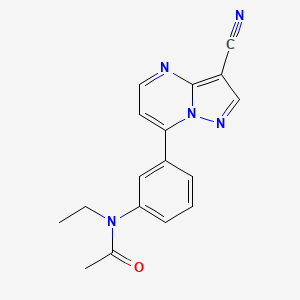
| Formula | C17H15N5O |
|---|---|
| Molecular weight | 305.34 g/mol |
| IUPAC name | N-[3-(3-cyanopyrazolo[1,5-a]pyrimidin-7-yl)phenyl]-N-ethylacetamide |
| CAS | 151319-34-5 |
| PubChem CID | 5719 |
| InChIKey | HUNXMJYCHXQEGX-UHFFFAOYSA-N |
| logP | 2.64 (XLogP 1.0) |
| Polar surface area | 74.29 Ų |
| H-bond acceptors / donors | 5 / 0 |
| Drug-likeness (QED) | 0.75 |
| Lipinski violations | 0 |
SMILES
CCN(C(C)=O)c1cccc(-c2ccnc3c(C#N)cnn23)c1Biology & Pharmacokinetics
Pharmacokinetics
| BBB penetrant | Yes |
|---|
Enzyme interactions
| Enzyme | Role | Detail |
|---|---|---|
| CYP1A2 | Inhibitor | — |
| CYP1A2 | Substrate | — |
| CYP2C19 | Inhibitor | — |
| CYP2C8 | Inhibitor | — |
| CYP2C9 | Inhibitor | — |
| CYP2D6 | Substrate | — |
| CYP3A4 | Substrate | — |
Transporters
BCRP (Inhibitor)BSEP (Inhibitor)BSEP (Inhibitor)MDR1 (Inhibitor)MRP1 (Inhibitor)MRP2 (Inhibitor)MRP3 (Inhibitor)MRP4 (Inhibitor)OATP1B1 (Inhibitor)OATP1B3 (Inhibitor)P-gp (Inhibitor)P-gp (Substrate)
Drug–drug interactions (60, DDInter)
| Interacting drug | Severity | Management |
|---|---|---|
| Codeine | major | |
| Hydrocodone | major | |
| Morphine | major | |
| Morphine (liposomal) | major | |
| Aldesleukin | moderate | |
| Alimemazine | moderate | |
| Amyl Nitrite | moderate | |
| Apalutamide | moderate | |
| Azatadine | moderate | |
| Brimonidine (ophthalmic) | moderate | |
| Brimonidine (topical) | moderate | |
| Brompheniramine | moderate | |
| Bupropion | moderate | |
| Carbinoxamine | moderate | |
| Cetirizine | moderate | |
| Chlorphenesin | moderate | |
| Chlorpheniramine | moderate | |
| Cimetidine | moderate | |
| Clemastine | moderate | |
| Clofedanol | moderate | |
| Cyclizine | moderate | |
| Cyproheptadine | moderate | |
| Dexbrompheniramine | moderate | |
| Dextromethorphan | moderate | |
| Diazoxide | moderate | |
| Diphenhydramine | moderate | |
| Doxepin | moderate | |
| Doxylamine | moderate | |
| Dronabinol | moderate | |
| Enzalutamide | moderate | |
| Ethanol | moderate | |
| Fostamatinib | moderate | |
| Ifosfamide | moderate | |
| Larotrectinib | moderate | |
| Levocetirizine | moderate | |
| Lorlatinib | moderate | |
| Mepyramine | moderate | |
| Metoclopramide | moderate | |
| Minoxidil | moderate | |
| Nabilone | moderate |
Showing 40 of 60.
Registered Products (2)
| Brand | Form / strength | Pack | Agent | Citizen (JOD) |
|---|---|---|---|---|
| Sonata Cap | Capsule 5 mg | 14 cap | Arab Company for Medical & Agricultural Products | 4.550 |
| Sonata Cap | Capsule 10 mg | 14 cap | Arab Company for Medical & Agricultural Products | 5.800 |