Danazol
JFDA label: DANOL CAP.
- Thromboembolic events:
- Pregnancy:
- Hepatic effects:
- Intracranial hypertension:
Mechanism of Action
Agonist of Progesterone receptor — Progesterone receptor agonist; Agonist of Androgen receptor — Androgen Receptor agonist
| Target | Action | Gene / class |
|---|---|---|
| Androgen receptor efficacy | AGONIST | AR |
| Progesterone receptor efficacy | AGONIST | PGR |
Indications
Approved
- Endometriosis
- Fibrocystic breast disease
- Hereditary angioedema
Off-label
- Autoimmune hemolytic anemia
- Immune thrombocytopenia, refractory
Contraindications
Source: Lexicomp
- Additional contraindications (not in the US labeling): Genital neoplasia Absolute
- Hypersensitivity to danazol or any component of the formulation Absolute
- active or history of thrombosis or thromboembolic disease Absolute
- androgen-dependent tumor Absolute
- breast-feeding Absolute
- concomitant administration with simvastatin Absolute
- markedly impaired hepatic, renal, or cardiac function Absolute
- undiagnosed abnormal genital bleeding Absolute
Adverse Reactions
Cardiac disorders (7)
Not Known Edema · flushing · hypertension · myocardial infarction · palpitations · syncope · tachycardia
Nervous system disorders (9)
Not Known Depression · dizziness · emotional lability · fatigue · headache · nervousness · paresthesia · sleep disorder · voice disorder (deepening of the voice, hoarseness, instability, sore throat)
Hepatobiliary disorders (6)
Not Known Cholestatic jaundice · hepatic adenoma · hepatic neoplasm (malignant; after prolonged use) · increased liver enzymes · jaundice · peliosis hepatitis
Renal and urinary disorders (8)
Not Known Asthenospermia · breast atrophy · decreased ejaculate volume · hematuria · inhibition of spermatogenesis · spermatozoa disorder (changes in sperm count and semen viscosity) · vaginal dryness · vaginal irritation
Blood and lymphatic system disorders (12)
Not Known Abnormal erythrocytes (increased) · decreased sex hormone binding globulin · eosinophilia · increased sex hormone-binding globulin · leukocytosis · leukopenia · malignant neoplasm (after prolonged use) · petechial rash · polycythemia · purpuric rash · thrombocythemia · thrombocytopenia
Metabolism and nutrition disorders (10)
Not Known Amenorrhea (may continue post-therapy) · change in libido · decreased glucose tolerance (and glucagon changes) · decreased HDL cholesterol · decreased thyroxine binding globulin · hirsutism (mild) · increased LDL cholesterol · increased thyroxine binding globulin · menstrual disease (altered timing of cycle, spotting) · weight gain
Gastrointestinal disorders (4)
Not Known Constipation · gastroenteritis · nausea · vomiting
Skin and subcutaneous tissue disorders (9)
Not Known Acne vulgaris · alopecia · diaphoresis · maculopapular rash · papular rash · pruritus · seborrhea · urticaria · vesicular eruption
Musculoskeletal and connective tissue disorders (11)
Not Known Ankylosing spondylitis · arthralgia · back pain · increased creatine phosphokinase · joint swelling · limb pain · muscle cramps · muscle spasm · neck pain · tremor · weakness
Eye disorders (1)
Not Known Visual disturbance
Respiratory, thoracic and mediastinal disorders (1)
Not Known Interstitial pneumonitis
Dosing
Source: Lexicomp
Warnings & Precautions
Source: Lexicomp
Androgenic effects
May cause nonreversible androgenic effects.
Blood lipid changes
Anabolic steroids may cause blood lipid changes (decreased high density lipoproteins and increased low density lipoproteins) with increased risk of arteriosclerosis and coronary artery disease.
Hepatotoxicity
Peliosis hepatis and benign hepatic adenoma have been reported with long-term use. Peliosis hepatis and hepatic adenoma may be silent until complicated by acute, potentially life-threatening intraabdominal hemorrhage. Use the lowest effective dose. When used for hereditary angioneurotic edema, if danazol was initiated during an exacerbation due to trauma, stress or other cause, consider periodic attempts to decrease or withdraw therapy. Monitor liver function tests and monitor closely for potential hepatotoxicity during therapy. Use is contraindicated in patients with marked hepatic impairment.
Intracranial hypertension
Danazol is associated with cases of benign intracranial hypertension (also known as pseudotumor cerebri). Early signs and symptoms include papilledema, headache, nausea and vomiting, and visual disturbances. Monitor for symptoms; if symptoms occur, screen for papilledema. Discontinue immediately and refer for neurology care if papilledema is present.
Thromboembolic events
Thromboembolism, thrombotic, and thrombophlebitic events have been reported (including sagittal sinus thrombosis and life-threatening or fatal strokes). Disease-related concerns:
Diabetes
Use with caution in patients with diabetes mellitus; insulin requirements may be increased; monitor carefully.
Edematous conditions
Use with caution in patients with conditions influenced by edema (eg, cardiovascular disease, migraine, seizure disorder, renal impairment); danazol may cause fluid retention.
Fibrocystic breast disease
Breast cancer should be ruled out prior to treatment for fibrocystic breast disease, and if fibrocystic nodules persist or enlarge during danazol treatment. The onset of relief of pain and tenderness is 1 month and symptoms are typically relieved within 2 to 3 months of treatment initiation; elimination of nodularity usually requires 4 to 6 months of continuous therapy. Symptoms of fibrocystic breast disease may recur within 1 year following discontinuation of therapy. Ovulation may not be suppressed at doses used for fibrocystic disease, therefore nonhormonal contraception is recommended.
Porphyria
May cause exacerbations of acute intermittent porphyria; use is contraindicated in patients with porphyria. Concurrent drug therapy issues:
Drug-drug interactions
Potentially significant interactions may exist, requiring dose or frequency adjustment, additional monitoring, and/or selection of alternative therapy. Consult drug interactions database for more detailed information. Special populations:
Pregnancy
Danazol use is contraindicated in pregnancy. Pregnancy should be ruled out immediately prior to starting treatment using a sensitive test (eg, beta subunit test if available) capable of determining early pregnancy. A nonhormonal method of contraception should also be used during therapy. If a patient becomes pregnant during danazol treatment, discontinue danazol and apprise the patient of the potential risk to the fetus. Exposure to danazol in utero may result in androgenic effects on the female fetus; reports of clitoral hypertrophy, labial fusion, urogenital sinus defect, vaginal atresia, and ambiguous genitalia have been received.
Pregnancy & Lactation
Pregnancy
[US Boxed Warning]: Danazol use is contraindicated in pregnancy. Pregnancy should be ruled out immediately prior to starting treatment using a sensitive test (eg, beta subunit test if available) capable of determining early pregnancy. A nonhormonal method of contraception should also be used during therapy. If a patient becomes pregnant during danazol treatment, discontinue danazol and apprise the patient of the potential risk to the fetus. Exposure to danazol in utero may result in androgenic effects on the female fetus; reports of clitoral hypertrophy, labial fusion, urogenital sinus defect, vaginal atresia, and ambiguous genitalia have been received. Therapy should be discontinued for 2 months prior to attempting pregnancy (Caballero 2012).
Lactation
Use of danazol in nursing women is contraindicated.
Monitoring
| Clinical pearl | Liver and renal function tests (periodically); hematologic parameters; lipid panel. Signs and symptoms of intracranial hypertension (papilledema, headache, nausea, vomiting), androgenic changes, and/or fluid retention. |
|---|
Chemistry & Properties
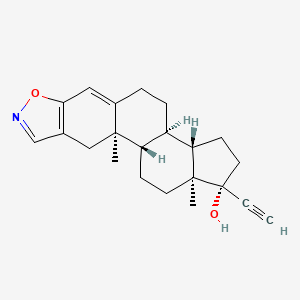
| Formula | C22H27NO2 |
|---|---|
| Molecular weight | 337.46 g/mol |
| IUPAC name | (1S,2R,13R,14S,17R,18S)-17-ethynyl-2,18-dimethyl-7-oxa-6-azapentacyclo[11.7.0.02,10.04,8.014,18]icosa-4(8),5,9-trien-17-ol |
| CAS | 17230-88-5 |
| PubChem CID | 28417 |
| InChIKey | POZRVZJJTULAOH-LHZXLZLDSA-N |
| logP | 4.22 (XLogP 3.8) |
| Polar surface area | 46.26 Ų |
| H-bond acceptors / donors | 3 / 1 |
| Drug-likeness (QED) | 0.72 |
| Lipinski violations | 0 |
SMILES
C#C[C@]1(O)CC[C@H]2[C@@H]3CCC4=Cc5oncc5C[C@]4(C)[C@H]3CC[C@@]21CBiology & Pharmacokinetics
Pharmacokinetics predicted
| Bioavailability | 70.0% |
|---|---|
| Half-life | 1.846 h |
| Volume of distribution | 4.691 L/kg |
| Protein binding | 97.4% |
| BBB penetrant | Yes |
Enzyme interactions
| Enzyme | Role | Detail |
|---|---|---|
| CYP1A2 | Substrate | — |
| CYP2B6 | Inhibitor | — |
| CYP2C19 | Inhibitor | — |
| CYP2C19 | Substrate | — |
| CYP2C8 | Inhibitor | IC₅₀ 1.9499999999999993 µM |
| CYP2C9 | Inhibitor | IC₅₀ 0.6572670690061999 µM |
| CYP2D6 | Inhibitor | IC₅₀ 2.74 µM |
| CYP3A4 | Inhibitor | — |
| CYP3A4 | Substrate | — |
Transporters
BCRP (Inhibitor)BSEP (Inhibitor)BSEP (Inhibitor)MRP1 (Inhibitor)MRP2 (Inhibitor)MRP3 (Inhibitor)MRP4 (Inhibitor)OATP1B1 (Inhibitor)OATP1B3 (Inhibitor)P-gp (Inhibitor)MDR1 (Substrate)P-gp (Substrate)
Drug–drug interactions (100+, DDInter)
| Interacting drug | Severity | Management |
|---|---|---|
| Carfilzomib | major | |
| Cisapride | major | |
| Dicoumarol | major | |
| Halofantrine | major | |
| Hemin | major | |
| Leflunomide | major | |
| Naloxegol | major | |
| Simvastatin | major | |
| Teriflunomide | major | |
| Warfarin | major | |
| Acalabrutinib | moderate | |
| Acarbose | moderate | |
| Acetohexamide | moderate | |
| Albiglutide | moderate | |
| Alogliptin | moderate | |
| Asparaginase Escherichia coli | moderate | |
| Axitinib | moderate | |
| Bosutinib | moderate | |
| Brentuximab vedotin | moderate | |
| Brigatinib | moderate | |
| Budesonide | moderate | |
| Budesonide (nasal) | moderate | |
| Canagliflozin | moderate | |
| Ceritinib | moderate | |
| Chlorpropamide | moderate | |
| Cilostazol | moderate | |
| Clofarabine | moderate | |
| Cobimetinib | moderate | |
| Conestat alfa | moderate | |
| Crizotinib | moderate | |
| Cyclosporine | moderate | |
| Dapagliflozin | moderate | |
| Dasatinib | moderate | |
| Docetaxel | moderate | |
| Dulaglutide | moderate | |
| Elagolix | moderate | |
| Eliglustat | moderate | |
| Empagliflozin | moderate | |
| Entrectinib | moderate | |
| Enzalutamide | moderate |
Showing 40 of 100+.
Registered Products (1)
| Brand | Form / strength | Pack | Agent | Citizen (JOD) |
|---|---|---|---|---|
| DANOL CAP. | Capsule 200 mg | 60 cap | Ulfa Pharma Co. | 41.910 |