Tobramycin
🧬 Cross-allergy: Aminoglycosides
JFDA label: NEBCIN Vial
- nephrotoxicity — ChEMBL drug_warning (Black Box Warning) | United States
- teratogenicity — ChEMBL drug_warning (Black Box Warning) | United States
- neurotoxicity — ChEMBL drug_warning (Black Box Warning) | United States
- Patients treated with Tobramycin Injection and other aminoglycosides should be under close clinical observation, because these drugs have an inherent potential for causing ototoxicity and nephrotoxici
Mechanism of Action
Inhibitor of 70S ribosome — 70S ribosome inhibitor
| Target | Action | Gene / class |
|---|---|---|
| 70S ribosome efficacy | INHIBITOR |
Indications
Approved
- Bacterial Infections — bacterial disease
- Conjunctivitis, Allergic — allergic conjunctivitis
- Cystic Fibrosis — cystic fibrosis
- Eye Infections — eye infection
- Infections — infection
- Inflammation — inflammation
- Respiratory Tract Infections — respiratory tract infectious disorder
Off-label
- Blepharitis
- Bronchiectasis
- Cataract
- Conjunctivitis, Bacterial
- Fractures, Bone
- Pneumonia
- Pneumonia, Bacterial
- Pseudomonas Infections
Antimicrobial Spectrum
Expected / intrinsic spectrum (EUCAST breakpoints & labels) — not local resistance. Source: EUCAST v16 · openfda-label.
Bacteria
| Organism | Activity | MIC |
|---|---|---|
| Acinetobacter spp. | Susceptible | 41.0 mg/L |
| Enterobacterales | Susceptible | 21.0 mg/L |
| Pseudomonas aeruginosa | Susceptible | 21.0 mg/L |
| Staphylococcus aureus | Active | — |
Contraindications
Source: openFDA
- hypersensitivity to any aminoglycoside is a contraindication to the use of tobramycin. A history of hypersensitivity or serious toxic reactions to aminoglycosides may also contraindicate the use of any other aminoglycoside because of the known cross-sensitivity of patients to drugs in this class. Absolute
Dosing
Source: openFDA
Warnings & Precautions
Source: openFDA
Boxed Warning
Patients treated with Tobramycin Injection and other aminoglycosides should be under close clinical observation, because these drugs have an inherent potential for causing ototoxicity and nephrotoxicity. Neurotoxicity, manifested as both auditory and vestibular ototoxicity, can occur. The auditory changes are irreversible, are usually bilateral, and may be partial or total. Eighth-nerve impairment and nephrotoxicity may develop, primarily in patients having pre-existing renal damage and in those with normal renal function to whom aminoglycosides are administered for longer periods or in higher doses than those recommended. Other manifestations of neurotoxicity may include numbness, skin tingling, muscle twitching, and convulsions. The risk of aminoglycoside-induced hearing loss increases with the degree of exposure to either high peak or high trough serum concentrations. Patients who develop cochlear damage may not have symptoms during therapy to warn them of eighth-nerve toxicity, and partial or total irreversible bilateral deafness may continue to develop after the drug has been discontinued. Rarely, nephrotoxicity may not become apparent until the first few days after cessation of therapy. Aminoglycoside-induced nephrotoxicity usually is reversible. Renal and eighth-nerve function should be closely monitored in patients with known or suspected renal impairment and also in those whose renal function is initially normal but who develop signs of renal dysfunction during therapy. Peak and trough serum concentrations of aminoglycosides should be monitored periodically during therapy to assure adequate levels and to avoid potentially toxic levels. Prolonged serum concentrations above 12 mcg/mL should be avoided. Rising trough levels (above 2 mcg/mL) may indicate tissue accumulation. Such accumulation, excessive peak concentrations, advanced age, and cumulative dose may contribute to ototoxicity and nephrotoxicity (see PRECAUTIONS ). Urine should be examined for decreased specific gravity and increased excretion of protein, cells, and casts. Blood urea nitrogen, serum creatinine, and creatinine clearance should be measured periodically. When feasible, it is recommended that serial audiograms be obtained in patients old enough to be tested, particularly high-risk patients. Evidence of impairment of renal, vestibular, or auditory function requires discontinuation of the drug or dosage adjustment. Tobramycin should be used with caution in premature and neonatal i
Warnings & Precautions
See WARNINGS box above. This product contains sodium metabisulfite, a sulfite that may cause allergic-type reactions, including anaphylactic symptoms and life-threatening or less severe asthmatic episodes, in certain susceptible people. The overall prevalence of sulfite sensitivity in the general population is unknown and probably low. Sulfite sensitivity is seen more frequently in asthmatic than in non-asthmatic people. Serious allergic reactions including anaphylaxis and dermatologic reactions including exfoliative dermatitis, toxic epidermal necrolysis, erythema multiforme, and Stevens-Johnson Syndrome have been reported rarely in patients on tobramycin therapy. Although rare, fatalities have been reported (see CONTRAINDICATIONS ). If an allergic reaction occurs, the drug should be discontinued and appropriate therapy instituted. Clostridium difficile associated diarrhea (CDAD) has been reported with use of nearly all antibacterial agents, including Tobramycin, and may range in severity from mild diarrhea to fatal colitis. Treatment with antibacterial agents alters the normal flora of the colon leading to overgrowth of C. difficile. C. difficile produces toxins A and B which contribute to the development of CDAD. Hypertoxin producing strains of C. difficile cause increased morbidity and mortality, as these infections can be refractory to antimicrobial therapy and may require colectomy. CDAD must be considered in all patients who present with diarrhea following antibiotic use. Careful medical history is necessary since CDAD has been reported to occur over two months after administration of antibacterial agents. If CDAD is suspected or confirmed, ongoing antibiotic use not directed against C. difficile may need to be discontinued. Appropriate fluid and electrolyte management, protein supplementation, antibiotic treatment of C. difficile , and surgical evaluation should be instituted as clinically indicated. Risk of Ototoxicity Due to Mitochondrial DNA Variants Cases of ototoxicity with aminoglycosides have been observed in patients with certain variants in the mitochondrially encoded 12S rRNA gene ( MT-RNR1 ), particularly the m.1555A>G variant. Ototoxicity occurred in some patients even when their aminoglycoside serum levels were within the recommended range. Mitochondrial DNA variants are present in less than 1% of the general US population, and the proportion of the variant carriers who may develop ototoxicity as well as the severity of ototoxicity is
Pregnancy & Lactation
Pregnancy
Lactation
Maternal use of an ear drop or eye drop that contains tobramycin presents little or no risk for the nursing infant. A task force respiratory experts from Europe, Australia and New
LactMed: monitor the infant.
Chemistry & Properties
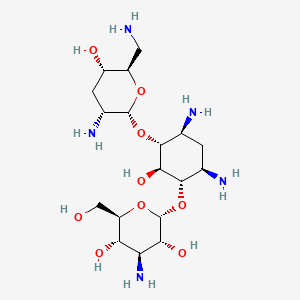
| Formula | C18H37N5O9 |
|---|---|
| Molecular weight | 467.52 g/mol |
| IUPAC name | (2S,3R,4S,5S,6R)-4-amino-2-[(1S,2S,3R,4S,6R)-4,6-diamino-3-[(2R,3R,5S,6R)-3-amino-6-(aminomethyl)-5-hydroxyoxan-2-yl]oxy-2-hydroxycyclohexyl]oxy-6-(hydroxymethyl)oxane-3,5-diol |
| CAS | 32986-56-4 |
| PubChem CID | 36294 |
| InChIKey | NLVFBUXFDBBNBW-PBSUHMDJSA-N |
| logP | -6.3 (XLogP -6.2) |
| Polar surface area | 268.17 Ų |
| H-bond acceptors / donors | 14 / 10 |
| Drug-likeness (QED) | 0.17 |
| Lipinski violations | 2 |
SMILES
NC[C@H]1O[C@H](O[C@H]2[C@H](O)[C@@H](O[C@H]3O[C@H](CO)[C@@H](O)[C@H](N)[C@H]3O)[C@H](N)C[C@@H]2N)[C@H](N)C[C@@H]1OBiology & Pharmacokinetics
Pharmacokinetics
| BBB penetrant | No |
|---|
Enzyme interactions
| Enzyme | Role | Detail |
|---|---|---|
| CYP2C19 | Substrate | — |
| CYP3A4 | Substrate | — |
Transporters
BCRP (Inhibitor)BSEP (Inhibitor)BSEP (Inhibitor)MRP1 (Inhibitor)MRP2 (Inhibitor)MRP3 (Inhibitor)MRP4 (Inhibitor)OATP1B1 (Inhibitor)OATP1B1 (Inhibitor)OATP1B3 (Inhibitor)P-gp (Inhibitor)P-gp (Substrate)Transporter(unspecified) (Substrate)
Drug–drug interactions (61, DDInter)
| Interacting drug | Severity | Management |
|---|---|---|
| Bacitracin | major | |
| Deferasirox | major | |
| Diatrizoate | major | |
| Everolimus | major | |
| Iodipamide | major | |
| Iodixanol | major | |
| Iohexol | major | |
| Iopamidol | major | |
| Iopromide | major | |
| Iothalamic acid | major | |
| Ioversol | major | |
| Ioxilan | major | |
| Magnesium sulfate | major | |
| Mannitol | major | |
| Polymyxin B | major | |
| Sirolimus | major | |
| Tacrolimus | major | |
| Temsirolimus | major | |
| Acetylsalicylic acid | moderate | |
| Amikacin | moderate | |
| Amikacin (liposome) | moderate | |
| Amphotericin B | moderate | |
| Amphotericin B (cholesteryl sulfate) | moderate | |
| Amphotericin B (lipid complex) | moderate | |
| Amphotericin B (liposomal) | moderate | |
| Balsalazide | moderate | |
| Carboplatin | moderate | |
| Celecoxib | moderate | |
| Cisplatin | moderate | |
| Clofarabine | moderate | |
| Cyclosporine | moderate | |
| Dexlansoprazole | moderate | |
| Diclofenac | moderate | |
| Esomeprazole | moderate | |
| Ethinylestradiol | moderate | |
| Exenatide | moderate | |
| Flucytosine | moderate | |
| Flurbiprofen | moderate | |
| Gentamicin | moderate | |
| Gentamicin (topical) | moderate |
Showing 40 of 61.
Registered Products (18)
| Brand | Form / strength | Pack | Agent | Citizen (JOD) |
|---|---|---|---|---|
| Optidex-T Ophthalmic Suspension | Ophthalmic Solution 0.3 %w/v, 0.1 %w/v | 5 ml | شركة مستودع ادوية الايمان | 1.700 |
| Tobradex Eye Oint | Ointment 3 mg/g, 1 mg/g | 3.5 g tube | The Jordan Drugstore Co | 1.730 |
| Lofoto (0.3 + 0.1)% w/v | Solution 0.3 %, 0.1 % | 5 ml | Sun Set Drug Store | 1.740 |
| Tobrastill Eye Drops | Ophthalmic Solution 0.3 % | 5 ml | Modern Drug Store | 1.870 |
| Tobracin E/O | Cream 3 mg/g | 5 g tube | Amman Pharmaceutical Indusries | 1.950 |
| Tobrex Eye Oint | Ointment 0.3 % | 3.5 g tube | The Jordan Drugstore Co | 2.050 |
| Tobracin E/D | Ophthalmic Solution 0.3 % | 10 ml | Amman Pharmaceutical Indusries | 2.080 |
| Tobrason Eye Suspension | Suspension 0.3 %, 0.1 % | 5 ml pack varies | Amman Pharmaceutical Industries Co | 2.310 |
| Tobrex Eye Drops | Ophthalmic Solution 0.3 % | 5 ml | The Jordan Drugstore Co | 2.340 |
| Tobrason Eye Ointment | Ointment 0.3 %, 0.1 % | 5gm pack varies | Amman Pharmaceutical Industries Co | 2.350 |
| Tobradex Eye Drops | Ophthalmic Solution 0.3 %, 0.1 % | 5 ml | The Jordan Drugstore Co | 2.430 |
| Ocubrax E/D | Ophthalmic Solution 3 mg, 1 mg | 5 ml | Jarzeem Drug Store | 3.550 |
| NEBCIN Vial | Vial 80 mg | 1 | THE ARAB DRUG STORE P.S.C | 4.070 |
| Tobrason Eye Suspension | Suspension 0.3 %, 0.1 % | 10 ml pack varies | Amman Pharmaceutical Industries Co | 4.390 |
| Zylet | Solution 0.3 %, 0.5 % | 5 ml | Petra Drug Store | 11.280 |
| Osteoset T Bone graft Pellets with tobramycin | Tablet 1.5 %, 94.5 %, 4 % | 10C (7000-0404) 5CC (7000-0402) Pellets 1Pc | شركة العلوم والتنمية للشرق الاوسط | — |
| Tobi Podhaler | Capsule 28 mg | 224 cap | ORIENT DRUG STORE CO | — |
| Tofibra Solution For Nebuliser | Solution 300 mg/5 ml | 56 amp | Hikma Pharmaceuticals Co.Ltd/Jordan | — |