Eplerenone
JFDA label: Epnone 50mg
Mechanism of Action
Antagonist of Mineralocorticoid receptor — Mineralocorticoid receptor antagonist
| Target | Action | Gene / class |
|---|---|---|
| Mineralocorticoid receptor efficacy | ANTAGONIST | NR3C2 |
Indications
Approved
- Heart failure
- Heart failure post-myocardial infarction (MI)
- Hypertension
- STEMI/NSTE-ACS
Off-label
- Heart failure (NYHA class II-IV) with left ventricular ejection fraction ≤35%
- Primary aldosteronism, treatment
Contraindications
Source: Lexicomp
- Additional contraindications (not in US labeling): Hypersensitivity to eplerenone or any component of the formulation Absolute
- CrCl Per the Endocrine Society clinical practice guidelines, use in patients with Addison disease is contraindicated (Endocrine Society [Bornstein 2016]) Absolute
- CrCl ≤30 mL/minute Absolute
- Serum potassium >5.5 mEq/L at initiation Absolute
- clinically significant hyperkalemia Absolute
- concomitant use of strong CYP3A4 inhibitors (eg, ketoconazole, itraconazole, nefazodone, troleandomycin, clarithromycin, ritonavir, nelfinavir). The following additional contraindications apply to patients with hypertension: Type 2 diabetes mellitus (noninsulin dependent, NIDDM) with microalbuminuria Absolute
- concomitant use with potassium supplements or potassium-sparing diuretics The following additional contraindications apply to patients with hypertension: Serum creatinine >1.5 mg/dL [132 micromole/L] in males or >1.3 mg/dL [115 micromole/L] in females Absolute
- serum creatinine >2.0 mg/dL in males or >1.8 mg/dL in females Absolute
- serum potassium >5 mEq/L at initiation Absolute
- severe hepatic impairment (Child-Pugh class C) Absolute
Adverse Reactions
Nervous system disorders (2)
Common Dizziness · fatigue
Renal and urinary disorders (3)
Common Abnormal vaginal hemorrhage · Increased serum creatinine · mastalgia
Metabolism and nutrition disorders (4)
Common albuminuria · gynecomastia · hypercholesterolemia · Hyponatremia
Gastrointestinal disorders (2)
Common abdominal pain · Diarrhea
Other (2)
Very Common Endocrine & metabolic: Hyperkalemia · hypertriglyceridemia
Respiratory, thoracic and mediastinal disorders (2)
Common Cough · flu-like symptoms
Dosing
Source: Lexicomp
Warnings & Precautions
Source: Lexicomp
Hyperkalemia
Hyperkalemia may occur; risk of hyperkalemia is increased with renal impairment, proteinuria, diabetes, and patients taking concomitant ACE inhibitors, angiotensin-II blockers, NSAIDs, and/or moderate CYP3A inhibitors. Monitor closely for hyperkalemia; increases in serum potassium were dose related during clinical trials (ACCF/AHA [Yancy 2013]). Dose reduction or interruption of therapy may be necessary with development of hyperkalemia. If concomitant moderate CYP3A4 inhibitor therapy cannot be avoided, reduce dose of eplerenone. Use is contraindicated in patients with potassium >5.5 mEq/L at initiation of therapy. Disease-related concerns:
Diabetes
Use with caution in patients with heart failure post-MI with diabetes (especially if patient has proteinuria); risk of hyperkalemia is increased.
Heart failure
When evaluating a heart failure patient for eplerenone treatment, eGFR should be >30 mL/minute/1.73 m2 or creatinine should be ≤2.5 mg/dL (men) or ≤2 mg/dL (women) with no recent worsening and potassium 6 mEq/L. The ACCF/AHA recommends considering discontinuation upon the development of serum potassium >5.5 mEq/L or worsening renal function with careful evaluation of the entire medical regimen. Avoid routine triple therapy with the combined use of an ACE inhibitor, ARB, and eplerenone. Instruct patients with heart failure to discontinue use during an episode of diarrhea or dehydration or when loop diuretic therapy is interrupted (ACCF/AHA [Yancy, 2013]).
Hepatic impairment
Use with caution in patients with moderate to severe hepatic impairment.
Renal impairment
Risk of hyperkalemia is increased with declining renal function. Use with caution in patients with mild renal impairment; based on indication and degree of impairment use may be contraindicated (refer to contraindications field). Concurrent drug therapy issues:
Drug-drug interactions
Potentially significant interactions may exist, requiring dose or frequency adjustment, additional monitoring, and/or selection of alternative therapy. Consult drug interactions database for more detailed information.
Potassium supplements
Avoid potassium supplements, potassium-containing salt substitutes, a diet rich in potassium, or other drugs that can cause hyperkalemia (eg, other potassium-sparing diuretics, NSAIDS). Concomitant use of potassium supplements or potassium-sparing diuretics is contraindicated in the treatment of hypertension.
Pregnancy & Lactation
Pregnancy
Adverse events have been observed in some animal reproduction studies. Information related to eplerenone use in pregnancy is limited (Cabassi, 2012; Morton, 2011). The use of mineralocorticoid receptor antagonists is not recommended to treat chronic uncomplicated hypertension in pregnant women and should generally be avoided in women of reproductive potential (ACOG, 2013).
Lactation
It is not known if eplerenone is excreted in breast milk. Due to the potential for serious adverse reactions in the nursing infant, the manufacturer recommends a decision be made whether to discontinue nursing or to discontinue the drug, taking into account the importance of treatment to the mother.
Monitoring
| Clinical pearl | Blood pressure; serum potassium (prior to therapy, within the first week, 1 month after start of treatment or dose adjustment, then periodically as clinically indicated); additionally, check serum potassium and serum creatinine within 3 to 7 days after initiating concurrent therapy with moderate a CYP3A4 inhibitor, ACE inhibitor, ARB or NSAID. ACCF/AHA heart failure guideline recommendations (ACCF/AHA [Yancy, 2013]): Serum potassium and renal function should be checked in 3 days after initiation, at 1 week after initiation, at least monthly for the first 3 months of therapy, and every 3 months thereafter. If adding or increasing the dose of concomitant ACE inhibitors or ARBs, a new cycle of monitoring should be done. If serum potassium increases to >5.5 mEq/L or renal function worsens, hold doses until potassium is |
|---|
Chemistry & Properties
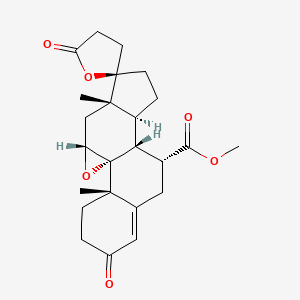
| Formula | C24H30O6 |
|---|---|
| Molecular weight | 414.5 g/mol |
| IUPAC name | methyl (1R,2S,9R,10R,11S,14R,15S,17R)-2,15-dimethyl-5,5'-dioxospiro[18-oxapentacyclo[8.8.0.01,17.02,7.011,15]octadec-6-ene-14,2'-oxolane]-9-carboxylate |
| CAS | 107724-20-9 |
| PubChem CID | 443872 |
| InChIKey | JUKPWJGBANNWMW-VWBFHTRKSA-N |
| logP | 3.12 (XLogP 1.4) |
| Polar surface area | 82.2 Ų |
| H-bond acceptors / donors | 6 / 0 |
| Drug-likeness (QED) | 0.48 |
| Lipinski violations | 0 |
SMILES
COC(=O)[C@@H]1CC2=CC(=O)CC[C@]2(C)[C@@]23O[C@@H]2C[C@@]2(C)[C@@H](CC[C@@]24CCC(=O)O4)[C@H]13Biology & Pharmacokinetics
Pharmacokinetics predicted
| Bioavailability | 70.0% |
|---|---|
| Half-life | 1.038 h |
| Volume of distribution | 1.366 L/kg |
| Protein binding | 74.1% |
| BBB penetrant | No |
Enzyme interactions
| Enzyme | Role | Detail |
|---|---|---|
| CYP1A2 | Substrate | — |
| CYP2C8 | Inhibitor | — |
| CYP3A4 | Substrate | — |
Receptor binding (top 2)
| Target | Action | Affinity |
|---|---|---|
| Mineralocorticoid receptor (NR3C2) | Antagonist | pKi 6.9 |
| Mineralocorticoid receptor (NR3C2) | Antagonist | pIC50 6.4 |
Transporters
BCRP (Inhibitor)BSEP (Inhibitor)BSEP (Inhibitor)MDR1 (Inhibitor)MRP1 (Inhibitor)MRP2 (Inhibitor)MRP3 (Inhibitor)MRP4 (Inhibitor)OATP1B1 (Inhibitor)OATP1B3 (Inhibitor)P-gp (Inhibitor)MDR1 (Substrate)P-gp (Substrate)
Drug–drug interactions (85, DDInter)
| Interacting drug | Severity | Management |
|---|---|---|
| Aminobenzoic acid | major | |
| Aprepitant | major | |
| Ceritinib | major | |
| Clarithromycin | major | |
| Clotrimazole | major | |
| Cobicistat | major | |
| Crizotinib | major | |
| Erythromycin | major | |
| Fedratinib | major | |
| Fluconazole | major | |
| Idelalisib | major | |
| Imatinib | major | |
| Ketoconazole | major | |
| Potassium Iodide | major | |
| Potassium acetate | major | |
| Potassium bicarbonate | major | |
| Potassium chloride | major | |
| Potassium citrate | major | |
| Potassium gluconate | major | |
| Potassium perchlorate | major | |
| Ribociclib | major | |
| Acetylsalicylic acid | moderate | |
| Alimemazine | moderate | |
| Amifostine | moderate | |
| Betamethasone | moderate | |
| Brigatinib | moderate | |
| Brimonidine (ophthalmic) | moderate | |
| Brimonidine (topical) | moderate | |
| Budesonide | moderate | |
| Bupropion | moderate | |
| Canagliflozin | moderate | |
| Celecoxib | moderate | |
| Chlorphenesin | moderate | |
| Corticotropin | moderate | |
| Cyclosporine | moderate | |
| Dabrafenib | moderate | |
| Dapagliflozin | moderate | |
| Deferasirox | moderate | |
| Deflazacort | moderate | |
| Dexamethasone | moderate |
Showing 40 of 85.
Registered Products (4)
| Brand | Form / strength | Pack | Agent | Citizen (JOD) |
|---|---|---|---|---|
| Epnone | Tablet 25 mg | 30 tab | Manar Drug Store | 7.470 |
| Epnone | Tablet 50 mg | 30 tab | Manar Drug Store | 13.070 |
| Elerax | Tablet 25 mg | 30 tab | UNITED PHARM.MFG.CO.LTD(UPM)/JORDAN | 17.970 |
| Elerax 50mg F.C.T | Tablet 50 mg | 30 tab | UNITED PHARM.MFG.CO.LTD(UPM)/JORDAN | 17.970 |