Estradiol
JFDA label: Femoston conti
- neurotoxicity — ChEMBL drug_warning (Black Box Warning) | United States
- cardiotoxicity — ChEMBL drug_warning (Black Box Warning) | United States
- vascular toxicity — ChEMBL drug_warning (Black Box Warning) | United States
- carcinogenicity — ChEMBL drug_warning (Black Box Warning) | United States
- respiratory toxicity — ChEMBL drug_warning (Black Box Warning) | United States
- CIGARETTE SMOKING AND SERIOUS CARDIOVASCULAR EVENTS Cigarette smoking increases the risk of serious cardiovascular events from combination oral contraceptive (COC) use. This risk increases with age, p
Mechanism of Action
Agonist of Estrogen receptor — Estrogen receptor alpha agonist
| Target | Action | Gene / class |
|---|---|---|
| Estrogen receptor efficacy | AGONIST | ESR1 |
Indications
Approved
- Atrophic Vaginitis — Atrophic Vaginitis
- Atrophy — Atrophy
- Breast Neoplasms — breast carcinoma
- Dyspareunia — Dyspareunia
- Hypogonadism — hypogonadism
- Menopause — menopause
- Osteoporosis — osteoporosis
- Osteoporosis, Postmenopausal — postmenopausal osteoporosis
- Primary Ovarian Insufficiency — Premature ovarian insufficiency
Off-label
- Aging
- Alzheimer Disease
- Amenorrhea
- Anorexia Nervosa
- Atherosclerosis
- Bone Diseases, Metabolic
- Bulimia Nervosa
- Carcinoid Tumor
- Coronary Disease
- Depression, Postpartum
- Depressive Disorder
- Dry Eye Syndromes
- Dysmenorrhea
- Endometriosis
- HIV Infections
- Heart Diseases
- Hereditary Breast and Ovarian Cancer Syndrome
- Hot Flashes
- Infertility
- Migraine Disorders
- Multiple Sclerosis
- Myocardial Ischemia
- Non-alcoholic Fatty Liver Disease
- Obesity
- Pain
- Prostatic Neoplasms
- Prostatic Neoplasms, Castration-Resistant
- Psychotic Disorders
- Schizophrenia
- Severe Acute Respiratory Syndrome
- Sexual Dysfunction, Physiological
- Stress Disorders, Post-Traumatic
- Triple Negative Breast Neoplasms
- Turner Syndrome
- Urinary Tract Infections
Contraindications
Source: openFDA
- Oral contraceptives are contraindicated in women who currently have the following conditions: • Thrombophlebitis or thromboembolic disorders • A past history of deep vein thrombophlebitis or thromboembolic disorders • Cerebral vascular or coronary artery disease • Current diagnosis of, or history of, breast cancer, which may be hormone sensitive • Carcinoma of the endometrium or other known or suspected estrogen-dependent neoplasia • Undiagnosed abnormal genital bleeding • Cholestatic jaundice of pregnancy or jaundice with prior pill use • Hepatic adenomas or carcinomas • Are receiving Hepatitis C drug combinations containing ombitasvir/paritaprevir/ritonavir, with or without dasabuvir, due to the potential for ALT elevations (see WARNINGS , RISK OF LIVER ENZYME ELEVATIONS WITH CONCOMITANT HEPATITIS C TREATMENT ). Absolute
Dosing
Source: openFDA
Warnings & Precautions
Source: openFDA
Boxed Warning
CIGARETTE SMOKING AND SERIOUS CARDIOVASCULAR EVENTS Cigarette smoking increases the risk of serious cardiovascular events from combination oral contraceptive (COC) use. This risk increases with age, particularly in women over 35 years of age, and with the number of cigarettes smoked. For this reason, COCs, including Hailey 1.5/30, are contraindicated in women who are over 35 years of age and smoke (see CONTRAINDICATIONS and WARNINGS ).
Warnings & Precautions
The use of oral contraceptives is associated with increased risks of several serious conditions including myocardial infarction, thromboembolism, stroke, hepatic neoplasia, and gallbladder disease, although the risk of serious morbidity or mortality is very small in healthy women without underlying risk factors. The risk of morbidity and mortality increases significantly in the presence of other underlying risk factors such as hypertension, hyperlipidemias, obesity, and diabetes. Practitioners prescribing oral contraceptives should be familiar with the following information relating to these risks. The information contained in this package insert is principally based on studies carried out in patients who used oral contraceptives with higher formulations of estrogens and progestogens than those in common use today. The effect of long-term use of the oral contraceptives with lower formulations of both estrogens and progestogens remains to be determined. Throughout this labeling, epidemiological studies reported are of two types: retrospective or case control studies and prospective or cohort studies. Case control studies provide a measure of the relative risk of a disease, namely, a ratio of the incidence of a disease among oral contraceptive users to that among nonusers. The relative risk does not provide information on the actual clinical occurrence of a disease. Cohort studies provide a measure of attributable risk, which is the difference in the incidence of disease between oral contraceptive users and nonusers. The attributable risk does provide information about the actual occurrence of a disease in the population (adapted from References 8 and 9 with the author’s permission). For further information, the reader is referred to a text on epidemiological methods. 1. Thromboembolic Disorders and Other Vascular Problems a. Myocardial infarction An increased risk of myocardial infarction has been attributed to oral contraceptive use. This risk is primarily in smokers or women with other underlying risk factors for coronary artery disease such as hypertension, hypercholesterolemia, morbid obesity, and diabetes. The relative risk of heart attack for current oral contraceptive users has been estimated to be two to six (10 - 16). The risk is very low under the age of 30. Smoking in combination with oral contraceptive use has been shown to contribute substantially to the incidence of myocardial infarctions in women in their mid-thirties or older with smoking ac
Oral contraceptives non-smoker** 0.3 0.5 0.9 1.9 13.8
Oral contraceptives non-smoker** 0.3 0.5 0.9 1.9 13.8
Oral contraceptives smoker** 2.2 3.4 6.6 13.5 51.1
Oral contraceptives smoker** 2.2 3.4 6.6 13.5 51.1
IUD** 0.8 0.8 1 1 1.4
IUD** 0.8 0.8 1 1 1.4
Condom* 1.1 1.6 0.7 0.2 0.3
Condom* 1.1 1.6 0.7 0.2 0.3
Diaphragm/spermicide* 1.9 1.2 1.2 1.3 2.2
Diaphragm/spermicide* 1.9 1.2 1.2 1.3 2.2
Periodic abstinence* 2.5 1.6 1.6 1.7 2.9 3.6 *Deaths are birth related
Periodic abstinence* 2.5 1.6 1.6 1.7 2.9 3.6 *Deaths are birth related. **Deaths are method related Adapted from H.W. Ory, Reference 41. 3. Malignant Neoplasms Breast Cancer Norethindrone acetate and ethinyl estradiol tablets are contraindicated in females who currently have or have had breast cancer because breast cancer may be hormonally sensitive (see CONTRAINDICATIONS ). Epidemiology studies have not found a consistent association between use of combined oral contraceptives (COCs) and breast cancer risk. Studies do not show an association between ever (current or past) use of COCs and risk of breast cancer. However, some studies report a small increase in the risk of breast cancer among current or recent users (<6 months since last use) and current users with longer duration of COC use (see ADVERSE REACTIONS , Postmarketing Experience). Cervical Cancer Some studies suggest that oral contraceptive use has been associated with an increase in the risk of cervical intraepithelial neoplasia in some populations of women (42-45). However, there continues to be controversy about the extent to which such findings may be due to differences in sexual behavior and other factors. 4. Hepatic Neoplasia Benign hepatic adenomas are associated with oral contraceptive use, although the incidence of benign tumors is rare in the United States. Indirect calculations have estimated the attributable risk to be in the range of 3.3 cases/100,000 for users, a risk that increases after four or more years of use (46). Rupture of rare, benign, hepatic adenomas may cause death through intra-abdominal hemorrhage (47,48). Studies from Britain have shown an increased risk of developing hepatocellular carcinoma (49 - 51) in long-term (greater than 8 years) oral contraceptive users. However, these cancers are extremely rare in the U.S., and the attributable risk (the excess incidence) of liver cancers in oral contraceptive users approaches less than one per million users. 5. Risk of Liver Enzyme Elevations with Concomitant Hepatitis C Treatment During clinical trials with the Hepatitis C combination drug regimen that contains ombitasvir/paritaprevir/ritonavir, with or without dasabuvir, ALT elevations greater than 5 times the upper limit of normal (ULN), including some cases greater than 20 times the ULN, were significantly more frequent in women using ethinyl estradiol-containing medications such as COCs. Discontinue norethindrone acetate and ethinyl estradiol tablets prior to starting
Pregnancy & Lactation
Pregnancy
Lactation
Maternal doses of up to 200 mcg daily transdermally do not increase estradiol or estriol in breastfed infants or cause any adverse
Chemistry & Properties
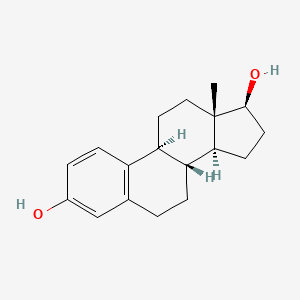
| Formula | C18H24O2 |
|---|---|
| Molecular weight | 272.39 g/mol |
| IUPAC name | (8R,9S,13S,14S,17S)-13-methyl-6,7,8,9,11,12,14,15,16,17-decahydrocyclopenta[a]phenanthrene-3,17-diol |
| CAS | 50-28-2 |
| PubChem CID | 5757 |
| InChIKey | VOXZDWNPVJITMN-ZBRFXRBCSA-N |
| logP | 3.61 (XLogP 4.0) |
| Polar surface area | 40.46 Ų |
| H-bond acceptors / donors | 2 / 2 |
| Drug-likeness (QED) | 0.76 |
| Lipinski violations | 0 |
SMILES
C[C@]12CC[C@@H]3c4ccc(O)cc4CC[C@H]3[C@@H]1CC[C@@H]2OBiology & Pharmacokinetics
Pharmacokinetics predicted
| Bioavailability | 70.0% |
|---|---|
| Half-life | 1.686 h |
| Volume of distribution | 1.041 L/kg |
| Protein binding | 86.6% |
| BBB penetrant | Yes |
Enzyme interactions
| Enzyme | Role | Detail |
|---|---|---|
| CYP1A2 | Substrate | — |
| CYP2B6 | Inhibitor | — |
| CYP2B6 | Substrate | — |
| CYP2C19 | Substrate | — |
| CYP2C8 | Inhibitor | — |
| CYP2C9 | Substrate | — |
| CYP2D6 | Substrate | — |
Receptor binding (top 9)
| Target | Action | Affinity |
|---|---|---|
| estrogen beta | Binding | pKi 10.0 |
| estrogen alpha | Binding | pKi 9.9 |
| Estrogen receptor-α (ESR1) | Agonist | pKi 9.8 |
| Estrogen receptor-β (ESR2) | Agonist | pKi 9.3 |
| Estrogen receptor beta (ESR2) | Binding | pKi 8.7 |
| Estrogen receptor alpha (ESR1) | Binding | pKi 8.3 |
| estrogen, ER alpha | Binding | pKi 6.4 |
| estrogen, ER beta | Binding | pKi 5.7 |
| KCa1.1 (KCNMA1) | Activator | pEC50 5.6 |
Transporters
BCRP (Inhibitor)BCRP (Inhibitor)BSEP (Inhibitor)BSEP (Inhibitor)MATE1 (Inhibitor)MATE2 (Inhibitor)MRP (Inhibitor)MRP1 (Inhibitor)MRP4 (Inhibitor)MRP7 (Inhibitor)OAT1 (Inhibitor)OAT3 (Inhibitor)OAT4 (Inhibitor)OATP1A2 (Inhibitor)OATP1B1 (Inhibitor)OATP1B1 (Inhibitor)OATP1B3 (Inhibitor)OATP1B3 (Inhibitor)OATP2B1 (Inhibitor)OCT1 (Inhibitor)OCT2 (Inhibitor)OCT3 (Inhibitor)P-gp (Inhibitor)BCRP (Substrate)MDR1 (Substrate)MRP2 (Substrate)MRP3 (Substrate)OATP (Substrate)OATP1B1 (Substrate)OATP1B2 (Substrate)OATP1B3 (Substrate)P-gp (Substrate)
Drug–drug interactions (100+, DDInter)
| Interacting drug | Severity | Management |
|---|---|---|
| Carfilzomib | major | |
| Hemin | major | |
| Lenalidomide | major | |
| Pomalidomide | major | |
| Thalidomide | major | |
| Tranexamic acid | major | |
| Acarbose | moderate | |
| Acetohexamide | moderate | |
| Albiglutide | moderate | |
| Alogliptin | moderate | |
| Amikacin | moderate | |
| Amikacin (liposome) | moderate | |
| Aminoglutethimide | moderate | |
| Aminophylline | moderate | |
| Amoxicillin | moderate | |
| Anastrozole | moderate | |
| Apalutamide | moderate | |
| Aprepitant | moderate | |
| Bacitracin | moderate | |
| Betamethasone | moderate | |
| Bexarotene | moderate | |
| Brigatinib | moderate | |
| Budesonide | moderate | |
| Calcipotriol (topical) | moderate | |
| Calcitriol (topical) | moderate | |
| Canagliflozin | moderate | |
| Chenodeoxycholic acid | moderate | |
| Chloramphenicol | moderate | |
| Chlorpropamide | moderate | |
| Clarithromycin | moderate | |
| Clindamycin | moderate | |
| Clotrimazole | moderate | |
| Cobicistat | moderate | |
| Conestat alfa | moderate | |
| Corticotropin | moderate | |
| Cyclosporine | moderate | |
| Dabrafenib | moderate | |
| Dapagliflozin | moderate | |
| Dasatinib | moderate | |
| Deferasirox | moderate |
Showing 40 of 100+.
Registered Products (8)
| Brand | Form / strength | Pack | Agent | Citizen (JOD) |
|---|---|---|---|---|
| PROGYLUTON Tab | Tablet 0.5 mg, 2 mg | 21 tab | The Jordan Drugstore Co | 1.520 |
| Climen Tab | Tablet 1 mg, 2 mg | 21 tab | The Jordan Drugstore Co | 4.870 |
| TRISEQUENS TABS | Tablet 2, 2, 1 mg, 0, 1, 0 mg | 2 mg | Khoury Drug Store | 4.890 |
| Estrofem Tablet | Tablet 2 mg | 28 tab | Khoury Drug Store | 5.300 |
| Kliogest Tablet | Tablet 1 mg, 2 mg | 28 tab | Khoury Drug Store | 5.320 |
| Femoston Tab | Tablet 2 mg, 10 mg | 3X28 | Khraim Drug Store | 17.140 |
| Vagifem 10 mcg Vag Tab | Tablet 10 mcg | 18 applicators with Insert Tabs | Khoury Drug Store | 17.290 |
| Femoston conti | Tablet 1 mg, 5 mg | 28 tab | Khraim Drug Store | 19.050 |